Paul KleeGerman, 1879–1940
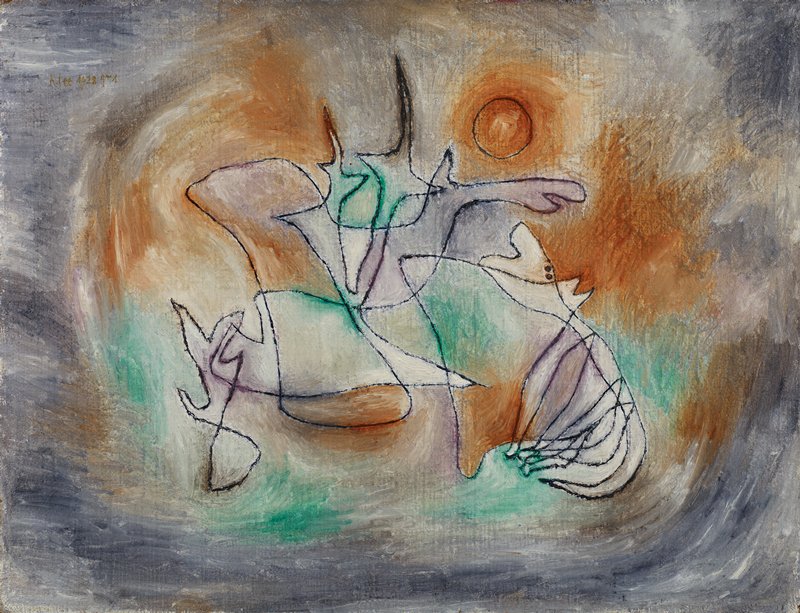
Fitzlibutzli
Can I see it?
Unknown
Where is “Fitzlibutzli” now? Collection: Musée d'Art moderne et contemporain de Strasbourg, Strasbourg. Whether it is on view today is unknown.
Strasbourg, France
The owner is known; whether it is on view today is not.
- In this state since
- Source
- The museum
Details
- Accession number
- LV 54
In the catalog
Sources
- Musée d'Art moderne et contemporain de Strasbourg
- Image: Wikimedia Commons — Public domain | Source/Photographer: [1]
In the life of Paul Klee
The whole lifeMarch 1916
First exhibition of abstract watercolours at Walden’s
Herwarth Walden’s gallery held the first exhibition of Klee’s abstract watercolours, a success with the public. He gave the works new titles, marking his break with war themes, and Walden asked him for more.
5 March 1916
Called up, and the news of Franz Marc’s death
On 5 March 1916 Klee, who had been expecting mobilisation since 1914, was called up; the same day he learned that Franz Marc had been killed at the Battle of Verdun. From March to August he went through military training at Landshut.
February 1917
Second show at Walden’s: the first commercial success
Klee showed the watercolours of the past year; many works were sold, and critics called him the most important German artist since Marc’s death. The success was made possible by a changed market: collectors had appeared who were ready to buy modern art.
1919
A rejected candidacy for the Stuttgart Academy
Oskar Schlemmer and Willi Baumeister put Klee forward, unsuccessfully, for a teaching post at the Stuttgart Academy of Fine Arts. Some of those who opposed the appointment hinted at the artist’s Jewish origin.
1920
Retrospective at Goltz’s: over 300 works
In 1920 Hans Goltz showed Klee’s works at his Munich gallery — a retrospective of more than 300 works.
October 1920
Gropius invites Klee to teach at the Bauhaus
In October 1920, on behalf of the Bauhaus staff, its director Walter Gropius invited Klee to teach; from January 1921 to April 1931 he was a “form master” — first in the bookbinding workshop, then, together with Kandinsky, in the stained-glass and mural-painting workshops, and later he ran a painting class.