 Nicholas RoerichRussian, 1874–1947
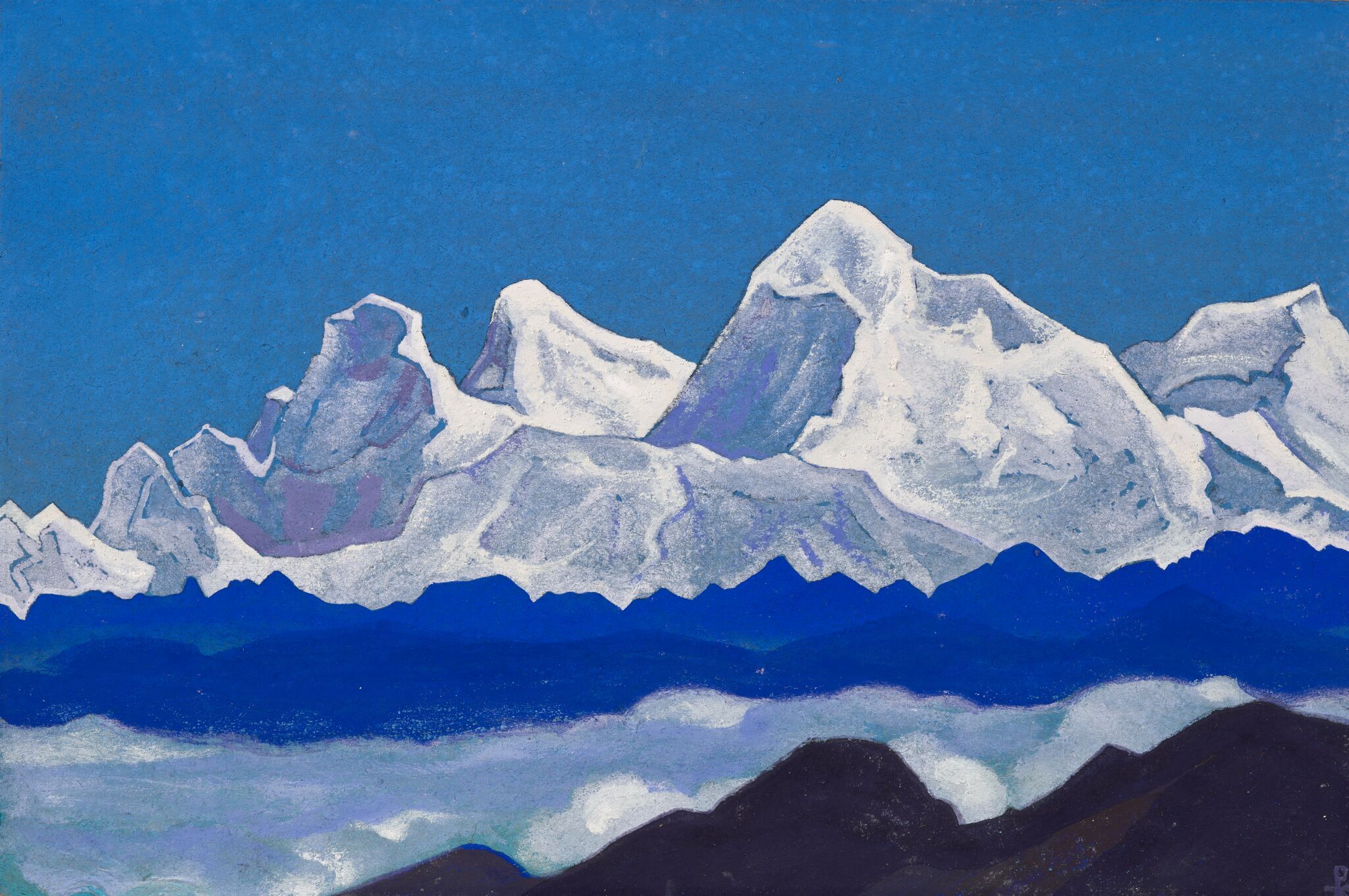
Эверест
May one see it?
Unknown

Moscow, Russia
The owner is known; whether it is on view today is not.
- Source
- The museum
About the painting
In the museum's own words — in Russian
В 1936 году Николай Рерих отправил из Индии несколько новых произведений, включая работу «Эверест», в Русский культурно-исторический музей в Праге, где благодаря усилиям В.Ф. Булгакова был открыт Рериховский зал и издан каталог коллекции.
В Индии художника называли Мастером гор, так как он прославился многочисленными гималайскими пейзажами. В картине Рерих изобразил панораму кристально чистых горных вершин на фоне небесной синевы. В схожей цветовой гамме создана работа «Эверест (Джомолунгма)» (1935) из собрания Русского музея.
Read on
Яркими темперными красками Рерих дает многоплановое изображение в стилистике китайской живописи. Как и в других похожих произведениях, мастер выбирает точку зрения почти на уровне гор, будто находится напротив высочайшей из вершин – Джомолунгмы. Лучше всего она видна из Непала и Китая. Во второй половине 1930-х художник написал несколько одноименных произведений, которые хранятся в разных музеях. Скорее всего, Эверест Рерих мог видеть ранее – в 1920-е годы, во время Центрально-Азиатской экспедиции, и позднее исполнил этот горный пейзаж по наброскам или фотографиям, которые делал во время путешествия.
В 1928 году в статье «Свет пустыни» художник написал следующие строки про Эверест: «Эта вершина суждена для Матери Мира. Она должна быть чиста, нетронута и девственна. Только Она Сама, Великая Матерь, может быть там. Великое молчание бережет мир».
Tretyakov Gallery
Particulars
- Accession number
- Ж-510
In the catalog
Sources
- Tretyakov Gallery
- Image: Tretyakov Gallery — © State Tretyakov Gallery
Meanwhile, in the life of Nicholas Roerich
The whole life28 April – 30 May 1934
The Manchurian expedition: from Seattle to Harbin
On 28 April 1934 Roerich and his elder son set out from Seattle for Yokohama: Henry Wallace, the US Secretary of Agriculture, who had befriended him in 1930, sends him to Manchuria and northern China to collect seeds of plants that protect the fertile layer of soil. In Japan he is received at the highest government level, and on 30 May the scientific part of the expedition begins in Harbin.
1934–1935
Results of the expedition: grasses, diaries, Stipa roerichii
The routes are the Greater Khingan range and the Bargan plateau (1934) and the Gobi, Ordos and Alashan deserts (1935). In 17 months Roerich writes 222 essays for his “Diary Leaves”; about 300 species of drought-resistant grasses are found, 2,000 parcels of seeds are sent to America, and one grass unknown to science is named in his honour — Stipa roerichii; Secretary Wallace will later report that almost all the seeds are of little or no value.
15 April 1935
The Roerich Pact is signed at the White House
The United States and the 20 other nations of the Pan-American Union sign the Roerich Pact, an early international instrument protecting cultural property and the outcome of his idea of Pax Cultura, the “Red Cross” of art and culture.
June 1935
A Chicago Tribune scandal and the break with Wallace
In June 1935 the Chicago Tribune reports military preparations by the expedition near the Mongolian border, and Secretary Wallace breaks with the Roeriches, fearing for his reputation in the eyes of the voters. The expedition is ended early in Shanghai on 21 September 1935.
August 1935
The break with Louis Horch
From 1929 the commercial ventures of Roerich and Horch go badly, and the scandal around the Manchurian expedition undermines Horch's once boundless trust; in August 1935 a crisis breaks out and Horch finally slips out of Roerich's sway.
1938
The Roerich Museum closes; lawsuits and debts
After a series of scandals, seizures of property and lawsuits, the Roerich Museum and the Institute are closed by 1938 and the building passes under Horch's control. Horch prompts a tax inspection, which finds that Roerich has failed to pay $48,000 in income tax, and wins a $200,000 lawsuit against him; Roerich will never again be able to return to the United States.