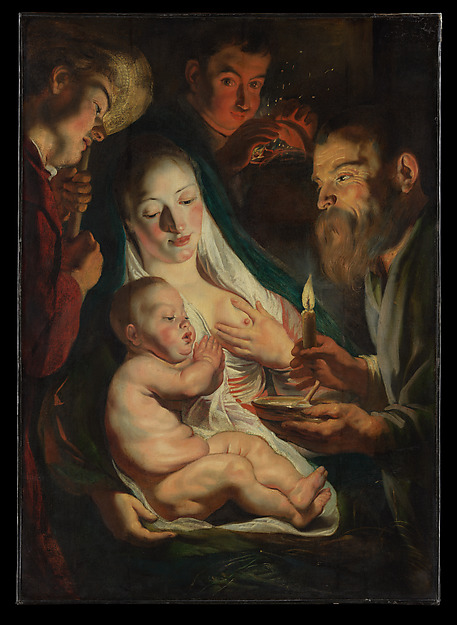
Jacques JordaensFlemish, 1593–1678
Ein stehendes Kind
Can I see it?
Unknown
Where is “Ein stehendes Kind” now? Collection: Kupferstich-Kabinett Dresden, Dresden. Unknown.

Dresden, Germany
The owner is known; whether it is on view today is not.
- In this state since
- Source
- The museum
Details
In the catalog
Sources
- Kupferstich-Kabinett Dresden
- Image: Kupferstich-Kabinett Dresden — In Copyright
In the life of Jacques Jordaens
The whole life1639–1640
Charles I's commission: “The Story of Cupid and Psyche”
Through the English king's agent in Brussels, Balthazar Gerbier, and the diplomat Cesare Alessandro Scaglia, Jordaens received a commission for 22 paintings for the Queen's House at Greenwich without knowing the patron or the destination; when Rubens, Gerbier's preferred choice, died on 30 May 1640, the whole commission passed to Jordaens. But Scaglia died in May 1641, only eight paintings reached the English court, and a dispute with his heirs over payment for seven of them dragged on into the next generation.
1640–1641
After Rubens's death, Antwerp's leading painter
With the deaths of Rubens in 1640 and van Dyck in 1641, Jordaens became the leading painter of Antwerp, and commissions came increasingly from abroad; Rubens's heirs asked him to finish “Perseus and Andromeda” for Philip IV. He never became a court painter: he worked mainly for wealthy townspeople and the clergy.
1645
Converts to Calvinism
Raised a Catholic, Jordaens converted to Calvinism (other accounts say only that this was towards the end of his life), yet the Catholic Church went on commissioning altarpieces from him. He belonged to the Protestant community De Brabantse Olijfberg and towards the end of his life opened his house for private services.
21 April 1648
Queen Christina's commission: 35 ceilings for Uppsala
Queen Christina of Sweden commissioned 35 large ceiling paintings from Jordaens for Uppsala Castle. Whether he completed the commission, or whether the works ever reached Sweden, is unknown.
1651
Amalia van Solms's commission for the Orange Hall
The widow of Stadtholder Frederick Henry of Orange invited artists to decorate the Huis ten Bosch in The Hague; for its Orange Hall Jordaens painted the large allegory “The Triumph of Frederick Henry”, celebrating the prince's military successes. Other accounts date the commission for the hall to 1645.
1661
Lunettes for Amsterdam's new Town Hall
Already an old man, Jordaens, along with other painters, was commissioned to paint large lunettes for the newly built Amsterdam Town Hall: two biblical subjects (“David and Goliath”, “Samson Defeats the Philistines”) and two scenes from Dutch history (“A Roman Camp under Attack by Night”, “Peace between the Romans and the Batavians”).