Paul KleeGerman, 1879–1940
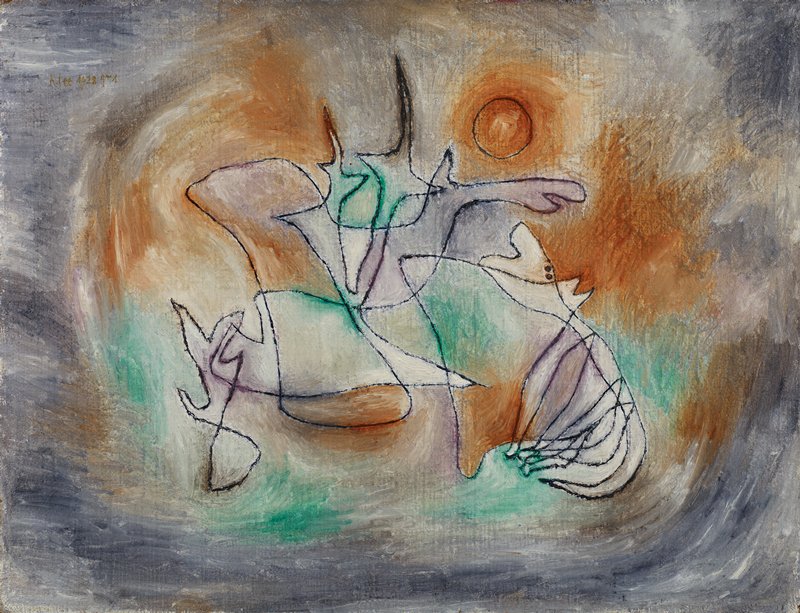
Eidechse
Can I see it?
Unknown
Where is “Eidechse” now? Collection: Albertina, Vienna. Whether it is on view today is unknown.

Vienna, Austria
The owner is known; whether it is on view today is not.
- In this state since
- Source
- The museum
Details
In the catalog
Sources
- Albertina
- Image: Albertina — Public Domain Mark 1.0
In the life of Paul Klee
The whole life1921–1931
The preliminary course on the “theory of form”
Klee developed a preliminary course in the “theory of form” that began with the “point as the beginning of all beginnings”, moving through space, and the “cosmic egg” from which line, spiral, square, circle and cube are born. Students listened to lectures illustrated with Klee’s own abstract watercolours and then painted their own, trying to express movement, balance, flight and tension.
26 January 1924
The lecture “On Modern Art” in Jena
At his exhibition at the Kunstverein in Jena Klee delivered the lecture “On Modern Art” (Über moderne Kunst).
1924–1925
Success with the Paris Surrealists
In 1924 Klee exhibited in Paris for the first time and became a hit with the French Surrealists, who were drawn to his partly morbid motifs. At the Paris Surrealist exhibition of 1925 Max Ernst was impressed by his work.
1925
Moving to Dessau with the Bauhaus
In 1925 the Bauhaus moved to Dessau, and Klee moved with the school.
1925
“Pedagogical Sketchbook” is published
Klee’s theoretical book “Pedagogical Sketchbook” (Pädagogisches Skizzenbuch) is published; five years earlier, in 1920, his essay “Schöpferische Konfession” had appeared.
1928–1929
A journey to Egypt
Egypt impressed Klee less than Tunisia, yet in the desert he felt an almost mystical bond with the land: he was drawn to the proportions of the ancient funerary monuments and to the esoteric numerology by which they were built. His later “Ad Parnassum” was influenced by the trip.