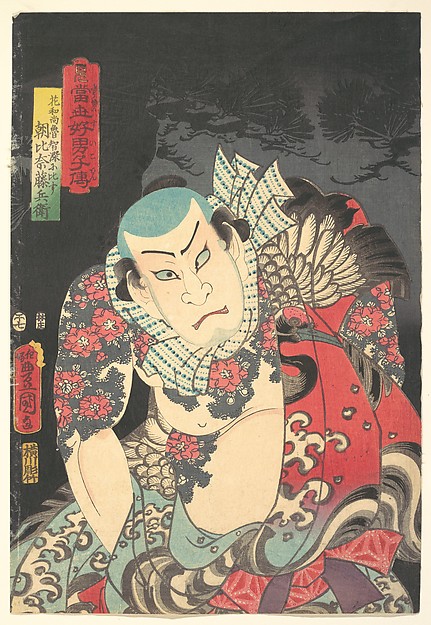
Utagawa KunisadaJapanese, 1786–1865
Dve ženy s opilcom (I)
Can I see it?
Unknown
Where is “Dve ženy s opilcom (I)” now? Collection: Slovak National Gallery, Bratislava. Unknown.

Bratislava, Slovakia
The owner is known; whether it is on view today is not.
- In this state since
- Source
- The museum
About the work
Museum text in Slovak
Podľa: ŠUGÁR, Martin: Japonské farebné drevorezy v zbierke Slovenskej národnej galéria. In: Ročenka SNG Galéria 2003, Bratislava 2004, s. 137 ‒ 142. Dielo bolo vystavené na výstave Ukiyo-e Japonské farebné drevorezy, ktorá sa konala v SNG v termíne 7. 9. ‒ 5. 11. 2006.
Slovak National Gallery
Details
In the catalog
Sources
- Slovak National Gallery
- Image: Slovak National Gallery — Public Domain Mark 1.0
In the life of Utagawa Kunisada
The whole life1800
Accepted as a Pupil of Toyokuni
The drawings of the young Sumida Shōgorō impressed Utagawa Toyokuni, head of the Utagawa school, who took him on as a pupil. From his teacher he received the name KUNIsada, whose first character is taken from the name ToyoKUNI.
1808
Beginning of Work as a Book Illustrator
From 1808 he worked as a book illustrator, and the popularity of his drawings grew year by year. In 1808 or 1809 his first series of portraits of theatre actors appeared.
1809
The "Star" of the Utagawa School
Contemporaries called him the "star" of the Utagawa school; his first bijin-ga series and a series of views of Edo appeared at the same time, and in 1810–1811 he was judged the equal in skill of his teacher Toyokuni.
1813
Second Master of Ukiyo-e After Toyokuni
A contemporary ranking of the most important ukiyo-e masters placed Kunisada second only to his teacher Toyokuni — official recognition in the art world of Edo.
1844
Adopted the Name Toyokuni III
He adopted the name of his teacher Toyokuni; from 1844–1845 all his prints are signed "Toyokuni." He called himself Toyokuni II, but is counted as Toyokuni III.
mid-1840s – early 1850s
Collaboration with Hiroshige and Kuniyoshi
From the mid-1840s to the early 1850s he collaborated with Hiroshige and Kuniyoshi on three large series and a number of smaller projects; the cooperation was in large part a show of solidarity against the tightened censorship of the Tenpō reforms.