Kitagawa UtamaroJapanese, 1754–1806
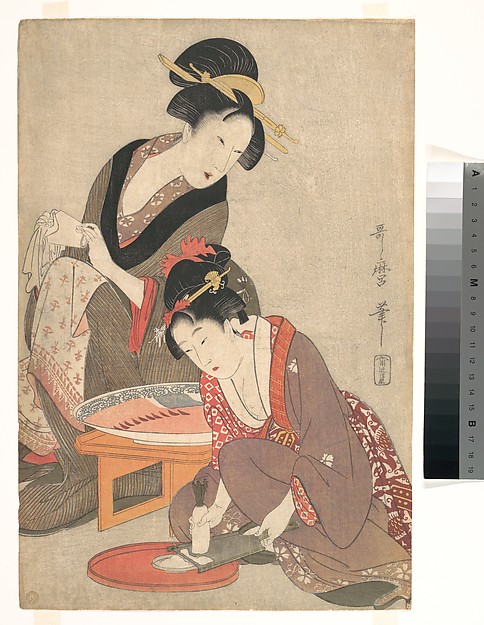
Doeken spannen
Can I see it?
Unknown
Where is “Doeken spannen” now? Collection: Rijksmuseum, Amsterdam. Unknown.

Amsterdam, Netherlands
The owner is known; whether it is on view today is not.
- Source
- The museum
About the work
Museum text in Dutch
Twee vrouwen, één met witte hoofddoek, de ander met loshangend haar, banen doek spannend om te drogen.
Rijksmuseum
Details
- Accession number
- RP-P-1964-807
What it shows
In the catalog
Sources
- Rijksmuseum
- Image: Rijksmuseum — public domain
In the life of Kitagawa Utamaro
The whole life1790–1801
Tightening censorship: seals on prints
From 1790 prints can be sold only with a censor's seal of approval; over the following decades censorship grows stricter, and violators can receive harsh punishments. From 1799 even preliminary drafts need approval, and in 1801 the works of a group of Utagawa-school offenders, including Toyokuni, are repressed.
1793
Recognition and the end of the arrangement with Tsutaya
In 1793 Utamaro achieves recognition as an artist, and his semi-exclusive arrangement with the publisher Tsutaya Jūzaburō ends. He then goes on to produce several well-known series featuring women of the Yoshiwara district, and becomes one of the few ukiyo-e artists to win fame throughout Japan in his lifetime.
1797
The death of his friend and patron Tsutaya Jūzaburō
In 1797 Utamaro's long-time friend and supporter, the publisher Tsutaya Jūzaburō, dies; the artist is apparently very upset by the loss, and some commentators feel that his work never reached its former heights afterwards. He later lives in Kyūemon-chō, then Bakuro-chō, and finally near the Benkei Bridge.