 Charles François DaubignyFrench, 1817–1878
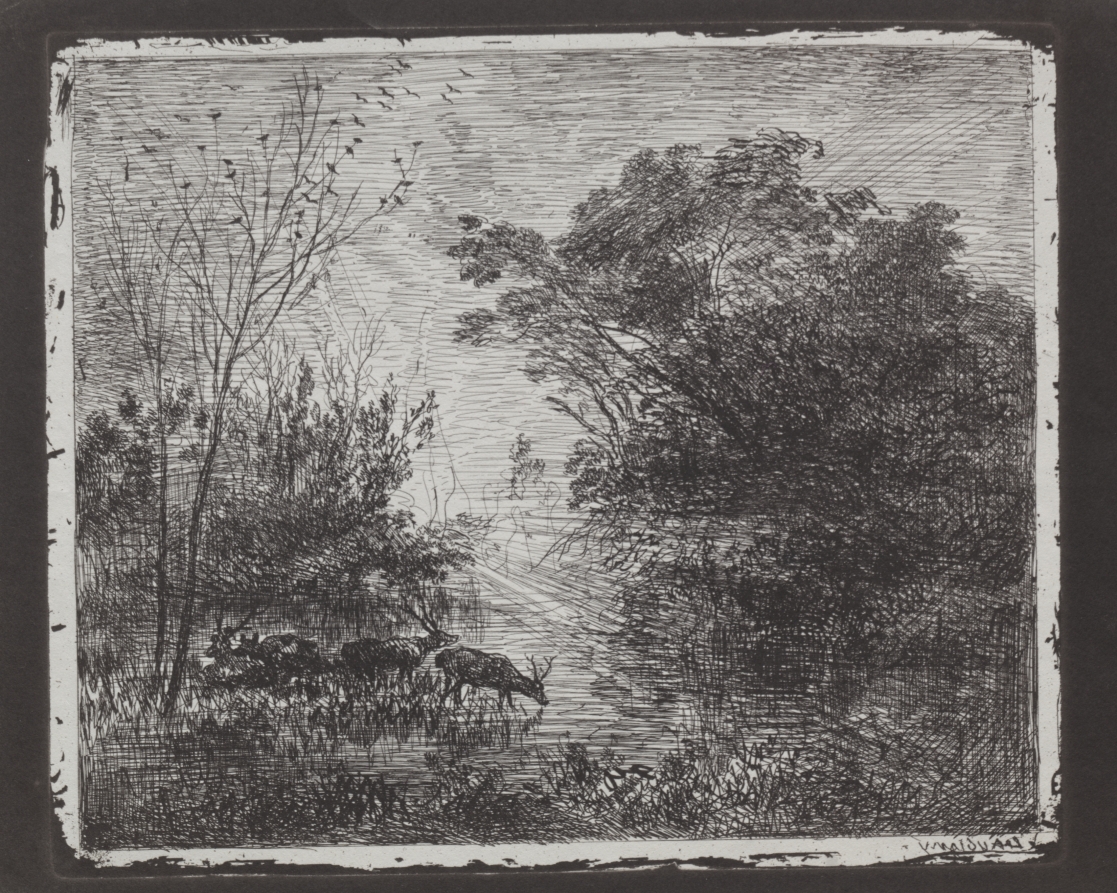
Deer
May one see it?
Not receiving at present

Cleveland, United States
It belongs to the collection, but is not on display at present.
- Checked
- In this state since
- Source
- The museum
About the work
Around 1853 a few artists and photography buffs who were searching for a photographic method of producing multiple prints developed the cliché-verre. A glass plate is coated with an opaque ground through which the design is drawn with a sharp instrument. The plate is then placed on top of a sheet of light-sensitive paper and exposed to light so that the image is reproduced on the paper.
The Cleveland Museum of Art
Particulars
- Accession number
- 1992.340
In the catalog
Sources
- The Cleveland Museum of Art
- Image: The Cleveland Museum of Art — Museum open access
Meanwhile, in the life of Charles François Daubigny
The whole life1860s
His technique influences the future Impressionists
Daubigny's impasto in the lights, translucent glazes in the shadows and small separate strokes, which earned him both praise and harsh criticism, influenced the future Impressionists in the 1860s. Like them, he cared little for crisp contours and favoured a broad manner.
1861
Gautier faults him for sketchiness
Reviewing the Paris Salon in 1861, Théophile Gautier ironically lamented that Daubigny was content with a first impression and neglected detail, so that his pictures were no more than sketches. The critic urged him to abandon this manner as soon as possible.
1862
The etching album “Voyage en Bateau”
Daubigny published Voyage en Bateau, a series of 19 etchings (including the title page) depicting his life on and along the water in his floating studio, with his son Karl as “cabin boy”.
1862
Experiments with cliché-verre alongside Corot
Together with Camille Corot, Daubigny experimented with the cliché-verre technique, a process halfway between photography and printmaking; he became one of its main practitioners.
1864
Among the first exhibitors of the Société nationale des beaux-arts
In 1864 Daubigny was one of the first exhibitors at the salon of the Société nationale des beaux-arts.
1864–1874
A decade of his finest pictures: forests and lakes
Daubigny's best-known paintings date from 1864 to 1874 and depict mostly forests and lakes. He was disappointed that the works he considered his finest were not understood by his contemporaries, yet by the end of his life he remained a sought-after and esteemed artist.