Albrecht DürerGerman, 1471–1528
De kleine kruisiging
Can I see it?
Unknown
Where is “De kleine kruisiging” now? Collection: Rijksmuseum, Amsterdam. Unknown.

Amsterdam, Netherlands
The owner is known; whether it is on view today is not.
- Source
- The museum
About the work
Museum text in Dutch
Ronde voorstelling van Christus aan het kruis. Aan zijn rechterzijde staat Johannes de evangelist, aan zijn linkerzijde zijn moeder Maria met nog twee vrouwen. Aan de voet van het kruis zit Maria Magdalena.
Rijksmuseum
Details
- Accession number
- RP-P-OB-1180
What it shows
In the catalog
Sources
- Rijksmuseum
- Image: Rijksmuseum — public domain
In the life of Albrecht Dürer
The whole life1507–1528 · Workplace
Nuremberg
1515
A life pension from the emperor
The perpetually cash-strapped Maximilian could not pay on time and offered to exempt the artist from city taxes, which the Nuremberg Council opposed. At Dürer's request the emperor granted him a life pension of 100 guilders a year from the sums Nuremberg paid into the imperial treasury.
1519
Death of Emperor Maximilian
Maximilian, Dürer's chief patron, died just as the artist feared he was losing “my sight and freedom of hand” (perhaps from arthritis) and was increasingly drawn to Luther's writings. Shortly before the emperor's death Dürer had made his portrait.
July 1520
Journey to the Netherlands with his wife
To renew his imperial pension and win the patronage of the new emperor, Charles V, Dürer travelled with his wife and her maid down the Rhine via Cologne to Antwerp, where he was warmly received. He attended the coronation at Aachen and saw van Eyck's Ghent Altarpiece and Michelangelo's Madonna of Bruges.
4 October 1520
Charles V confirms his pension
The new emperor, Charles V, confirmed Dürer's right to his pension of 100 guilders a year; the main aim of the journey had been achieved.
1520–1521
An illness caught in the Netherlands
In the Netherlands Dürer caught an unknown illness, possibly malaria, whose attacks plagued him for the rest of his life. He drew himself pointing to his spleen, with the note: “Where the yellow spot is, and where I point with my finger, that is where it hurts.”
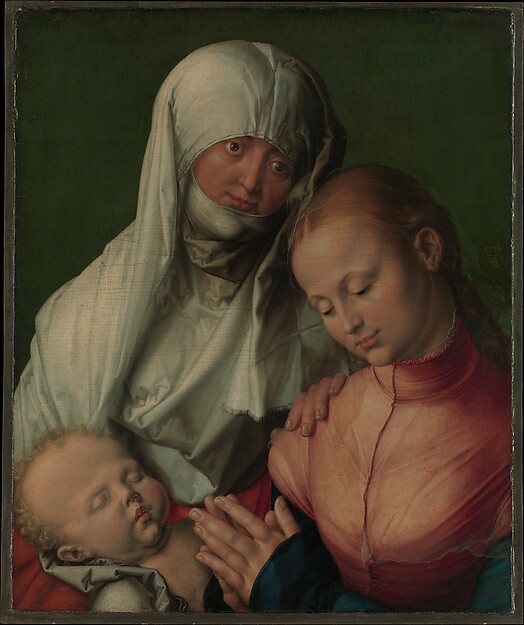
![Madonna and Child [obverse], Albrecht Dürer, c. 1496/1499](https://api.nga.gov/iiif/878db7e6-10ae-4cae-ba5d-6d6f5c413ae8/full/!2400,2400/0/default.jpg)
![Lot and His Daughters [reverse], Albrecht Dürer, c. 1496/1499](https://api.nga.gov/iiif/7565a449-f82a-414b-9bda-c93f55a51b4d/full/!2400,2400/0/default.jpg)