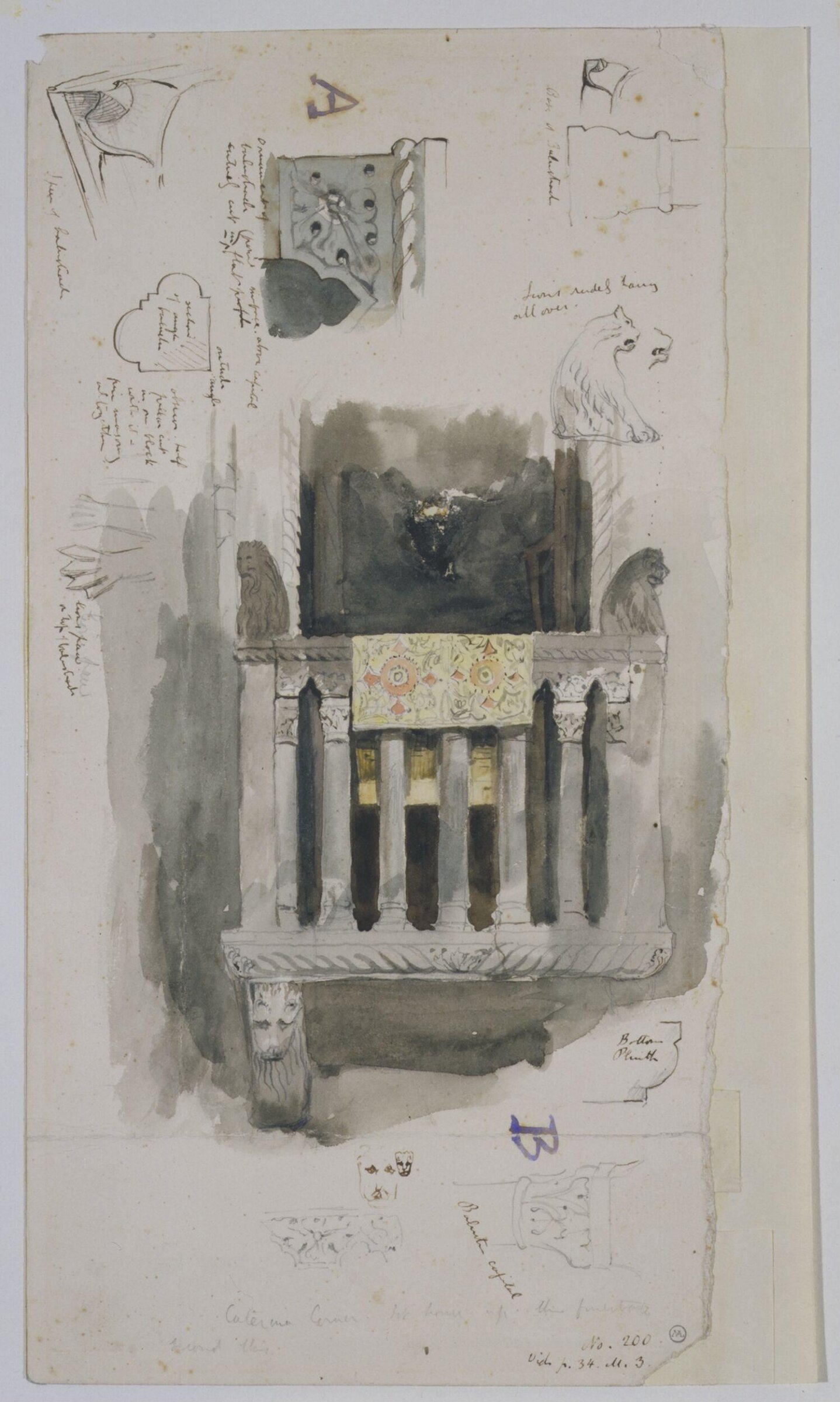
John RuskinEnglish, 1819–1900
Dawn at Neuchâtel
May one see it?
Not receiving at present

Cambridge, United States
It belongs to the collection, but is not on display at present.
- Checked
- In this state since
- Source
- The museum
Particulars
- Accession number
- 1919.49
In the catalog
Sources
- Harvard Art Museums
- Image: Harvard Art Museums — © President and Fellows of Harvard College
Meanwhile, in the life of John Ruskin
The whole life1834–1900 · Workplace
Great Britain
from 1864
Charitable ventures funded by his father's legacy
One of Ruskin's first actions is to support the housing work of Octavia Hill, originally one of his art pupils: he buys property in Marylebone. He also sets up a shop at 29 Paddington Street selling pure tea, giving employment to two former Ruskin family servants, and pays for crossing-sweepers to keep the area around the British Museum clean and tidy.
3 March 1864
His father's death and a considerable inheritance
On 3 March 1864 his father, John James Ruskin, dies; the son inherits an estate worth between £120,000 and £157,000 (the exact figure is disputed), which gives him the means for personal philanthropy and practical schemes of social amelioration. On the tombstone he describes his father as an entirely honest merchant.
April 1864
Bradford: a lecture on taste and morality
Invited because of a local debate about the style of a new Exchange building, Ruskin delivers his widely admired lecture “Traffic”, on the relation between taste and morality, at Bradford Town Hall, telling his audience he does not care about this Exchange because they do not. Together with the lectures “Work” and “War” it will be published in “The Crown of Wild Olive” (1866).
December 1864
The “Sesame and Lilies” lectures in the town halls
In December 1864 at the town halls of Rusholme and Manchester Ruskin delivers the lectures “Of Kings' Treasuries” (for a library fund, on reading and the value of books) and “Of Queens' Gardens” (for a school fund, on women's rights and duties in education). Published in 1865 as “Sesame and Lilies”, they become one of his most popular books and are regularly awarded as Sunday School prizes.
1866–1872
A proposal to Rose La Touche and a final refusal
Eight years after they meet, in 1866, Ruskin proposes to Rose La Touche, but in 1872 he receives a final refusal from her parents.