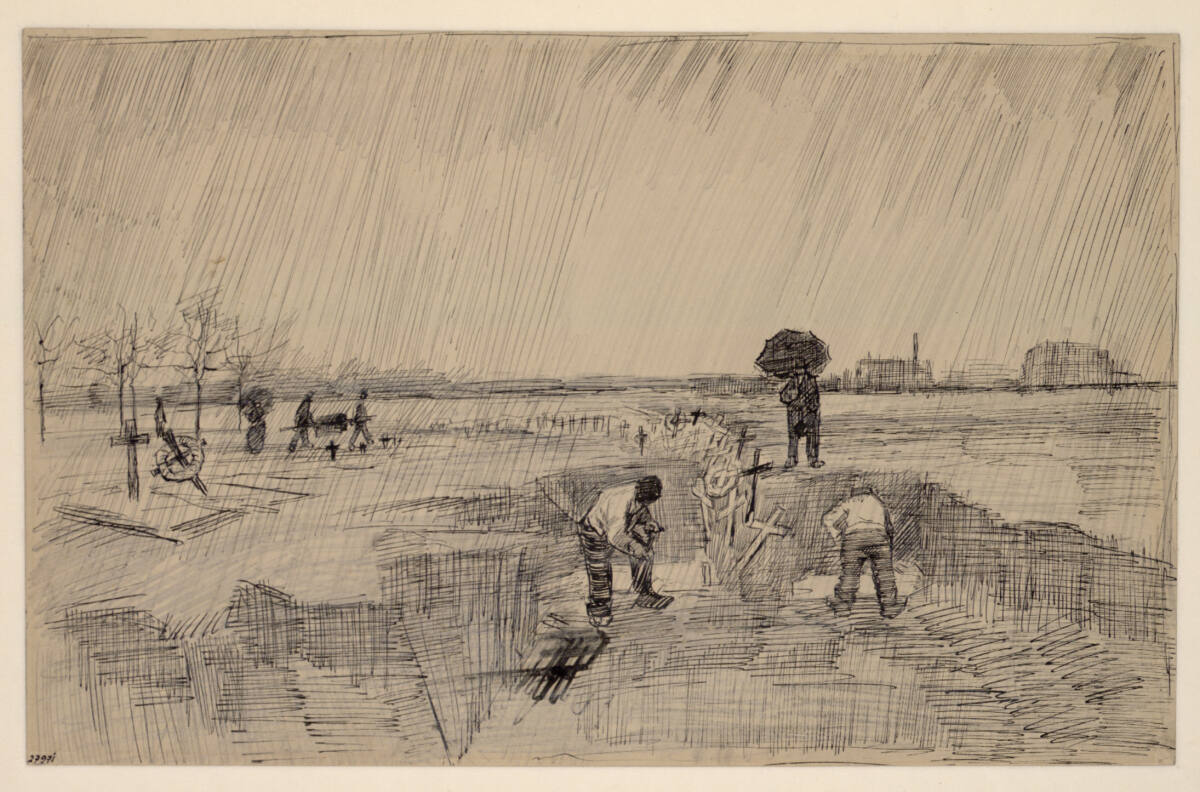
Wilhelm BuschGerman, 1832–1908
Das warme Bad (3)
May one see it?
Unknown

Vienna, Austria
The owner is known; whether it is on view today is not.
- In this state since
- Source
- The museum
Particulars
In the catalog
Sources
- Albertina
- Image: Albertina — Public Domain Mark 1.0
Meanwhile, in the life of Wilhelm Busch
The whole life1858–1865
Work for the “Fliegende Blätter” and Kaspar Braun
Busch drew close to the artists' association Jung München (Young Munich), wrote and drew for its newspaper, and the publisher of satirical papers Kaspar Braun proposed a collaboration that gave him enough to live on. Between 1860 and 1863 he contributed more than a hundred pieces to the “Münchener Bilderbogen” and “Fliegende Blätter”.
1864
A new publisher, Richter, and the failure of “Bilderpossen”
Feeling his dependence on Kaspar Braun had become constricting, Busch appointed the Dresden publisher Heinrich Richter, son of the painter Ludwig Richter, as his new publisher, but the tales published in 1864 as “Bilderpossen” were a failure.
1865
“Max and Moritz”: Richter declines, Braun buys
Busch offered Richter the manuscript of “Max and Moritz” without a fee, but Richter rejected it as sales prospects seemed poor; his former publisher Braun bought the rights for 1,000 gulden, roughly twice a craftsman's annual wage. The book tells of seven pranks by two mischievous boys who are finally ground up and fed to ducks.
June 1867
From Munich to Frankfurt: meeting his brother Otto
Busch decided to leave Munich, where few relatives lived and the artists' association had been temporarily disbanded; in June 1867 he met his brother Otto in Frankfurt, who was working as a tutor to the family of the banker and industrialist Kessler.
1867–1872
Johanna Kessler — patron and friend
Johanna Kessler, the banker's wife, a mother of seven and an influential patron of art and music whose villa was open to artists, musicians and philosophers, believed Busch to be a great painter — although his humorous drawings did not appeal to her — and gave him an apartment and studio in her villa, later an apartment nearby. Her support and the introduction to Frankfurt's cultural life made the “Frankfurt years” his most artistically productive.
1867–1872
Discovering Schopenhauer together with Otto
During the Frankfurt years Wilhelm and his brother Otto discovered the philosophical works of Arthur Schopenhauer, whose pessimism echoes in “Helen Who Couldn't Help It” and in Busch's later realistic view of human nature.