ART WIKI33,040 on view
MapCollectionArtistsMuseumsExhibitionsJournal
Sign in

ART WIKI

Where the masterpiece hangs, and when they let you in.

Collections: Art Institute of Chicago, Getty Villa, Harvard Art Museums, Hirshhorn Museum and Sculpture Garden, J. Paul Getty Museum, Minneapolis Institute of Art, Musée du Louvre, National Gallery of Art, National Museum of Asian Art, National Portrait Gallery (Smithsonian), Pushkin State Museum of Fine Arts, Rijksmuseum, Smithsonian American Art Museum, SMK — National Gallery of Denmark, State Hermitage Museum, State Russian Museum, The Cleveland Museum of Art, The Metropolitan Museum of Art, The Museum of Modern Art, Tretyakov Gallery, Victoria and Albert Museum, Whitney Museum of American Art, State Catalogue of the Museum Fund of Russia (274 museums), Europeana (19 museums), Wikidata (6 museums), Paris Musées (12 museums), and Joconde, the French Ministry of Culture's museum database (495 museums). Images belong to their rights holders.

Sections

  • Map
  • Search
  • Collection
  • Masterpieces
  • On view now
  • Artists

More

  • Museums & galleries
  • Exhibitions
  • Journal
  • Where the data comes from
  • Privacy & cookies
HomeMapBrowse
  1. Collection/
  2. Albertina/
  3. Das warme Bad (13)
Das warme Bad (13), Wilhelm Busch, 1865
Wilhelm Busch, portraitWilhelm BuschGerman, 1832–1908

Das warme Bad (13)

1865 · Drawing

May one see it?

Unknown

Albertina

Vienna, Austria

The owner is known; whether it is on view today is not.

In this state since
Sep 27, 2026
Source
The museum
On the mapMuseum page

Particulars

1865 · aged 33
18321908

In the catalog

Drawings & watercolorsRealismImpressionism19th century

Sources

  • Albertina
  • Image: Albertina — Public Domain Mark 1.0

Meanwhile, in the life of Wilhelm Busch

The whole life
  1. 1858–1865

    Work for the “Fliegende Blätter” and Kaspar Braun

    Busch drew close to the artists' association Jung München (Young Munich), wrote and drew for its newspaper, and the publisher of satirical papers Kaspar Braun proposed a collaboration that gave him enough to live on. Between 1860 and 1863 he contributed more than a hundred pieces to the “Münchener Bilderbogen” and “Fliegende Blätter”.

  2. 1864

    A new publisher, Richter, and the failure of “Bilderpossen”

    Feeling his dependence on Kaspar Braun had become constricting, Busch appointed the Dresden publisher Heinrich Richter, son of the painter Ludwig Richter, as his new publisher, but the tales published in 1864 as “Bilderpossen” were a failure.

  3. 1865

    “Max and Moritz”: Richter declines, Braun buys

    Busch offered Richter the manuscript of “Max and Moritz” without a fee, but Richter rejected it as sales prospects seemed poor; his former publisher Braun bought the rights for 1,000 gulden, roughly twice a craftsman's annual wage. The book tells of seven pranks by two mischievous boys who are finally ground up and fed to ducks.

  4. June 1867

    From Munich to Frankfurt: meeting his brother Otto

    Busch decided to leave Munich, where few relatives lived and the artists' association had been temporarily disbanded; in June 1867 he met his brother Otto in Frankfurt, who was working as a tutor to the family of the banker and industrialist Kessler.

  5. 1867–1872

    Johanna Kessler — patron and friend

    Johanna Kessler, the banker's wife, a mother of seven and an influential patron of art and music whose villa was open to artists, musicians and philosophers, believed Busch to be a great painter — although his humorous drawings did not appeal to her — and gave him an apartment and studio in her villa, later an apartment nearby. Her support and the introduction to Frankfurt's cultural life made the “Frankfurt years” his most artistically productive.

  6. 1867–1872

    Discovering Schopenhauer together with Otto

    During the Frankfurt years Wilhelm and his brother Otto discovered the philosophical works of Arthur Schopenhauer, whose pessimism echoes in “Helen Who Couldn't Help It” and in Busch's later realistic view of human nature.

More by Wilhelm Busch

All works
De boer en zijn varken, Wilhelm Busch, 1843 - c. 1920

De boer en zijn varken

1843 - c. 1920 · Rijksmuseum

De boer en zijn varken, Wilhelm Busch, 1843 - c. 1920

De boer en zijn varken

1843 - c. 1920 · Rijksmuseum

De boer en de molenaar, Wilhelm Busch, 1843 - c. 1920

De boer en de molenaar

1843 - c. 1920 · Rijksmuseum

De vechtende hanen, Wilhelm Busch, 1843 - c. 1920

De vechtende hanen

1843 - c. 1920 · Rijksmuseum

De boer en zijn varken, Wilhelm Busch, 1843 - c. 1920

De boer en zijn varken

1843 - c. 1920 · Rijksmuseum

De boer en het kalf, Wilhelm Busch, 1843 - c. 1920

De boer en het kalf

1843 - c. 1920 · Rijksmuseum

De boer en zijn varken, Wilhelm Busch, 1843 - c. 1920

De boer en zijn varken

1843 - c. 1920 · Rijksmuseum

De wraak van den olifant, Wilhelm Busch, 1843 - c. 1920

De wraak van den olifant

1843 - c. 1920 · Rijksmuseum

From the collection of Albertina

Museum page
Zwei groteske Köpfe im Profil, Leonardo da Vinci

Leonardo da Vinci

Zwei groteske Köpfe im Profil

Landschaft mit Haus und Bäumen, Vincent van Gogh

Vincent van Gogh

Landschaft mit Haus und Bäumen

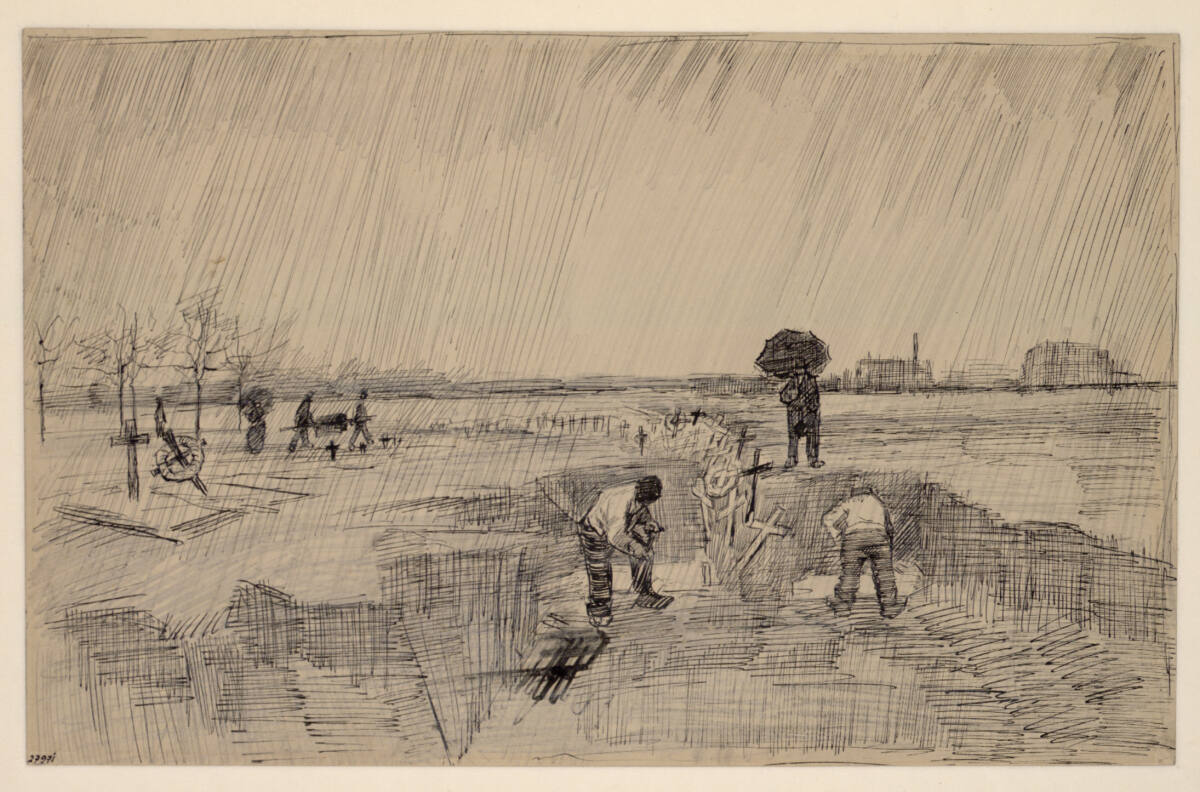
Friedhof im Regen, Vincent van Gogh

Vincent van Gogh

Friedhof im Regen

Studien eines erhobenen Armes mit Schultergelenk, Michelangelo

Michelangelo

Studien eines erhobenen Armes mit Schultergelenk

Studien eines weiblichen sitzenden Rückenakts, Michelangelo

Michelangelo

Studien eines weiblichen sitzenden Rückenakts

Männlicher Oberkörper mit gefalteten Händen sowie Handstudien, Michelangelo

Michelangelo

Männlicher Oberkörper mit gefalteten Händen sowie Handstudien

Männlicher Rückenakt (Studie zu dem eine Lanze tragenden Soldaten des geplanten Wandgemäldes "Schlacht von Cascina"), Michelangelo

Michelangelo

Männlicher Rückenakt (Studie zu dem eine Lanze tragenden Soldaten des geplanten Wandgemäldes "Schlacht von Cascina")

Beweinung Christi, Michelangelo

Michelangelo

Beweinung Christi