John RuskinEnglish, 1819–1900
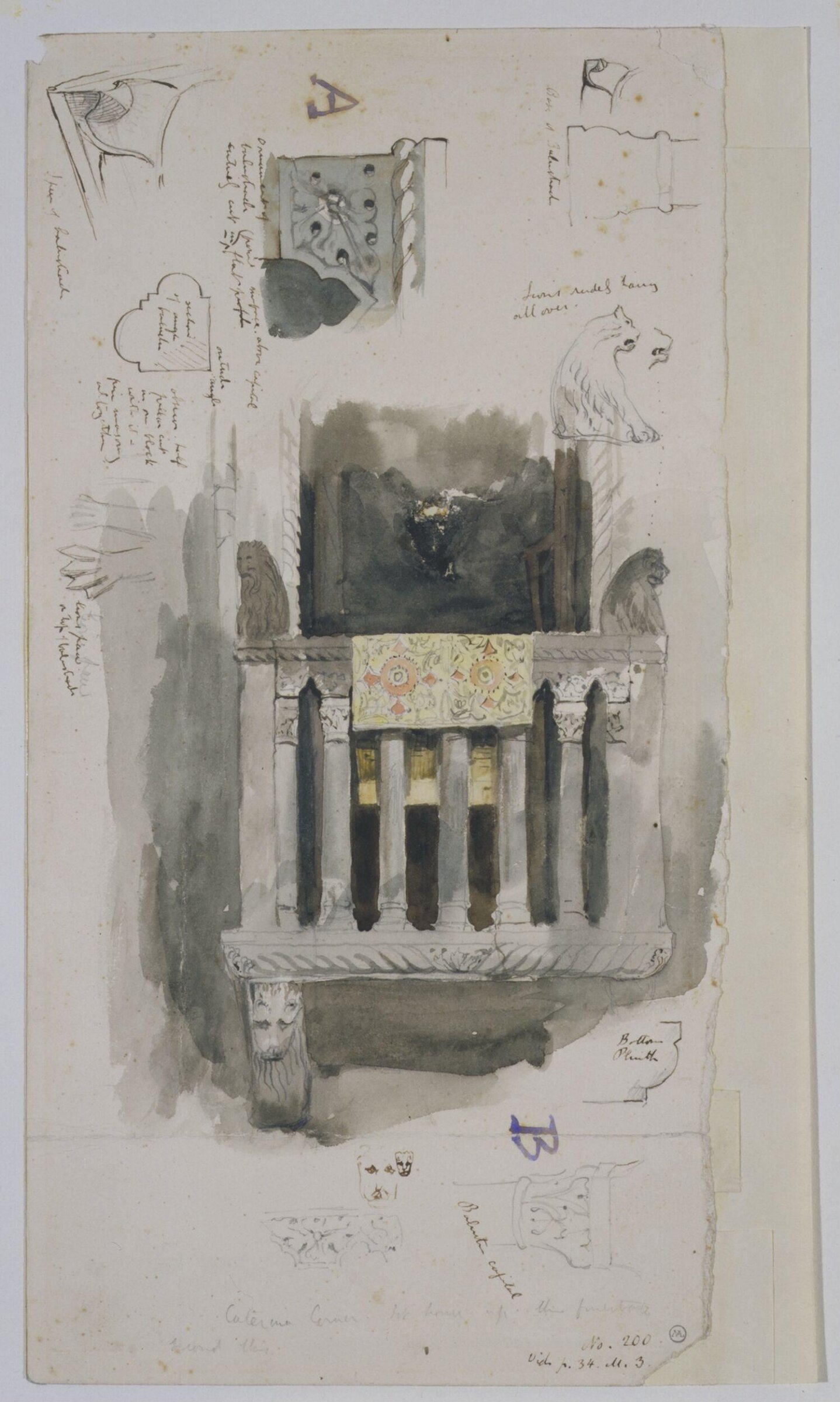
Coral Oysters
Can I see it?
Not on view at present
Where is “Coral Oysters” now? Collection: Harvard Art Museums, Cambridge. Not on view at present. Checked September 29, 2026.

Cambridge, United States
It belongs to the collection, but is not on display at present.
- Checked
- In this state since
- Source
- The museum
Details
- Accession number
- 1945.36
In the catalog
Sources
- Harvard Art Museums
- Image: Harvard Art Museums — © President and Fellows of Harvard College
In the life of John Ruskin
The whole life1834–1900 · Workplace
Great Britain
1859–1868
The girls' school at Winnington Hall
Ruskin is a frequent visitor and letter-writer to the progressive girls' school at Winnington Hall and a donor of pictures and geological specimens, approving of the mixture of sports, handicrafts, music and dancing encouraged by its principal, Miss Bell. The association leads to “The Ethics of the Dust” (1866), an imagined conversation with Winnington's girls in which he casts himself as the “Old Lecturer”.
1866–1872
A proposal to Rose La Touche and a final refusal
Eight years after they meet, in 1866, Ruskin proposes to Rose La Touche, but in 1872 he receives a final refusal from her parents.
August 1869
First Slade Professor of Fine Art at Oxford
In August 1869 Ruskin is unanimously appointed the first Slade Professor of Fine Art at Oxford University, largely through the offices of his friend Henry Acland. His lectures are so popular that they have to be given twice — once for the students and again for the public.
8 February 1870
Inaugural lecture at the Sheldonian Theatre
On his 51st birthday Ruskin delivers his inaugural lecture at the Sheldonian Theatre to a larger-than-expected audience, saying that the art of any country expresses its social and political virtues and that England must found colonies as fast as she can. It has been claimed that Cecil Rhodes cherished a long-hand copy of the lecture, believing that it supported his own view of the British Empire.
1870s
A hereditary neurological illness worsens
Against the background of a personal crisis tied to his love for Rose La Touche, Ruskin's hereditary neurological disorder (CADASIL syndrome) worsens in the 1870s.