Gerard van HonthorstDutch, 1592–1656
Christ Crowned with Thorns
May one see it?
Yes, receiving visitors
On public display.
- Checked
- In this state since
- Source
- The museum
About the painting
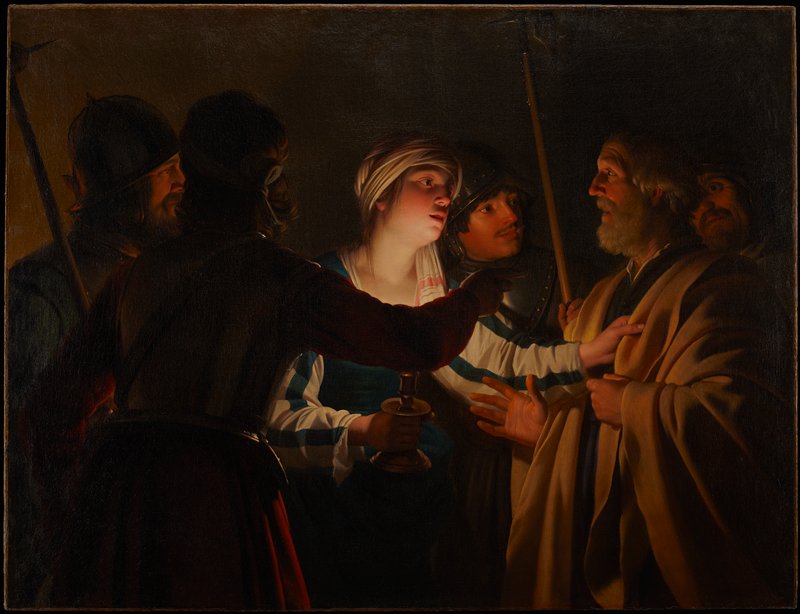
As was customary for promising Dutch painters in the 1600s, Gerrit van Honthorst traveled to Italy to complete his artistic training. In Rome he fell under the spell of Caravaggio's revolutionary style and adopted his use of realistic figures and dramatic lighting, known as chiaroscuro. In Italy he acquired the nickname *Gherardo delle Notti* (Gerrit of the Nights) because he painted so many night scenes lit by candles or torches. This recently discovered painting may have been made as an altarpiece. It shows the Crowning with Thorns, one of the last of the series of events comprising the trial of Christ. His crude features illuminated by a torch, a jeering soldier mocks Christ, who humbly accepts the soldier's derision. In the shadows, another soldier places the crown of thorns on Christ's head, using a cane to protect his own hands. At the left, two dimly lit figures, perhaps Pontius Pilate and an advisor, discuss Christ's fate.
J. Paul Getty Museum
Particulars
- Accession number
- 90.PA.26
In the catalog
Sources
- J. Paul Getty Museum
- Image: J. Paul Getty Museum — Open Content
Meanwhile, in the life of Gerard van Honthorst
The whole lifec. 1610 – 1620
At the palace of Marquis Giustiniani in Rome
In Rome Honthorst lodged at the palace of Marquis Vincenzo Giustiniani, where he painted “Christ Before the High Priest” (now in the National Gallery, London), and under Caravaggio's influence took up night scenes lit by a hidden artificial source. Italian documents of his day call him “Gherardo Fiammingo” or “Gherardo Hollandese”: the nickname “Gherardo delle Notti” came into use only in the 18th century.
c. 1610 – 1620
Commissions from Cardinal Scipione Borghese
Cardinal Scipione Borghese became another important patron, securing him commissions at San Silvestro in Monte Compatri and Santa Maria della Vittoria in Rome. The artist also worked for Cosimo II de' Medici, Grand Duke of Tuscany.
1620
Returns to Utrecht
Back in Utrecht, Honthorst built a considerable reputation at home and abroad: Sir Dudley Carleton, the English envoy at The Hague, recommended his work to the Earl of Arundel, and his work impressed the young Rembrandt and Frans Hals.
1622
The Guild of St. Luke and a drawing academy
Honthorst was admitted to the Guild of St. Luke and the same year opened a drawing academy in Utrecht, in fact a small studio for visiting pupils. According to Joachim von Sandrart, his pupil in the mid-1620s, the master taught about 24 students at a time, each paying 100 guilders a year.