John RuskinEnglish, 1819–1900
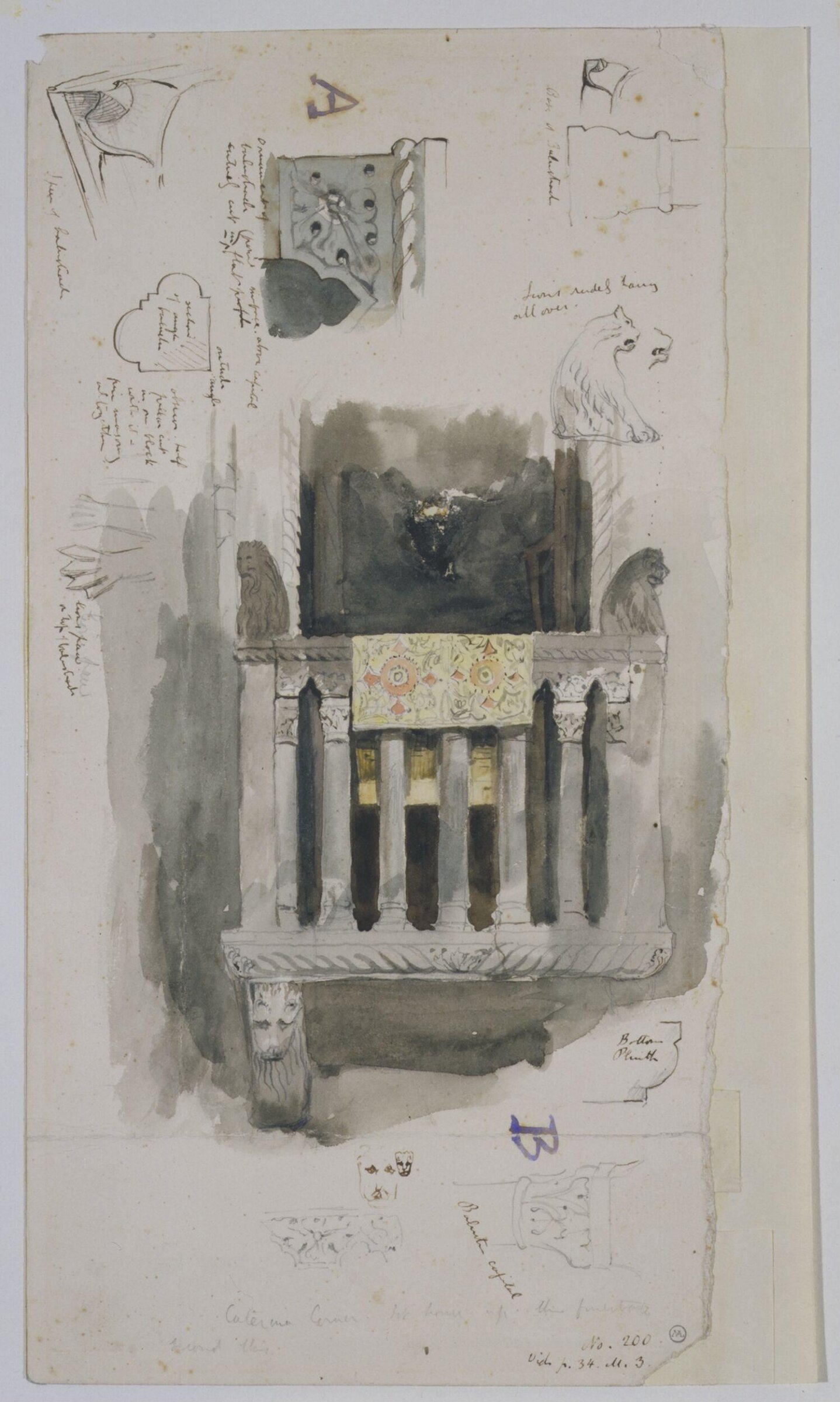
Bridge at Croyland
May one see it?
Not receiving at present

Chicago, United States
It belongs to the collection, but is not on display at present.
- Checked
- In this state since
- Source
- The museum
Particulars
- Accession number
- 1973.515
In the catalog
Sources
- Art Institute of Chicago
- Image: Art Institute of Chicago — CC0
Meanwhile, in the life of John Ruskin
The whole life1858
Turin: Veronese against a dull sermon
In Turin Ruskin sits through a particularly dull sermon at a Waldensian church and sees Paolo Veronese's “Presentation of the Queen of Sheba” at the Galleria Sabauda; later, in April 1877, he will name this as the start of his “unconversion” from Evangelical Christianity. His faith, long shaken by Biblical and geological scholarship, collapses, and, believing that much of his writing had rested on lies and half-truths, Ruskin goes through a deep personal crisis before returning to Christianity after a long struggle.
August – November 1860
“Unto This Last” in the Cornhill Magazine
In four essays published in the Cornhill Magazine Ruskin rejects the division of labour as dehumanising and calls political economy a false “science” that ignores the social affections that bind communities together, but the editor, Thackeray, is forced to abandon the series by the outcry of conservative readers and a nervous publisher. The national press is hostile and his father disapproves, while Carlyle is delighted and declares that they are henceforth “a minority of two”.
3 March 1864
His father's death and a considerable inheritance
On 3 March 1864 his father, John James Ruskin, dies; the son inherits an estate worth between £120,000 and £157,000 (the exact figure is disputed), which gives him the means for personal philanthropy and practical schemes of social amelioration. On the tombstone he describes his father as an entirely honest merchant.
August 1869
First Slade Professor of Fine Art at Oxford
In August 1869 Ruskin is unanimously appointed the first Slade Professor of Fine Art at Oxford University, largely through the offices of his friend Henry Acland. His lectures are so popular that they have to be given twice — once for the students and again for the public.
1871
Founds the Ruskin School of Drawing and Fine Art
In 1871 Ruskin founds his own art school at Oxford, the Ruskin School of Drawing and Fine Art — first housed in the Ashmolean Museum, now on High Street — and endows the drawing mastership with £5000 of his own money; for his lectures he assembles a collection of over 800 frames of drawings and watercolours. The school challenges the orthodox, mechanical methodology of the government art schools, the “South Kensington System”.
January 1871
Begins “Fors Clavigera”, letters to the workmen
In January 1871, the month before he starts lecturing the wealthy Oxford undergraduates, Ruskin begins his monthly “letters to the workmen and labourers of Great Britain” — ninety-six letters of “Fors Clavigera”, personal, on every subject and in a variety of styles, in which he develops the principles of his ideal society; its practical outcome will be the Guild of St George. From 1873 he has full control of all his publications, having made George Allen his sole publisher.