John RuskinEnglish, 1819–1900
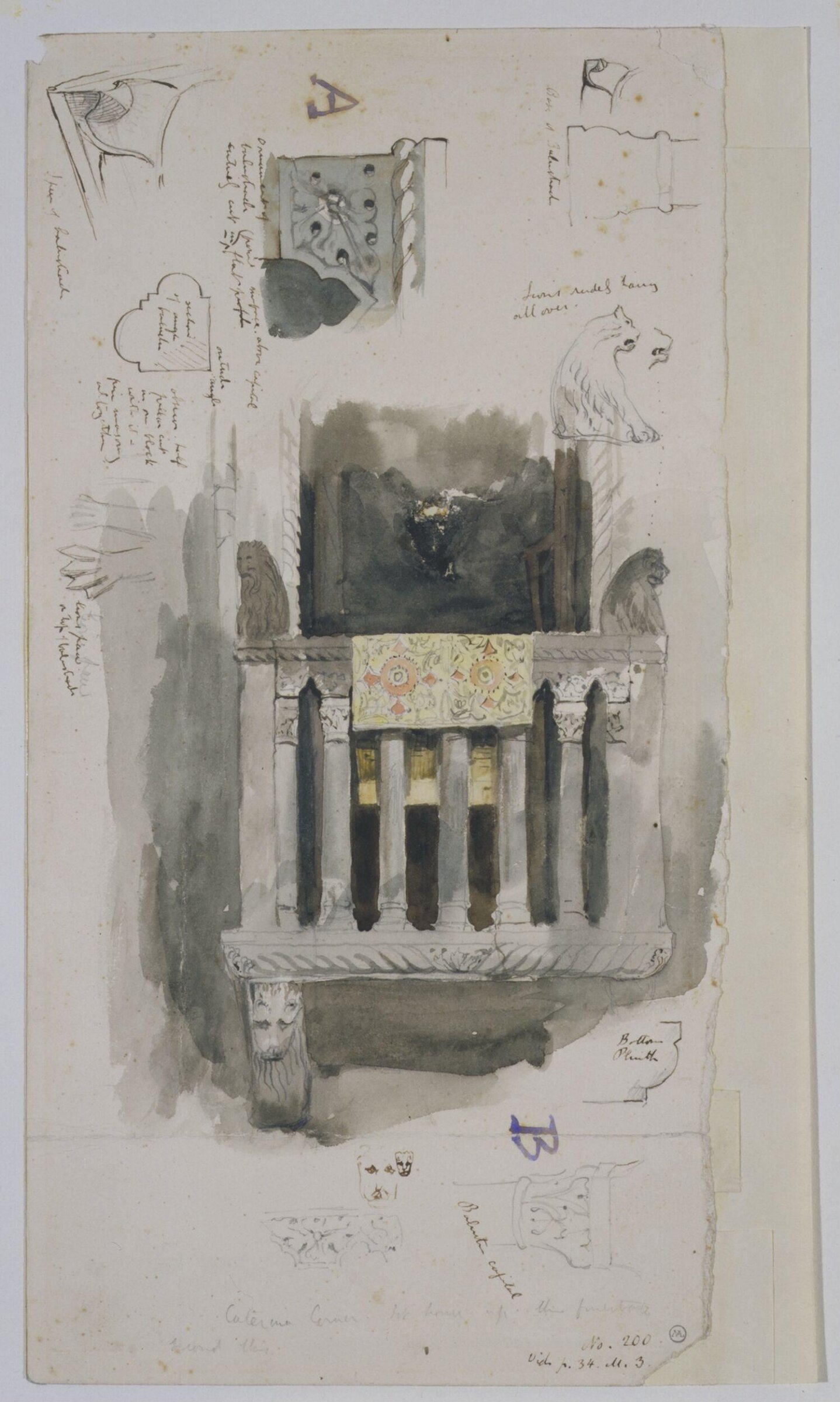
Branch with Leaves
May one see it?
Not receiving at present

Harvard Art Museums
Cambridge, United States
It belongs to the collection, but is not on display at present.
- Checked
- In this state since
- Source
- The museum
Particulars
- Accession number
- 1926.33.193
In the catalog
Sources
- Harvard Art Museums
- Image: Harvard Art Museums — © President and Fellows of Harvard College
Meanwhile, in the life of John Ruskin
The whole life8 February 1819
Born
1843
In defence of Turner: the first volume of “Modern Painters”
The first volume of “Modern Painters” — an answer to Turner's critics — is published by Smith, Elder & Co. under the name “A Graduate of Oxford”; Ruskin controversially argues that modern landscape painters, above all Turner, surpass “Old Masters” such as Gaspard Dughet, Claude and Salvator Rosa in “truth to nature”, moral as well as material. Reviews are mixed, but Charlotte Brontë and Elizabeth Gaskell are impressed, and the book cements Ruskin's relationship with Turner.
April – July 1854
Effie leaves Ruskin and the marriage is annulled
Suffering from illness and from fierce quarrels with her husband and his overly protective parents, Effie goes to her own parents in Scotland; she and Millais have fallen in love, and her leaving causes a public scandal. In April 1854 she files a suit of nullity on grounds of non-consummation, which is granted in July; Ruskin does not even mention it in his diary.
1858
Turin: Veronese against a dull sermon
In Turin Ruskin sits through a particularly dull sermon at a Waldensian church and sees Paolo Veronese's “Presentation of the Queen of Sheba” at the Galleria Sabauda; later, in April 1877, he will name this as the start of his “unconversion” from Evangelical Christianity. His faith, long shaken by Biblical and geological scholarship, collapses, and, believing that much of his writing had rested on lies and half-truths, Ruskin goes through a deep personal crisis before returning to Christianity after a long struggle.
August – November 1860
“Unto This Last” in the Cornhill Magazine
In four essays published in the Cornhill Magazine Ruskin rejects the division of labour as dehumanising and calls political economy a false “science” that ignores the social affections that bind communities together, but the editor, Thackeray, is forced to abandon the series by the outcry of conservative readers and a nervous publisher. The national press is hostile and his father disapproves, while Carlyle is delighted and declares that they are henceforth “a minority of two”.
20 January 1900
Died