Bloom
Can I see it?
Not on view at present
Where is “Bloom” now? Collection: Art Institute of Chicago, Chicago. Not on view at present. Checked November 16, 2026.

Chicago, United States
It belongs to the collection, but is not on display at present.
- Checked
- In this state since
- Source
- The museum
About the painting
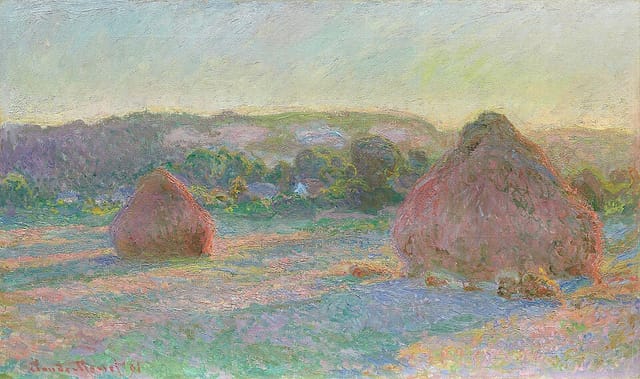
Magenta and lavender passages suggest plants in Julia Fish’s Bloom, painted in 1989 and now at the Art Institute of Chicago, Chicago. Dark green paint seems alternately to advance and withdraw. Although no source of light is visible, the surface appears illuminated from behind. Fish was concerned here with the difficulty of making out garden shapes at dusk, rather than identifying a particular flower. She built up layers through strokes running across and down the picture. Their accumulating texture makes the surface appear to grow unpredictably, while the forms seem to fade and shift.
In the museum's words
Julia Fish’s methodical, meditative paintings are distillations of personal experiences, memories, and, above all, the artist’s immediate surroundings. Meticulously made and attentive to observed reality, her works nevertheless balance representation and abstraction, seeking an oscillation or equilibrium between the two. For the past two decades, Fish has worked in reference to the given materials, surfaces, and construction of her Chicago home and study—a former storefront dating to 1922—but another approach to "found" subjects took priority in the late 1980s. As the artist wrote in a statement in 1990, “With each painting I attempt to reconcile a singular response to an aspect of Nature. . . . Living within an urban setting, my work has grown to reflect the isolated framing of the natural world; and I find through developing each painting a parallel process of selection and reduction.”
Read on
In Bloom, an intimate and intense early work, Fish describes what might be read as vegetation in magenta, lavender, and deep green passages of paint that appear at once to hover above and recede into the pictorial plane. There is no evident light source, yet the painting as a whole seems to glow, as if backlit. More than a particular kind of bloom, this work captures the experience of seeing—or of straining to see—garden forms in twilight. Fish constructed a sense of fading, fluctuation, and ultimate visual instability through repeated horizontal and vertical brush marks. Progressive layers of point generated a lush, tactile surface that seems to behave organically rather than predictably.
Art Institute of ChicagoCC BY 4.0
Details
- Accession number
- 2007.73
What it shows
In the catalog
Sources
- Art Institute of Chicago
- Image: Art Institute of Chicago — © the artist or rights holder