John CageAmerican, 1912–1992
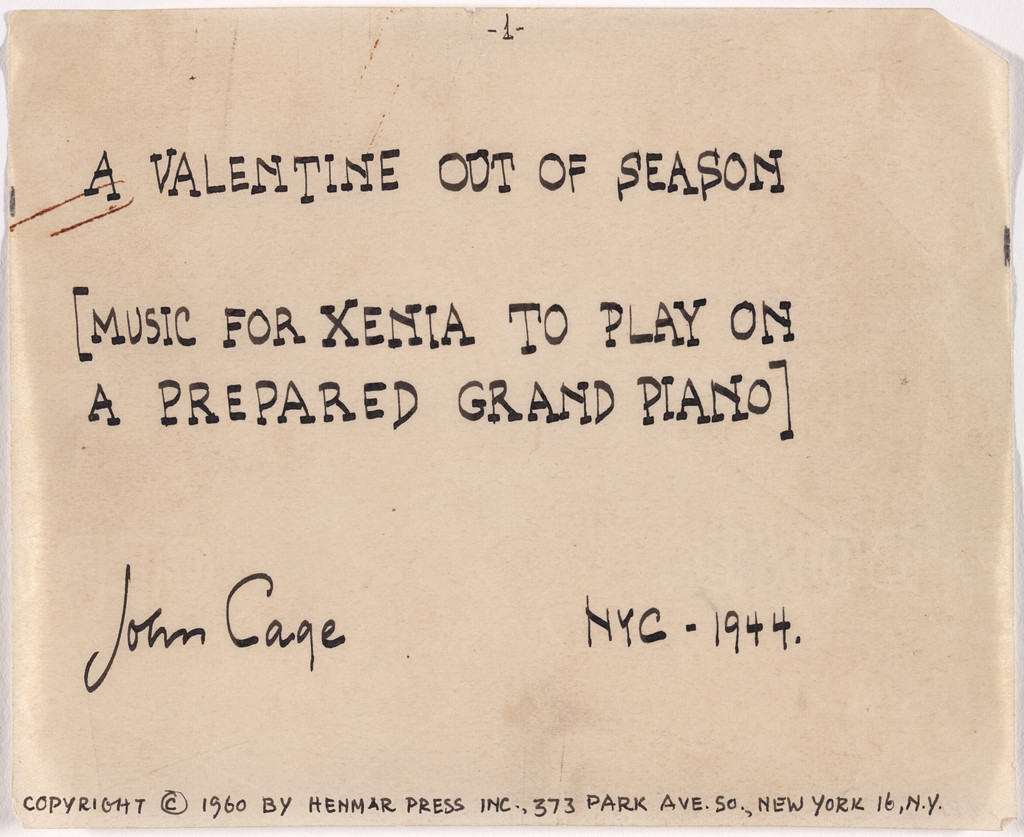
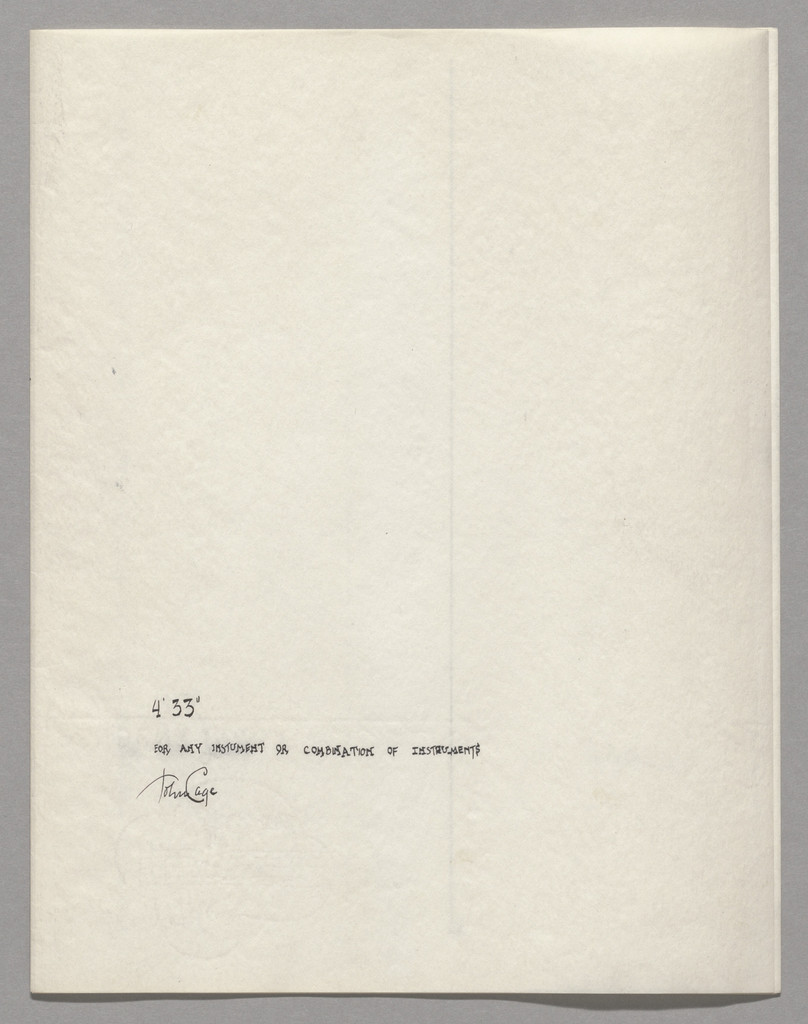
Atlas Eclipticalis (Mixer Manipulation)
May one see it?
Not receiving at present

Art Institute of Chicago
Chicago, United States
It belongs to the collection, but is not on display at present.
- Checked
- In this state since
- Source
- The museum
Particulars
- Accession number
- 2023.3450
In the catalog
Sources
- Art Institute of Chicago
- Image: Art Institute of Chicago — © the artist or rights holder
Meanwhile, in the life of John Cage
The whole life1950s
Chance wrecks his reputation
The adoption of chance procedures has disastrous consequences for Cage's reputation: the press, which used to react favourably to his percussion and prepared-piano music, ignores his new works, and many valuable friendships and connections are lost. Boulez, who used to promote Cage's work in Europe, opposes his particular use of chance, as do other composers who came to prominence in the 1950s, such as Stockhausen.
1956–1961
The New School class and Fluxus
From 1956 to 1961 Cage teaches classes in experimental composition at The New School in New York (from 1956 to 1958 he also works as an art director and designer of typography); most of his students are visual artists with little or no musical background: Jackson Mac Low, Allan Kaprow, Al Hansen, George Brecht, Ben Patterson, Dick Higgins. The classes influence the formation of Fluxus; Cage met Kaprow, who coined the term “happenings”, on a mushroom hunt with George Segal and invited him to join his class.
1960
Wesleyan University and Norman O. Brown
From the 1950s until his death Cage collaborates with the music department of Wesleyan University in Middletown, where the philosopher, poet and classicist Norman O. Brown befriends him — an association fruitful to both. In 1960 Cage is appointed a fellow on the faculty of the Center for Advanced Studies and starts teaching classes in experimental music.
from 1960 until the early 1970s
Arthritis: Cage stops performing in public
Arthritis troubles Cage from 1960, and by the early 1970s his hands are painfully swollen, so that he can no longer perform — “Cheap Imitation” is the last work he plays in public — and manuscripts for publication, previously done in his calligraphic script, now have to be completed by assistants. On top of this, David Tudor leaves performing for composition in the early 1970s, and Cage, for the first time in two decades, has to rely on other performers — Grete Sultan, Paul Zukofsky, Margaret Leng Tan and many others.
October 1961
“Silence” and Edition Peters: wide fame
In October 1961 Wesleyan University Press publishes “Silence”, a collection of Cage's lectures and writings on a wide variety of subjects, including the famous “Lecture on Nothing”, composed using a complex time-length scheme; it is the first of his six books and remains his most widely read and influential. In the early 1960s he begins a lifelong association with the music publisher Edition Peters: its president Walter Hinrichsen offers an exclusive contract and instigates a catalogue of Cage's works (1962); together with “Silence” this brings the composer much greater prominence than ever before.
9 – 11 September 1963
The “Vexations” marathon of Erik Satie
In 1963 Cage, captivated by Erik Satie since his first journey to Europe, presents the American premiere of “Vexations”, a simple short piano piece marked “repeat 840 times”. Eleven pianists, among them Viola Farber and Robert Wood, take over from one another every two hours; the audience comes and goes, the New York Times critic falls asleep in his chair, and the performance ends at 0:40 on 11 September, reckoned the longest piano concert in history.