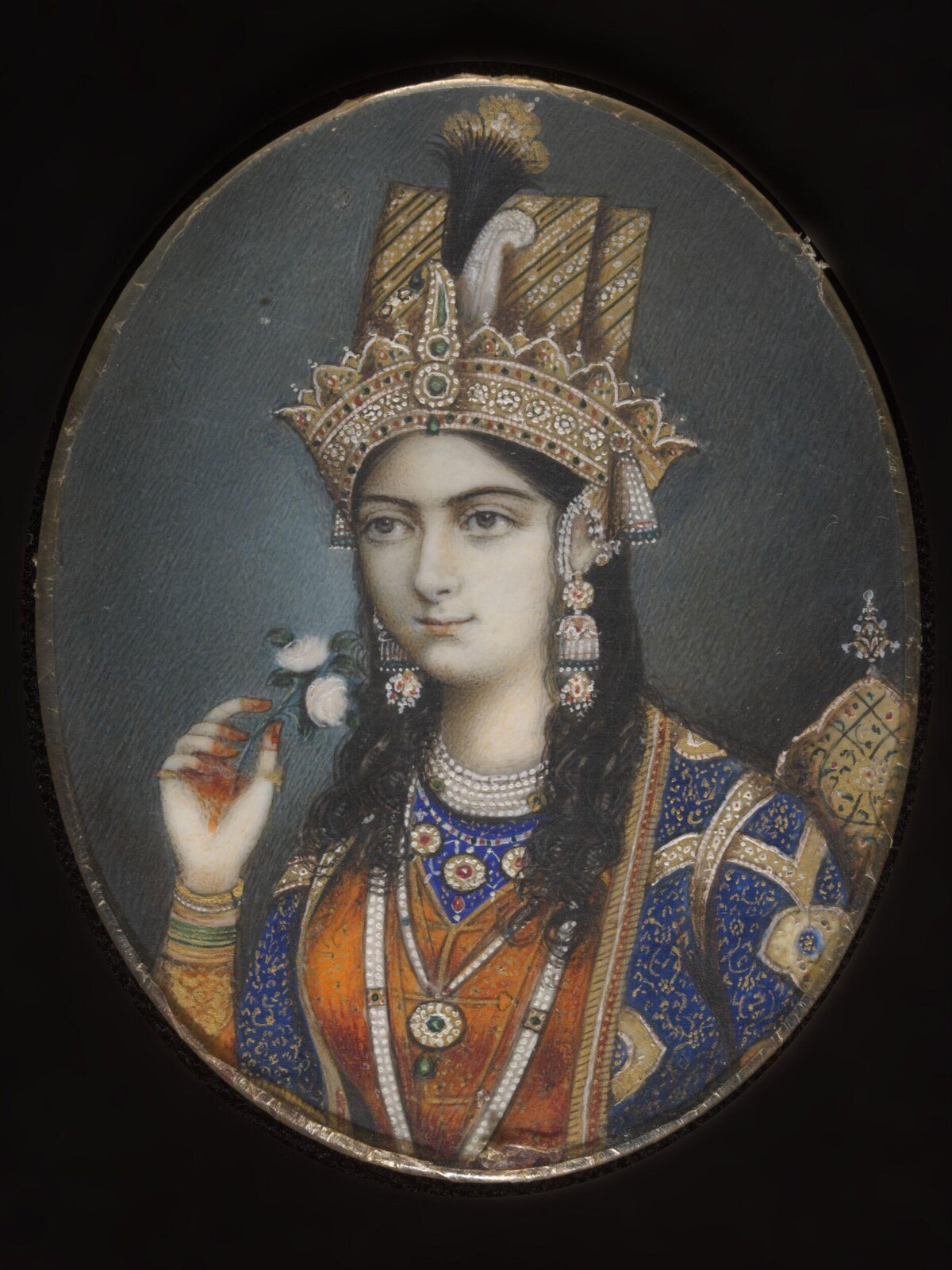
Arjumand Banu Begum
May one see it?
Not receiving at present

Victoria and Albert Museum
London, United Kingdom
It belongs to the collection, but is not on display at present.
- Checked
- In this state since
- Source
- The museum
About the painting
A Company Painting is a picture made by an Indian artist for the British in India. This one is a portrait in watercolour on ivory. An unknown Delhi artist painted it in about 1830. It depicts Arjumand Banu Begum, better known as Mumtaz Mahal ('Elect of the Palace'). She was the favourite wife of the Mughal Emperor Shah Jahan. She died shortly after giving birth to her fourteenth child in 1631. The following year the emperor began work on the mausoleum that would house her body. The result was the world-famous Taj Mahal, situated by the River Jumna at Agra.
Read on
There are no contemporary portraits of Mumtaz Mahal. This imaginary picture is one of thousands that artists produced to satisfy a huge demand for images of Shah Jahan's favourite. Painting on ivory in India has an ancient history. However, this kind of portrait painting did not develop on a large scale until the 18th century, as a result of British influence. Indian artists soon adjusted to the new technique of stippling (painting with small dots) and watercolour tinting instead of line-drawing and opaque colour. They still practice it today.
Victoria and Albert Museum
Particulars
- Accession number
- IM.277-1913
What it shows
In the catalog
Sources
- Victoria and Albert Museum
- Image: Victoria and Albert Museum — © Victoria and Albert Museum, London







