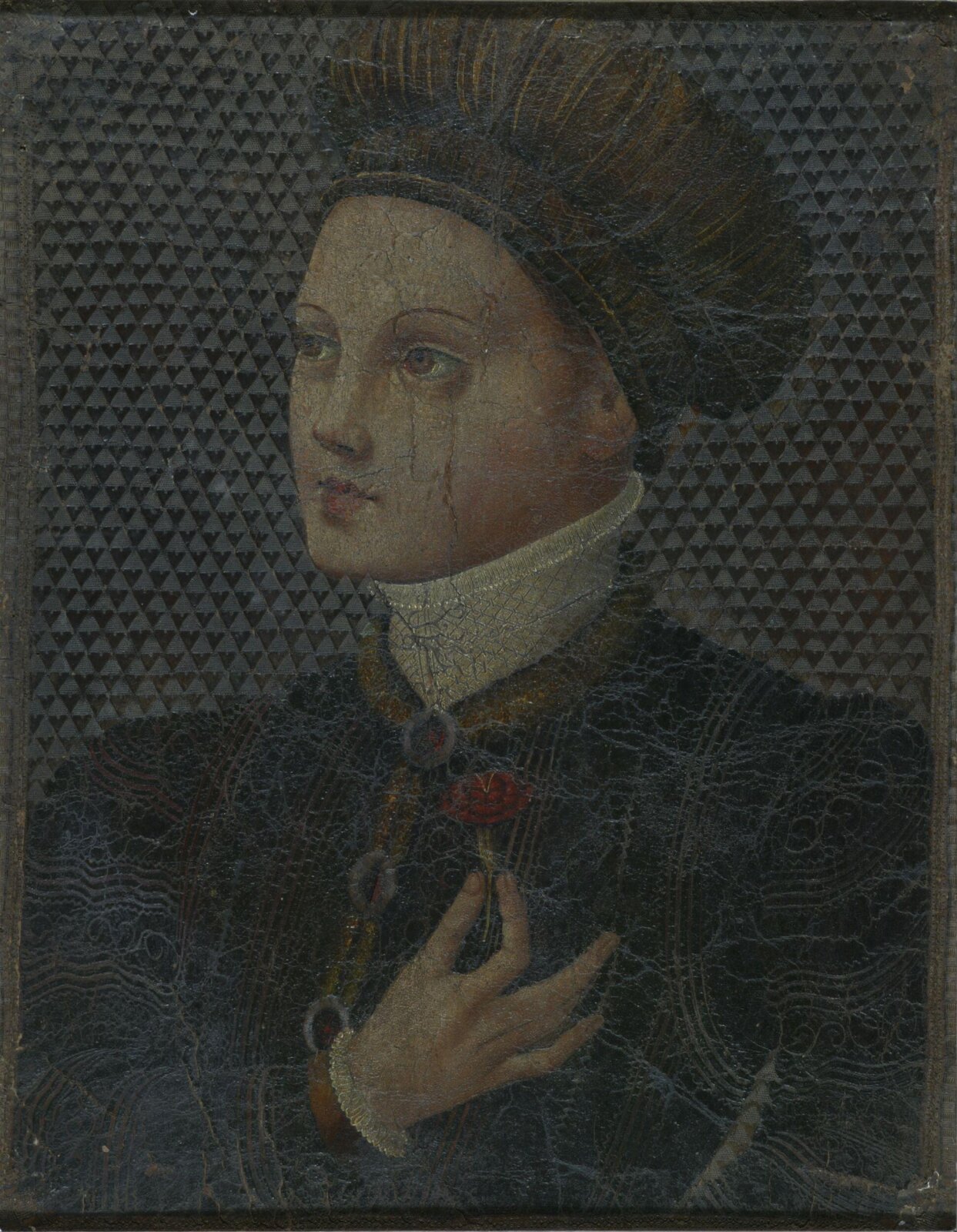
A young man holding a carnation
May one see it?
Not receiving at present

Victoria and Albert Museum
London, United Kingdom
It belongs to the collection, but is not on display at present.
- Checked
- In this state since
- Source
- The museum
About the painting
The sensitive looking young man in this portrait delicately holds a red carnation in his right hand over his heart. Carnations or pinks, especially when red, were symbols of betrothal, probably originating in a Flemish wedding custom. In portrait painting especially of the 15th and 16th centuries, when held in the sitters hand it signifies betrothal. A similar, earlier example of the Italian type is Andrea Solario's Man with a Pink ca. 1495 (London, National Gallery).
Read on
This portrait is painted on leather, an ususual, though not unheard of support for this period. In some cases, a kind of parchment would be used, as in the case of Hans Holbein's portrait of Anne of Cleeves ca. 1539 (Paris, Louvre) or the portrait of Rudolf IV of Austria ca. 1365 (Dom- und Diözesanmuseum of Vienna, originally displayed above his tomb in the Cathedral) which were then mounted on panel and canvas respectively. In such cases, parchment was used for expediency ie. if there wasn't sufficient time to prepare a panel, and for easy transportability. This appears to have been the case for Holbein's portrait, probably painted in Düren for Henry VIII in England, or for Sebastiano del Piombo’s portrait of Clement VII (now in Corsini Collection, Florence) on leather which was probably painted at Michelangelo’s request to send to Florence as a model for Bugiardini.
Tooled and stamped leatherware such as in 69-1898 are more characteristic of household decoration, furniture and objects of this period in Italy such as shields, coffers, and gilt-leather hangings as depicted in Titian’s Venus of Urbino (c. 1538; Florence, Uffizi). The background of this portrait appears to be stamped with an alternating triangle and heart pattern which would fit well with its amorous subject matter. It is possible that the portrait was once part of a larger decorative scheme.
Victoria and Albert Museum
Particulars
- Accession number
- 69-1898
What it shows
In the catalog
Sources
- Victoria and Albert Museum
- Image: Victoria and Albert Museum — © Victoria and Albert Museum, London