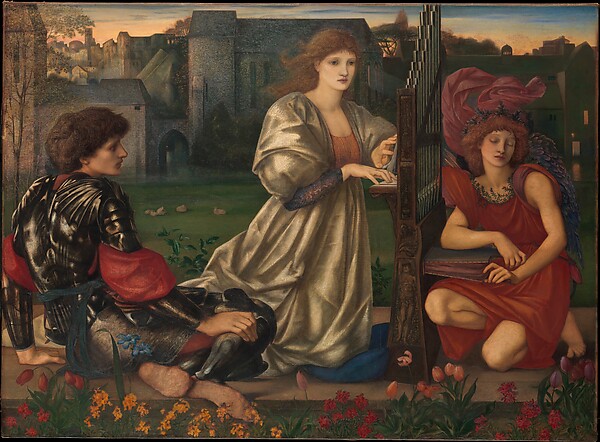
Edward Burne-JonesBritish, 1833–1898
A Siren
May one see it?
Not receiving at present

Cambridge, United States
It belongs to the collection, but is not on display at present.
- Checked
- In this state since
- Source
- The museum
Particulars
- Accession number
- 1943.678
In the catalog
Sources
- Harvard Art Museums
- Image: Harvard Art Museums — © President and Fellows of Harvard College
Meanwhile, in the life of Edward Burne-Jones
The whole life1892–1898
Designs books for the Kelmscott Press
Between 1892 and 1898 he designed books for the Kelmscott Press; among the books with his illustrations is “The Works of Geoffrey Chaucer” (1896).
1894
Sets and costumes for “King Arthur” at the Lyceum
Henry Irving commissioned him to design the sets and costumes for J. Comyns Carr’s “King Arthur”, with Irving as Arthur and Ellen Terry as Guinevere. Burne-Jones accepted with enthusiasm but was disappointed with much of the result, confiding to his friend May Gaskell that he hated the stage.
3 May 1894
Created a baronet
In November 1893 he was sounded out about a baronetcy on the recommendation of the outgoing Prime Minister, Gladstone; in February 1894 he legally changed his name to Burne-Jones, and on 3 May he was created a baronet of Rottingdean and of the Grange. The honour made him unhappy, disgusted his socialist friend Morris and was scorned by his wife; only his son Philip, who would inherit the title, truly wanted it.
1896
Death of William Morris
After Morris’s death Burne-Jones’s health declined substantially. The last major commission the firm carried out in Morris’s lifetime was Stanmore Hall, with tapestries on the story of the Holy Grail whose figures were by Burne-Jones.
1898
Influenza and a sudden relapse
Burne-Jones had an attack of influenza and had apparently recovered when he was suddenly taken ill again; he died on 17 June. At the intervention of the Prince of Wales his memorial service was held at Westminster Abbey, the first time an artist had been so honoured.
17 June 1898
Died