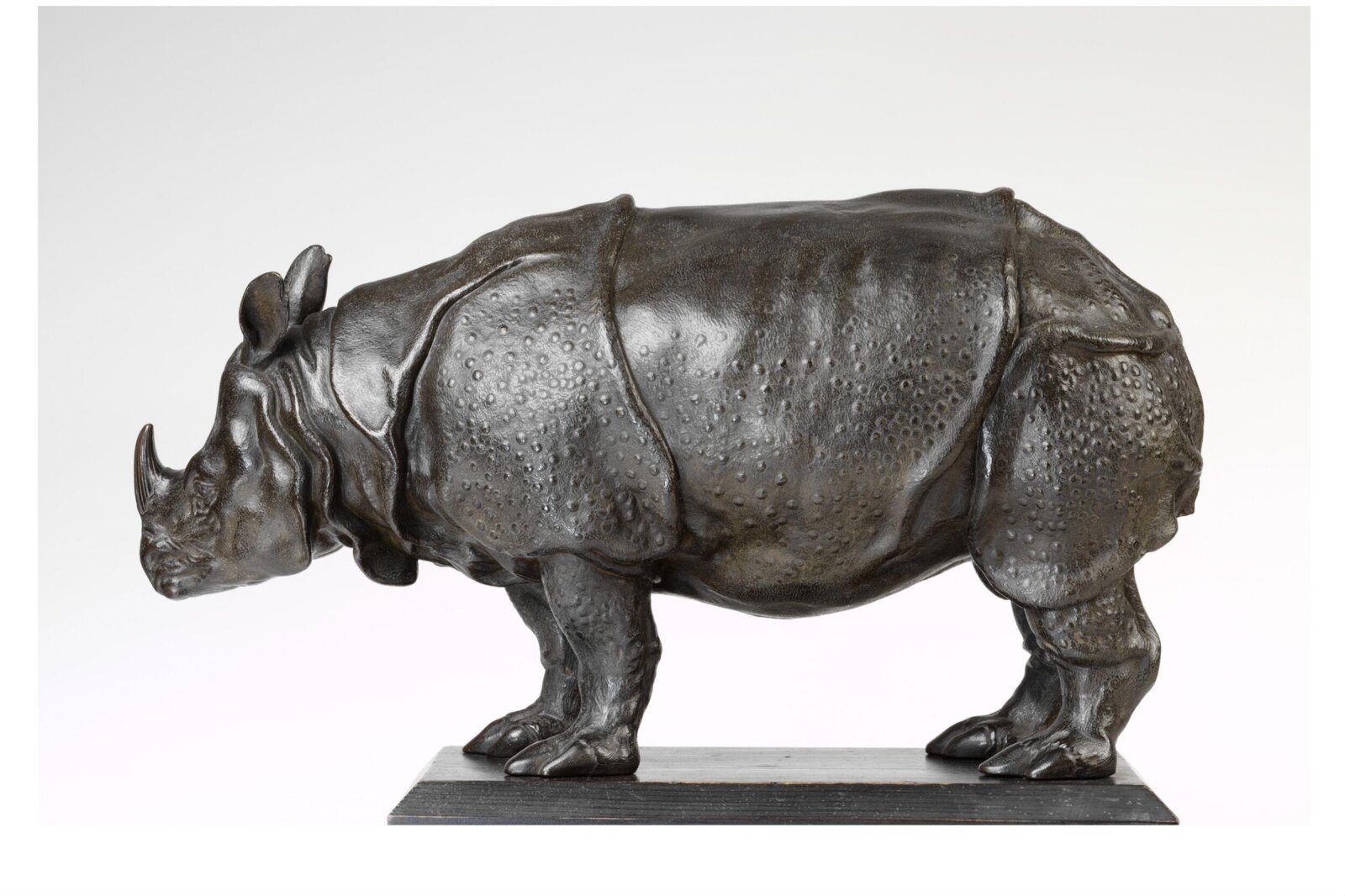
A Rhinoceros called Miss Clara
Can I see it?
Not on view at present
Where is “A Rhinoceros called Miss Clara” now? Collection: Victoria and Albert Museum, London. Not on view at present. Checked September 25, 2026.

London, United Kingdom
It belongs to the collection, but is not on display at present.
- Checked
- In this state since
- Source
- The museum
About the sculpture
In July 1741, after a seven-month sea voyage around Africa, Dutch captain Douwemout Van der Meer arrived in the port of Rotterdam with a young female Indian rhinoceros. It was the first example of rhino to be seen in the continent since 1579 and the impact of its arrival was spectacular. In 18th-century Europe, the rhinoceros was considered a mythical animal, much like the fabled unicorn. For those who believed the animal really existed, the only image that would have been familiar was a woodcut print by German artist Albrecht Dürer (1471-1528), dating from 1515, and showing the rhino with an armour-like hide, reptilian scales on its legs and an extra small horn between its shoulders.
Read on
The female Indian rhino was exhibited in the Netherlands for several years before she made a first trip to Hamburg, Germany, in 1744. Miss Clara, who acquired her nickname in 1748, toured extensively through Europe, in Germany, France, Italy, Poland and went to London on three occasions, in 1751-2, 1756 and finally in 1758 when she died unexpectedly.
Widely popular among all classes of society, she was exhibited publicly and had private audiences with several Europeans monarchs such as King Frederick II of Prussia in Berlin or King Louis XV in Versailles. Miss Clara became very fashionable, starting a proper rhino-mania. Prints and medals with her effigy were sold as souvenirs, while her image inspired textiles and luxury goods, such as Meissen porcelain, clocks, music boxes and snuffboxes.
Miss Clara also inspired many artists of the time throughout Europe. For example, French Painter Jean-Baptiste Oudry (1686-1755) painted her portrait at the Saint-Germain faire in Paris (oil on canvas, now in Schwerin, Staatliches Museum). Venetian painter Pietro Longhi (1701-1785), painted her during Carnival time, after she had sheared her horn by rubbing against the boards of her enclosure in Rome the previous year (Venice, Museo del Settecento Veneziano, Ca’ Rezzonico).
Peter Anton von Verschaffelt (1710-1793), court sculptor to Elector Carl Theodor in the Palatinate, sculpted a large rhinoceros in marble which was documented in his workshop after his death (E. Hoffmann, Peter Anton von Verschaffelt. Hofbildhauer des Kurfürsten Carl Theodor in Mannheim, PhD diss., 1982, p.18). He may have made a smaller version of his sculpture as a model for the Frankenthaler porcelain manufacture (see F. H. Hofmann, Frankenthaler porzellan, Munich, 1911, II, no. 520 and no. 749). In 1799, after the collapse of the Frankenthal factory, the Nymphenburg Porcelain manufacture acquired many of its workmen and moulds, therefore adding Frankenthal designs to its products.
This bronze, beautifully modelled and cast, is believed to have been made in Germany, maybe after Verschaffelt’s model. Two other versions are known, one in the Barber Institute of Fine Arts (acc. No. 42.9), the other, formerly in the Heseltine Collection (W. von Bode, Italian Bronze Statuettes of the Renaissance, London, 1908, II, pl. 118; current location unknown). Other smaller versions, sometimes of later casts, have appeared recently on the art market (e.g. Sotheby’s, Paris, 14 May 2014, lot 80 [dated 1750-52]; Sotheby’s, London, 3 July 2018, lot 51 [cast probably 19th c.]).
Victoria and Albert Museum
Details
- Accession number
- A.528-1910
What it shows
In the catalog
Sources
- Victoria and Albert Museum
- Image: Victoria and Albert Museum — © Victoria and Albert Museum, London