ART WIKI32,963 on view
MapCollectionArtistsMuseumsExhibitionsJournal
Sign in

ART WIKI

Where the masterpiece hangs, and when they let you in.

Collections: Art Institute of Chicago, Getty Villa, Harvard Art Museums, Hirshhorn Museum and Sculpture Garden, J. Paul Getty Museum, Minneapolis Institute of Art, Musée du Louvre, National Gallery of Art, National Museum of Asian Art, National Portrait Gallery (Smithsonian), Pushkin State Museum of Fine Arts, Rijksmuseum, Smithsonian American Art Museum, SMK — National Gallery of Denmark, State Hermitage Museum, State Russian Museum, The Cleveland Museum of Art, The Metropolitan Museum of Art, The Museum of Modern Art, Tretyakov Gallery, Victoria and Albert Museum, Whitney Museum of American Art, State Catalogue of the Museum Fund of Russia (274 museums), Europeana (19 museums), Wikidata (6 museums), Paris Musées (12 museums), and Joconde, the French Ministry of Culture's museum database (495 museums). Images belong to their rights holders.

Sections

  • Map
  • Search
  • Collection
  • Masterpieces
  • On view now
  • Artists

More

  • Museums & galleries
  • Exhibitions
  • Journal
  • Where the data comes from
  • Privacy & cookies
HomeMapBrowse
  1. Collection/
  2. Victoria and Albert Museum/
  3. A Mamluk from Aleppo
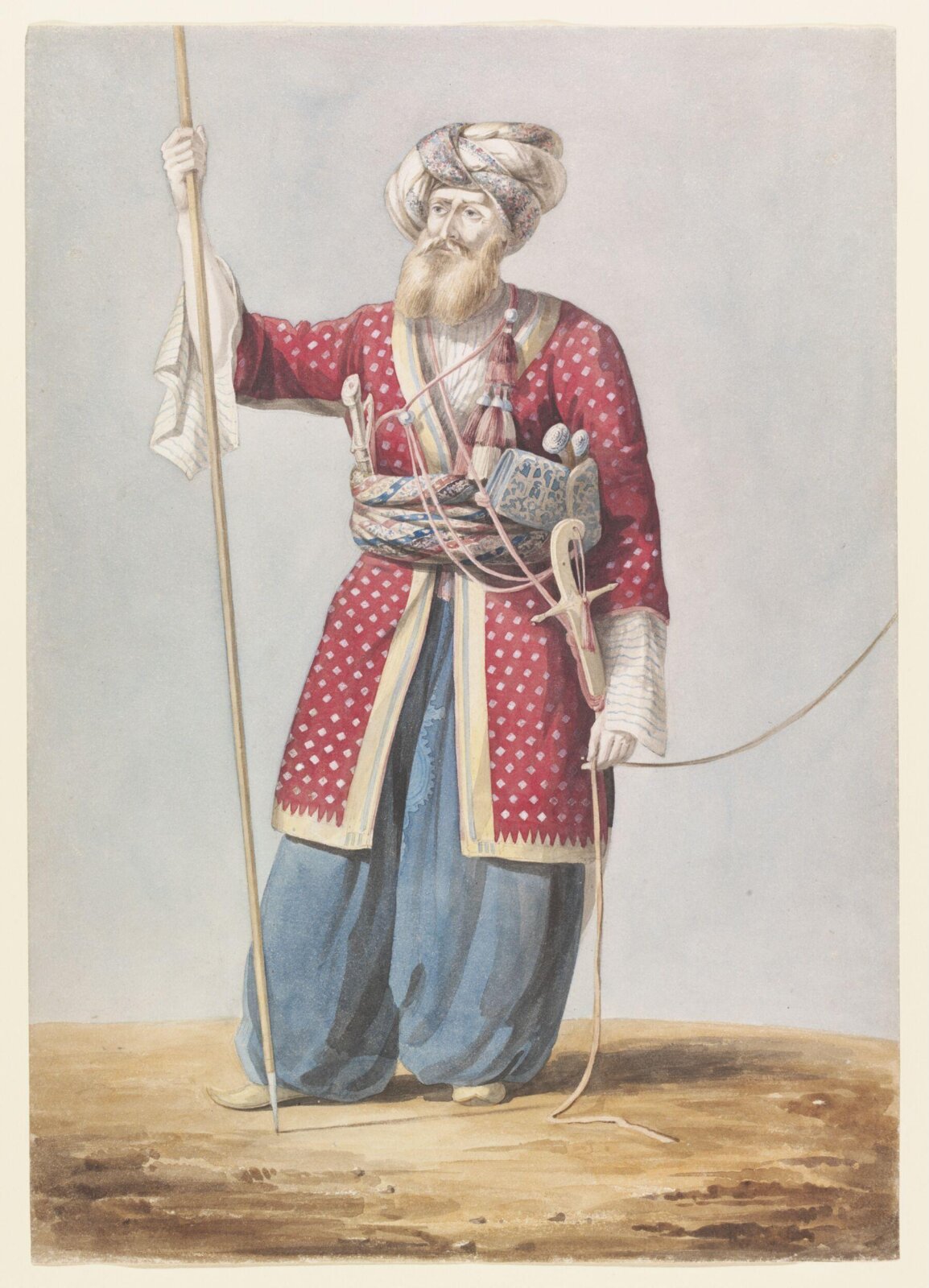
A Mamluk from Aleppo, William Page, ca. 1816-1824

A Mamluk from Aleppo

ca. 1816-1824 · Watercolour · 37.7 × 26.4 cm

About the work

The Mamluks (literally `owned’, i.e., slaves) had controlled Egypt from 1250 until the Ottoman conquest of 1516-17, yet even then they still continued to govern Egypt for the Ottoman Sultan, while paying tribute. Originally they had been a military caste of former slaves serving the Egyptian sultans. Young boys, mainly Kipchak Turks from regions north of the Black Sea, were bought from slave dealers and trained as warriors by previous generations of Mamluk amirs or commanders. They were set free on reaching adulthood, given a horse and arms, and then took employment with their former masters. In 1250, a group of Mamluk generals seized power from the Ayyubid dynasty, and ruled Egypt, even after the Ottoman conquest, until the time of Napoleon’s invasion in 1797. Under the Mamluk Sultan Baybars, they had even defeated the Mongols in a pitched battle in 1260.

Read on

Although to the end spectacularly brave horsemen, their power slowly declined. The Egyptian economy was weakened by the rise of European trading rivals and new trade routes, and by devastating visitations of the plague. After surviving the invasion by the French, and then the British, the Mamluks struggled on. Yet, apart from a few survivors, the most prominent were finally eliminated in a treacherous massacre by the new ruler of Egypt, the Albanian general Muhammad Ali in 1811.

This is one of twenty-one costume figure studies, probably intended for illustration, by Page in the Museum’s collections. They show Ottoman subjects of various ranks and occupations, both male and female. Page recorded in fine detail their elaborate costumes in the last years preceding the modernising reforms that steadily eroded many traditional forms of dress and behaviour. It is not clear how many Mamluks survived the massacre by Muhammad Ali in 1811, but the detail of the costume of this individual, and that it seems to be a kind of portrait, implies that Page saw this survivor first-hand. Unlike Henry Alken’s preoccupation with horses [See SD.17], Page has focused his attention on the remarkable costume, including the embroidered shawl round the waist and the distinctive turban. The fact that he was a horseman is only suggested by the rope he is holding, and the long lance that had made the Mamluks so feared in battle.

More by William Page

All works

Neighbors at Victoria and Albert Museum

Museum page

On the same theme · Mamluk

All works on the theme

Victoria and Albert Museum

Particulars

ca. 1816-1824
18111885
Accession number
SD.724

Sources

  • Victoria and Albert Museum
  • Image: Victoria and Albert Museum — © Victoria and Albert Museum, London
William Page, portraitWilliam PageAmerican, 1811–1885

May one see it?

Not receiving at present

Victoria and Albert Museum

London, United Kingdom

It belongs to the collection, but is not on display at present.

Checked
12 days ago
In this state since
Sep 25, 2026
Source
The museum
On the mapMuseum page
Portrait of a Young Man, William Page, ca. 1830-1835

Portrait of a Young Man

ca. 1830-1835 · Smithsonian American Art Museum

Charlotte Cushman, William Page, 1853

Charlotte Cushman

1853 · National Portrait Gallery (Smithsonian)

Studies - 2 cows, horse, etc., William Page, n.d.

Studies - 2 cows, horse, etc.

n.d. · Smithsonian American Art Museum

Nude Boy Playing a Flute, William Page, n.d.

Nude Boy Playing a Flute

n.d. · Smithsonian American Art Museum

Profile of an Ideal Female Head, William Page, n.d.

Profile of an Ideal Female Head

n.d. · Smithsonian American Art Museum

Drawing, William Page

Drawing

Not on view · Victoria and Albert Museum

Head of an Elderly Man, William Page, n.d.

Head of an Elderly Man

n.d. · Smithsonian American Art Museum

Standing Nude Child, William Page, n.d.

Standing Nude Child

n.d. · Smithsonian American Art Museum

Bird of Paradise, Hashimoto Chitaka, 2026

Hashimoto Chitaka

Bird of Paradise, 2026

Torsion 2, Taruma Shoko, 2025

Taruma Shoko

Torsion 2, 2025

Fu, Someya Satoshi, 2025

Someya Satoshi

Fu, 2025

Bow Before the Curtain Falls, 2024

Bow Before the Curtain Falls, 2024

Summer, 2024

Summer, 2024

Red Flow, Ishizuka Genta, 2024

Ishizuka Genta

Red Flow, 2024

3D replica of Michelangelo's Prisoner (4117-1854), Factum Arte, 2024

Factum Arte

3D replica of Michelangelo's Prisoner (4117-1854), 2024

Sculpture, ‘Co-Existence – the Man and the Monkey’, Zhao Lin, 2024

Zhao Lin

Sculpture, ‘Co-Existence – the Man and the Monkey’, 2024

A Mounted Mamluk with his Sais [Groom], S. Bossi, 1820-1821

S. Bossi

A Mounted Mamluk with his Sais [Groom], 1820-1821

Not on view · Victoria and Albert Museum

A Mameluke and Turks of Egypt, William Marshall Craig, 1804

William Marshall Craig

A Mameluke and Turks of Egypt, 1804

Not on view · Victoria and Albert Museum

Mamluk, Carle Vernet, 1822

Carle Vernet

Mamluk, 1822

Not on view · Victoria and Albert Museum

What it shows

MamlukSyriaAleppo

In the catalog

Drawings & watercolorsWatercolourNeoclassicismRomanticism19th centuryBritish SchoolOrientalism