 Gerard ter BorchDutch, 1617–1681
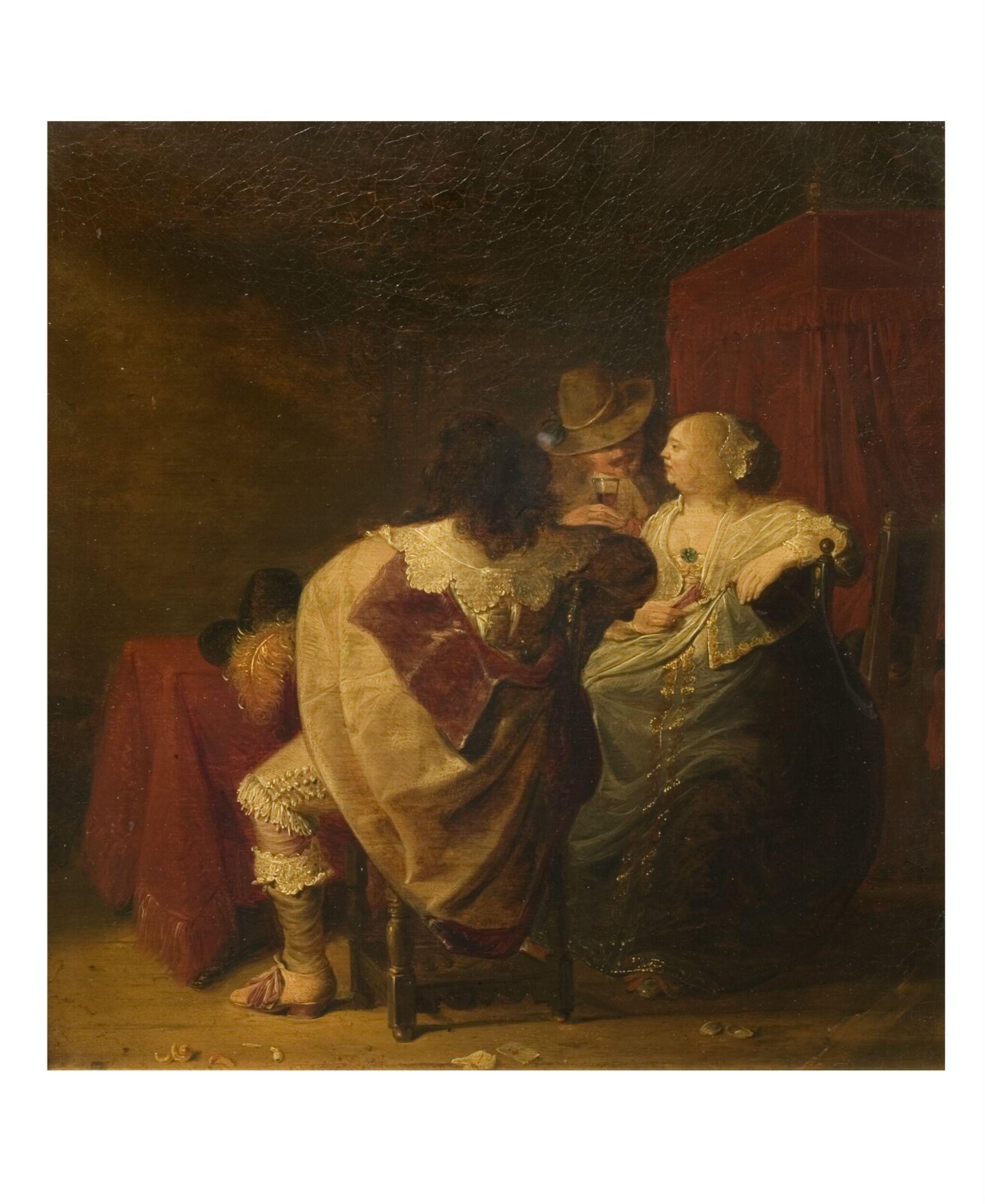
A lady being propositioned by two gentlemen
Can I see it?
Not on view at present
Where is “A lady being propositioned by two gentlemen” now? Collection: Victoria and Albert Museum, London. Not on view at present. Checked September 25, 2026.

London, United Kingdom
It belongs to the collection, but is not on display at present.
- Checked
- In this state since
- Source
- The museum
About the painting
Two well dressed men appear to proposition an extravagantly dressed woman, one proffering her a drink, in a darkened interior furnished with a red velvet canopy bed. On the floor lays a variety of detritus including a broken clay pipe, fruit peels, oyster shells and an Ace of Hearts playing card. This type of ‘merry company’ scene, made popular during the first thirty years of the seventeenth century, recalls the works of Jan Steen and/or Gerard Ter Borch who often set their moralising geselschapjes in taverns or brothels as a playful condemnation of drunkenness, gambling and prostitution. This work is very likely a nineteenth-century copy of a work in this seventeenth century style.
Read on
It may be compared for example with Steen's An Interior with a Man offering an Oyster to a Woman in the National Gallery, London (NG 2559) ca.1660-5. In the 17th century, oysters (traditionally a symbol of lust) were thought to be an aphrodisiac and the discarded oyster shells scattered around the woman's chair may be an allusion to her occupation as a prostitute. Similarly, Steen often included clay pipes in his genre paintings as objects with erotic connotations as in The Interior of an Inn also in the National Gallery, London (NG 5637). Gerard Ter Borch (1617-1681) specialised, from the late 1640s onwards, in small panels featuring figures, selectively lit against dark backgrounds, talking, drinking and making music in elegant dress and was particularly skilled in recording the way light strikes shimmering and costly fabrics.
Although 509-1870 appears to emulate him in many ways, it is much less finely painted. Like Ter Borch's A Woman playing a Theorbo to Two Men (NG 864) in the National Gallery, London, 509-1870 is anecdotal in character, with two men present and the relationship between the figures is deliberately ambiguous. The viewer is invited to decide whether is just a happy domestic scene, or, possibly a scene taking place in brothel. Another comparable genre picture by Ter Borch is The Card Players (Johnny Van Haeften, London 2009), a subject which emphasises the idleness of the pastime, the stupidity or untrustworthiness of the participants or set the scene for an amorous dalliance between the sexes, in the case of the V&A picture, the ace of hearts symbolises romance.
Victoria and Albert Museum
Details
- Accession number
- 509-1870
What it shows
In the catalog
Sources
- Victoria and Albert Museum
- Image: Victoria and Albert Museum — © Victoria and Albert Museum, London
In the life of Gerard ter Borch
The whole life1666
One of the forty-eight “common men” of Deventer
In 1666 he is considered so important a citizen that he is appointed one of the forty-eight “common men” who met four or five times a year to decide the city’s policy. Other accounts say he became a member of the town council.
1672
Deventer surrenders to Cologne and Münster
During the Second Münster War the city surrenders to Cologne and Münster; ter Borch probably leaves Deventer at that time. The occupying forces withdraw in 1674, and a new government is set up in the city.
1681
Asks to be buried in Zwolle
Dying in Deventer, he expresses the last wish to be buried in the Great, or St Michael’s, Church of his native Zwolle.
8 December 1681
Died