John RuskinΑγγλία, 1819–1900
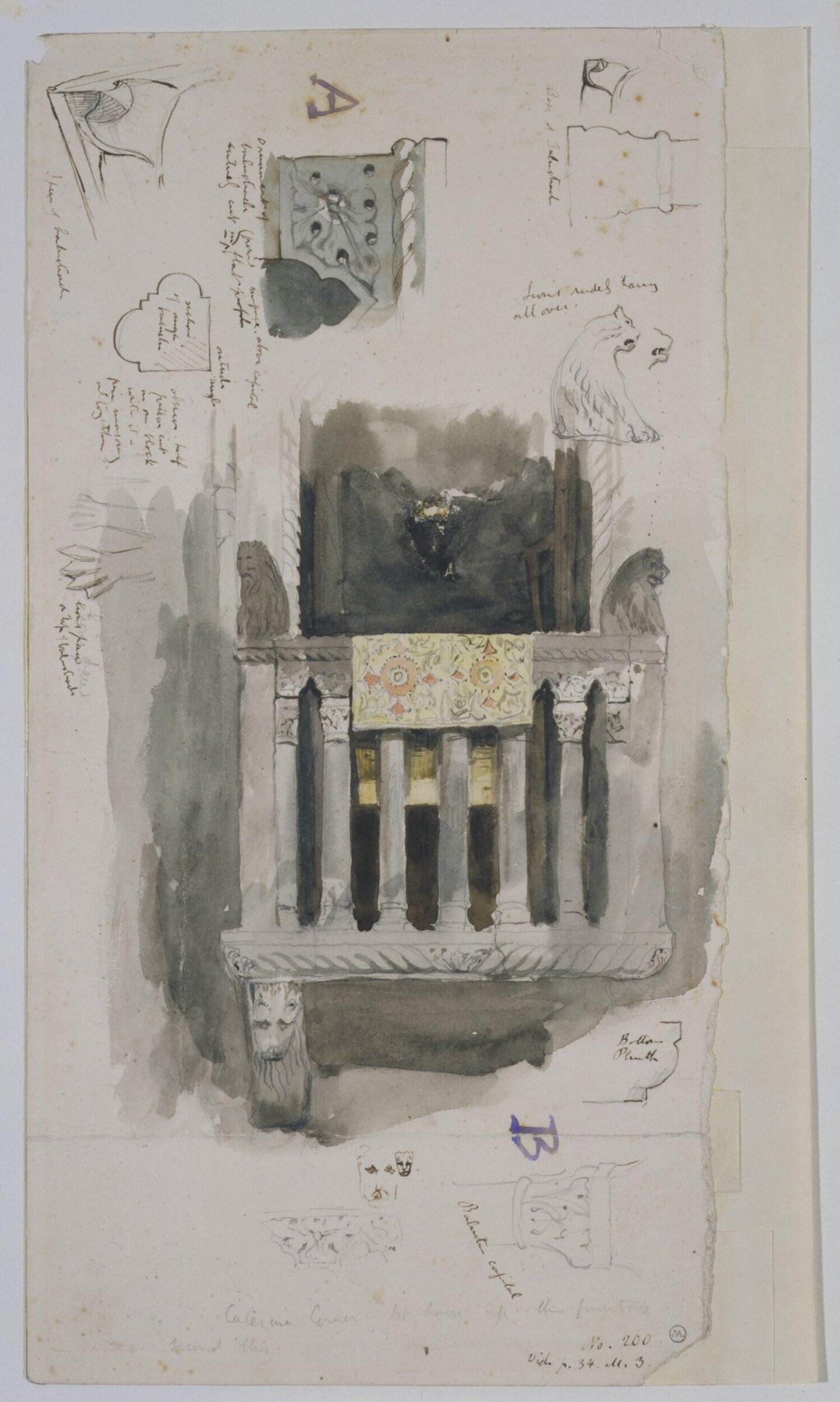
Viterbo
Μπορώ να το δω;
Δεν εκτίθεται αυτή την περίοδο
Πού βρίσκεται τώρα το έργο «Viterbo»; Συλλογή: Art Institute of Chicago, Σικάγο. Δεν εκτίθεται αυτή την περίοδο. Ελέγχθηκε 2 Νοεμβρίου 2026.

Σικάγο, Ηνωμένες Πολιτείες Αμερικής
Ανήκει στη συλλογή, αλλά δεν εκτίθεται αυτή την περίοδο.
- Ελέγχθηκε
- Σε αυτή την κατάσταση από
- Πηγή
- Το μουσείο
Στοιχεία
- Αριθμός καταλόγου
- 1929.448
Στον κατάλογο
Πηγές
- Art Institute of Chicago
- Εικόνα: Art Institute of Chicago — CC0
Στη ζωή του καλλιτέχνη: John Ruskin
Όλη η ζωή1834–1900 · Τόπος εργασίας
Great Britain
late 1840 – autumn 1842
Italy with his parents: guided by George Richmond
For much of the period from late 1840 to autumn 1842 Ruskin is abroad with his parents, mainly in Italy, where George Richmond — introduced to the family by Joseph Severn, a friend of Keats — guides his study of Italian art. Back at Oxford in 1842 he sits for a pass degree and is awarded an unusual honorary double fourth-class degree in recognition of his achievements.
1843
In defence of Turner: the first volume of “Modern Painters”
The first volume of “Modern Painters” — an answer to Turner's critics — is published by Smith, Elder & Co. under the name “A Graduate of Oxford”; Ruskin controversially argues that modern landscape painters, above all Turner, surpass “Old Masters” such as Gaspard Dughet, Claude and Salvator Rosa in “truth to nature”, moral as well as material. Reviews are mixed, but Charlotte Brontë and Elizabeth Gaskell are impressed, and the book cements Ruskin's relationship with Turner.
1845
“Venice is lost to me”: restoration is destruction
Alarmed by the combined effects of decay and modernisation on the city, Ruskin writes that Venice is lost to him, and becomes convinced that architectural restoration is destruction and that the only true and faithful action is preservation and conservation.
10 Απριλίου 1848
Married: Effie Gray
1851–1853
The three-volume “Stones of Venice”
Growing from a technical history of Venetian architecture, from the Byzantine to the Renaissance, into a broad cultural history, the work is a warning to contemporary England about the moral and spiritual health of society: Ruskin explains the decline of Venice by the loss of true Christian faith. The chapter “The Nature of Gothic” from the second volume — a critique of the division of labour and industrial capitalism — will be published by William Morris as a separate book.