El LissitzkyΡωσία, 1890–1941
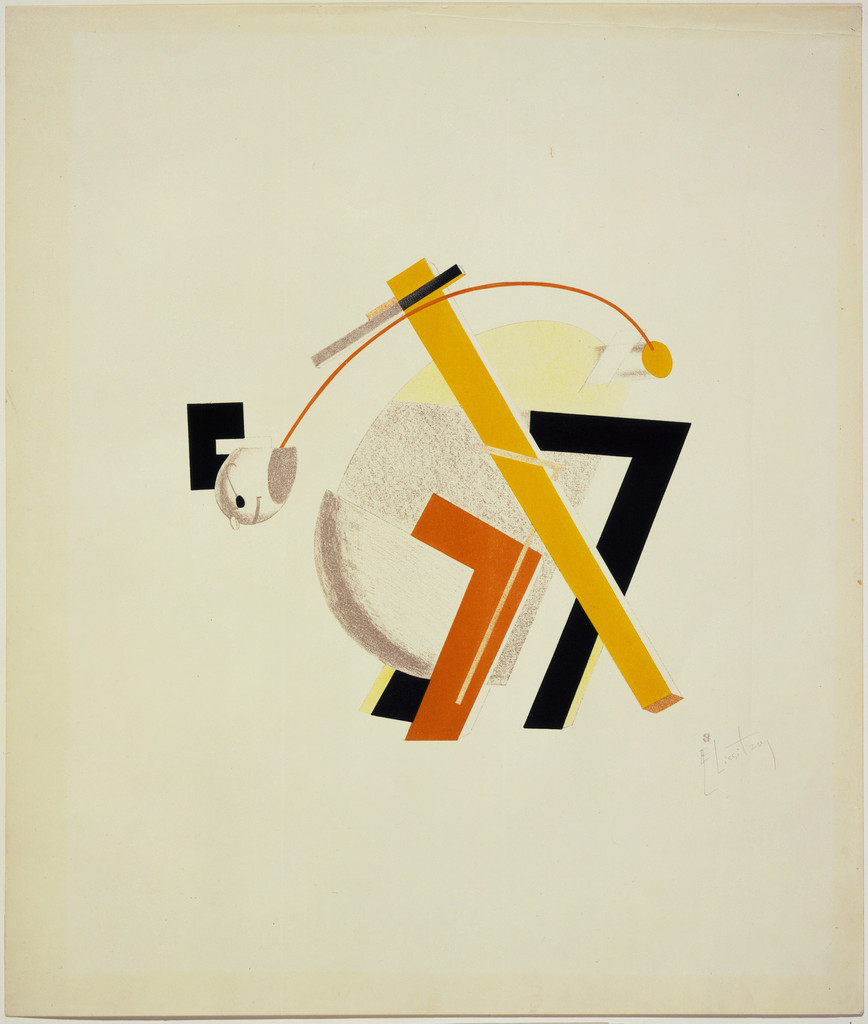
Proun 99
Μπορώ να το δω;
Δεν εκτίθεται αυτή την περίοδο
Πού βρίσκεται τώρα το έργο «Proun 99»; Συλλογή: Yale University Art Gallery, Νιου Χέιβεν. Δεν εκτίθεται αυτή την περίοδο. Ελέγχθηκε 19 Οκτωβρίου 2026.
Νιου Χέιβεν, Ηνωμένες Πολιτείες Αμερικής
Ανήκει στη συλλογή, αλλά δεν εκτίθεται αυτή την περίοδο.
- Ελέγχθηκε
- Σε αυτή την κατάσταση από
- Πηγή
- Το μουσείο
Για τον πίνακα
El Lissitzky was a designer, typographer, architect, and photographer affiliated with the Soviet Constructivist and Suprematist movements. He studied and worked as an architect and engineer in Germany and Russia before receiving an invitation from Marc Chagall in 1919 to teach at the Vitebsk School of Art in Belarus. There he encountered painter Kasimir Malevich, the recent founder of the Suprematist movement, which strove to create a style of purely non-objective painting comprised of a language of geometric forms. In 1920 Lissitzky coined the term "Proun"—an acronym for the Russian words meaning "project for the affirmation of the new"—to refer to a series of abstract works that combined the Suprematist lexicon of geometric, monochromatic forms with tools of architectural rendering.
Συνέχεια
In Proun 99, the large composite object that dominates the upper left quadrant could either be a cube or a recessed meeting of three planes. The gridded triangle at the bottom appears to create a sense of depth, yet the elements above it seem to exist in their own, gravity-less space. Through constructing a complex dimensional space that hovers between the coherent and the impossible, Lissitzky strives to evoke utopia—literally "no place"—and to achieve the task of inventing a new art for a post-revolutionary Soviet society.
Yale University Art Gallery
Στοιχεία
- Αριθμός καταλόγου
- 1941.548
Στον κατάλογο
Πηγές
- Yale University Art Gallery
- Εικόνα: Yale University Art Gallery — Image: Yale University Art Gallery
Στη ζωή του καλλιτέχνη: El Lissitzky
Όλη η ζωή1921
Leaving for Germany as a “cultural emissary”
In 1921, as UNOVIS declines and suprematism begins to fracture into a utopian, spiritual half and a utilitarian one, Lissitzky aligns with neither and leaves Vitebsk: he takes a job as a “cultural emissary” of Soviet Russia and moves to Weimar Berlin to establish contacts between Russian and German artists — what exactly he did in this role remains unclear. In 1921–1925 he lives in Germany and Switzerland.
1922
First solo exhibition in Hanover
The year after the publication of his first Proun series in 1921, Kurt Schwitters introduces Lissitzky to the Hanover gallery Kestnergesellschaft, where he holds his first solo exhibition. The second Proun series, printed in Hanover in 1923, is a success.
1923
The Proun Room at the Great Berlin Art Exhibition
In 1923, for the Great Berlin Art Exhibition, Lissitzky transforms a small room (about 3 by 3 by 2.5 m) into a single work of art, the Proun Room, which lets viewers “walk into an image” and become active participants. He violates the unwritten rule of rejecting the commercialization of art by putting price tags on three elements of the room; the price tags, together with his “half-dance” during the demonstration of the room, alienate his friend Theo van Doesburg.
1923–1924
Tuberculosis and a Swiss hospital
In 1923–1924 Lissitzky is severely ill with tuberculosis and stays in a Swiss hospital; at this time he is reported even to have considered suicide. He will die of tuberculosis in 1941.
1925
Return to the USSR
Lissitzky's years in Germany and Switzerland run from 1921 to 1925; it appears that in 1925 he returns to the Soviet Union.
1927
The All-Union Polygraphic Exhibition in Moscow
In 1927 the All-Union Typographic (Polygraphic) Exhibition takes place in Moscow under Lissitzky's direction and to his design; one of its aims is to show the paths humanity has travelled in conveying thought by means of symbolic and graphic signs. He develops new principles of exhibition display, treating an exhibition as a whole organism.