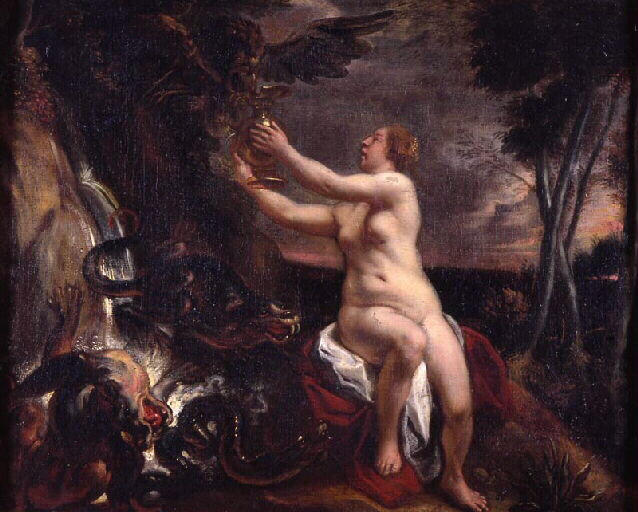
 Jacques JordaensΦλάνδρα, 1593–1678
Hébé
Μπορώ να το δω;
Άγνωστο
Πού βρίσκεται τώρα το έργο «Hébé»; Συλλογή: Musée des Beaux-Arts de Pau, Πω. Δεν γνωρίζουμε αν εκτίθεται σήμερα.
Πω, Γαλλία
Ο κάτοχος είναι γνωστός· δεν γνωρίζουμε αν το έργο εκτίθεται σήμερα.
- Σε αυτή την κατάσταση από
- Πηγή
- Το μουσείο
Στοιχεία
- Αριθμός καταλόγου
- D.872.5.11 ; INV 1284 (N° Inv.Musée du Louvre :)
Τι απεικονίζει
Στον κατάλογο
Πηγές
- Musée des Beaux-Arts de Pau
- Εικόνα: Musée des Beaux-Arts de Pau — © POUMEYROL Jean-Christophe; Ministère de la Culture (France), base Joconde
Στη ζωή του καλλιτέχνη: Jacques Jordaens
Όλη η ζωή1621–1667
His workshop: fifteen pupils in the guild records
Between 1621 and 1667 the guild registered fifteen pupils with Jordaens (the best known being Jan Boeckhorst), and six more are named in court documents; his son Jacob and his cousin Arnoldus also trained with him. His fame drew foreigners: after 1642 the Polish painter Aleksander Jan Tricius became his pupil, and in 1645 Queen Christina of Sweden meant to send her protégé Georg Waldau, but the threat of war in Flanders prevented it.
1651–1658
Fined for “heretical” writings
The schout (chief law officer) of Antwerp fined Jordaens 200 pounds and 15 shillings for his “scandalous”, that is heretical, writings (other accounts give 1651–1659 and speak of “heretical” works). As a famous master he was tolerated as long as he did not speak openly on matters of faith.
1652–1678
Late years: a grey-blue palette
In the final years of his career his creative powers declined: he abandoned vibrant colours for a grey-blue palette with dull brown accents and applied paint so thinly that the canvas showed through. The exceptions were the religious paintings made after his conversion to Protestantism and the Cupid and Psyche series for his own house.