ART WIKI37.788 ausgestellt
KarteSammlungKünstlerMuseenAusstellungenJournal
Anmelden

ART WIKI

Wo Kunst zu sehen ist und wann das Museum öffnet.

Sammlungen: Art Institute of Chicago, Cleveland Museum of Art, Cooper Hewitt, Smithsonian Design Museum, Eremitage, Getty Villa, Harvard Art Museums, Hirshhorn Museum and Sculpture Garden, J. Paul Getty Museum, Louvre, Metropolitan Museum of Art, Minneapolis Institute of Art, Museum of Modern Art, National Gallery of Art, National Museum of Asian Art, National Portrait Gallery, Puschkin-Museum, Rijksmuseum Amsterdam, Russisches Museum, Smithsonian American Art Museum, Statens Museum for Kunst, Tretjakow-Galerie, Victoria and Albert Museum, Whitney Museum of American Art, Yale Center for British Art, Yale University Art Gallery, Staatskatalog des Museumsfonds Russlands (274 Museen), Europeana (19 Museen), Wikidata (44 Museen), Paris Musées (12 Museen), Joconde, die Museumsdatenbank des französischen Kulturministeriums (495 Museen) und der Catalogo generale dei Beni Culturali des italienischen Kulturministeriums (25 Museen). Die Bilder gehören ihren Rechteinhabern.

Rubriken

  • Karte
  • Suche
  • Sammlung
  • Meisterwerke
  • Gestohlen und verschollen
  • Werkstatus einbetten
  • Jetzt ausgestellt
  • Künstler

Mehr

  • Museen & Galerien
  • Ausstellungen
  • Journal
  • Woher die Daten stammen
  • Datenschutz & Cookies
  • Über uns
  • Nutzungsbedingungen
StartseiteKarteKatalog

Katalog

Radierung

130.252 Werke aus 146 Museen133 jetzt ausgestelltAlle löschen

/
Technik
  • Alle
  • Radierung130.252
  • Lithografie89.179
  • Kupferstich63.364
  • Holzschnitt56.703
  • Kaltnadel9.308
  • Siebdruck8.459
  • Aquatinta7.452
  • Fotomechanischer Druck6.933
  • Schabkunst6.751
  • Linolschnitt2.658
Hadrian's Villa: The Piazza d'Oro (Piazza of Gold) (Veduta degli Avanzi della Circonferenza delle antiche Fabbriche di una delle Piazze della Villa Adriana oggidi chiamata Piazza d'oro), Giovanni Battista Piranesi, ca. 1776Giovanni Battista PiranesiHadrian's Villa: The Piazza d'Oro (Piazza of Gold) (Veduta degli Avanzi della Circonferenza delle antiche Fabbriche di una delle Piazze della Villa Adriana oggidi chiamata Piazza d'oro)ca. 1776Metropolitan Museum of Art
The Arch of Septimius Severus, with the Church of S. Martina on the right (Arco di Settimio Severo), from "Vedute di Roma", Giovanni Battista Piranesi, ca. 1759Giovanni Battista PiranesiThe Arch of Septimius Severus, with the Church of S. Martina on the right (Arco di Settimio Severo), from "Vedute di Roma"ca. 1759Metropolitan Museum of Art
The Sawhorse, from "Carceri d'invenzione" (Imaginary Prisons), Giovanni Battista Piranesi, ca. 1749–50Giovanni Battista PiranesiThe Sawhorse, from "Carceri d'invenzione" (Imaginary Prisons)ca. 1749–50Metropolitan Museum of Art
Plate 22: Rear View of the Temple of Pola in Istria. 1. Rear View of another temple. (Rovescio del Tempio di Pola di Istria. 1. Rovescio di un Altro Tempio.), from "Alcune Vedute di Archi Trionfali ed altri monumenti inalzati da Romani parte di quali se veggono in Roma e parte per l'Italia" (Some Views of Triumphal Arches and other monuments erected by the Romans, some of which are in Rome and some elsewhere in Italy), Giovanni Battista Piranesi, ca. 1748Giovanni Battista PiranesiPlate 22: Rear View of the Temple of Pola in Istria. 1. Rear View of another temple. (Rovescio del Tempio di Pola di Istria. 1. Rovescio di un Altro Tempio.), from "Alcune Vedute di Archi Trionfali ed altri monumenti inalzati da Romani parte di quali se veggono in Roma e parte per l'Italia" (Some Views of Triumphal Arches and other monuments erected by the Romans, some of which are in Rome and some elsewhere in Italy)ca. 1748Metropolitan Museum of Art
Plate 14: Senatorial Bridge, today called the Ponte Rotto (Broken Bridge). 1. Temple of Vesta. 2. Temple of Fortuna Virilis. 3. Part of the ancient Palatine. (Ponte Senatorio oggi detto Ponte rotto), from "Antichità Romane de' Tempi della Repubblica, e de' primi Imperatori", Giovanni Battista Piranesi, ca. 1748Giovanni Battista PiranesiPlate 14: Senatorial Bridge, today called the Ponte Rotto (Broken Bridge). 1. Temple of Vesta. 2. Temple of Fortuna Virilis. 3. Part of the ancient Palatine. (Ponte Senatorio oggi detto Ponte rotto), from "Antichità Romane de' Tempi della Repubblica, e de' primi Imperatori"ca. 1748Metropolitan Museum of Art
The Triumphal Arch, from "Grotteschi" (Grotesques), Giovanni Battista Piranesi, ca. 1748Giovanni Battista PiranesiThe Triumphal Arch, from "Grotteschi" (Grotesques)ca. 1748Metropolitan Museum of Art
Avanzi del Tempio detto di Apollo nella Villa Adriana vicino a Tivoli (Hadrian's Villa. Remains of the Smaller Palace [Formerly called the Temple of Apollo]), Giovanni Battista Piranesi, ca. 1768Giovanni Battista PiranesiAvanzi del Tempio detto di Apollo nella Villa Adriana vicino a Tivoli (Hadrian's Villa. Remains of the Smaller Palace [Formerly called the Temple of Apollo])ca. 1768Metropolitan Museum of Art
Title page from "Roman Antiquity of the Time of the Republic and the First Emperors" (Antichità Romane de' Tempi della Repubblica, e de' primi Imperatori), Giovanni Battista Piranesi, ca. 1748Giovanni Battista PiranesiTitle page from "Roman Antiquity of the Time of the Republic and the First Emperors" (Antichità Romane de' Tempi della Repubblica, e de' primi Imperatori)ca. 1748Metropolitan Museum of Art
The Pyramid of Gaius Cestius, from Vedute di Roma (Roman Views), Giovanni Battista Piranesi, ca. 1756Giovanni Battista PiranesiThe Pyramid of Gaius Cestius, from Vedute di Roma (Roman Views)ca. 1756Metropolitan Museum of Art
A sedan chair, a coach, a commode, a side table and two clocks (Deux ch. à porteurs v. de côté, une commode, une console, deux pedules, un meuble indét), from Diverse Maniere d'adornare i cammini ed ogni altra parte degli edifizi...(Different Ways of ornamenting chimneypieces and all other parts of houses), Giovanni Battista Piranesi, ca. 1769Giovanni Battista PiranesiA sedan chair, a coach, a commode, a side table and two clocks (Deux ch. à porteurs v. de côté, une commode, une console, deux pedules, un meuble indét), from Diverse Maniere d'adornare i cammini ed ogni altra parte degli edifizi...(Different Ways of ornamenting chimneypieces and all other parts of houses)ca. 1769Metropolitan Museum of Art
Remains of a covered portico, or a cryptoporticus, in a villa of Domitian, five miles outside Rome on the Frascati road, from Vedute di Roma (Roman Views), Giovanni Battista Piranesi, ca. 1766Giovanni Battista PiranesiRemains of a covered portico, or a cryptoporticus, in a villa of Domitian, five miles outside Rome on the Frascati road, from Vedute di Roma (Roman Views)ca. 1766Metropolitan Museum of Art
Various Lamps and a vase encusted with cameos, from "Vasi, candelabri, cippi, sarcofagi, tripodi, lucerne, ed ornamenti antichi disegnati ed incisi dal Cav. Gio. Batt. Piranesi" (Vases, candelabra, grave stones, sarcophagi, tripods, lamps and ornaments designed and etched by Cavaliere Giovanni Battista Piranesi), Giovanni Battista Piranesi, ca. 1778Giovanni Battista PiranesiVarious Lamps and a vase encusted with cameos, from "Vasi, candelabri, cippi, sarcofagi, tripodi, lucerne, ed ornamenti antichi disegnati ed incisi dal Cav. Gio. Batt. Piranesi" (Vases, candelabra, grave stones, sarcophagi, tripods, lamps and ornaments designed and etched by Cavaliere Giovanni Battista Piranesi)ca. 1778Metropolitan Museum of Art
Plate 16: The Bridge at Rimini built by the Emperors Augustus and Tiberius (Ponte di Rimino fabbricato da Augusto e da Tiberio Imperatori), from "Antichità Romane fuori di Roma", Giovanni Battista Piranesi, ca. 1748Giovanni Battista PiranesiPlate 16: The Bridge at Rimini built by the Emperors Augustus and Tiberius (Ponte di Rimino fabbricato da Augusto e da Tiberio Imperatori), from "Antichità Romane fuori di Roma"ca. 1748Metropolitan Museum of Art
Stairways adorned by magnificient architecture... (Gruppo di Scale ornato di magnifica Architettura...), from "Prima Parte di Architettura, e Prospettive", Giovanni Battista Piranesi, ca. 1750Giovanni Battista PiranesiStairways adorned by magnificient architecture... (Gruppo di Scale ornato di magnifica Architettura...), from "Prima Parte di Architettura, e Prospettive"ca. 1750Metropolitan Museum of Art
Frontispiece to "Roman Antiquities outside Rome drawn and etched by Giambat'ta Piranesi, Venetian Architect Part Two" (ANTCHITÀ ROMANE FUORI DI ROMA DISEGNATE ED INCISE DA GIAMBAT'TA PIRANESI, ARCHITETTO VENEZIANO, PARTE SECONDA), Giovanni Battista Piranesi, ca. 1748Giovanni Battista PiranesiFrontispiece to "Roman Antiquities outside Rome drawn and etched by Giambat'ta Piranesi, Venetian Architect Part Two" (ANTCHITÀ ROMANE FUORI DI ROMA DISEGNATE ED INCISE DA GIAMBAT'TA PIRANESI, ARCHITETTO VENEZIANO, PARTE SECONDA)ca. 1748Metropolitan Museum of Art
The Pier with Chains, from "Carceri d'invenzione" (Imaginary Prisons), Giovanni Battista Piranesi, ca. 1749–50Giovanni Battista PiranesiThe Pier with Chains, from "Carceri d'invenzione" (Imaginary Prisons)ca. 1749–50Metropolitan Museum of Art
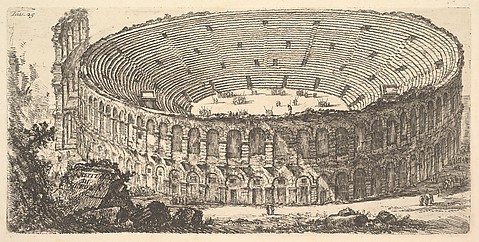
Plate 25: Amphitheater of Verona (Anfiteatro di Verona), from "Alcune Vedute di Archi Trionfali ed altri monumenti inalzati da Romani parte di quali se veggono in Roma e parte per l'Italia" (Some Views of Triumphal Arches and other monuments erected by the Romans, some of which are in Rome and some elsewhere in Italy), Giovanni Battista Piranesi, ca. 1748Giovanni Battista PiranesiPlate 25: Amphitheater of Verona (Anfiteatro di Verona), from "Alcune Vedute di Archi Trionfali ed altri monumenti inalzati da Romani parte di quali se veggono in Roma e parte per l'Italia" (Some Views of Triumphal Arches and other monuments erected by the Romans, some of which are in Rome and some elsewhere in Italy)ca. 1748Metropolitan Museum of Art
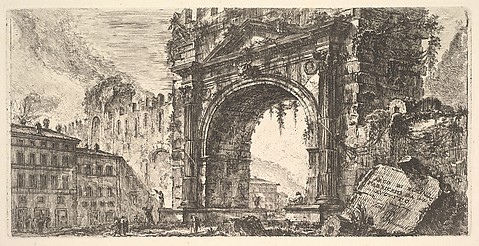
Plate 17: The Arch of Rimini built by Augustus (Arco di Rimino fabbricato da Augusto), from "Alcune Vedute di Archi Trionfali ed altri monumenti inalzati da Romani parte di quali se veggono in Roma e parte per l'Italia", Giovanni Battista Piranesi, ca. 1748Giovanni Battista PiranesiPlate 17: The Arch of Rimini built by Augustus (Arco di Rimino fabbricato da Augusto), from "Alcune Vedute di Archi Trionfali ed altri monumenti inalzati da Romani parte di quali se veggono in Roma e parte per l'Italia"ca. 1748Metropolitan Museum of Art
Plate 19: Part of the ancient Appian Way about three miles outside Porta S. Sebastiano, from "Alcune Vedute di Archi Trionfali ed altri monumenti inalzati da Romani parte de quali se veggono in Roma e parte per l'Italia" (Some Views of Triumphal Arches and other monuments erected by the Romans, some of which are in Rome and some elsewhere in Italy), Giovanni Battista Piranesi, ca. 1748Giovanni Battista PiranesiPlate 19: Part of the ancient Appian Way about three miles outside Porta S. Sebastiano, from "Alcune Vedute di Archi Trionfali ed altri monumenti inalzati da Romani parte de quali se veggono in Roma e parte per l'Italia" (Some Views of Triumphal Arches and other monuments erected by the Romans, some of which are in Rome and some elsewhere in Italy)ca. 1748Metropolitan Museum of Art
Cornice and column from the Temple of Fortuna Virilis (Tempio della Fortuna Virile), from "Le Antichità Romane", Giovanni Battista Piranesi, 1756Giovanni Battista PiranesiCornice and column from the Temple of Fortuna Virilis (Tempio della Fortuna Virile), from "Le Antichità Romane"1756Metropolitan Museum of Art
Title Page, from "Carceri d'invenzione" (Imaginary Prisons), Giovanni Battista Piranesi, ca. 1749–50Giovanni Battista PiranesiTitle Page, from "Carceri d'invenzione" (Imaginary Prisons)ca. 1749–50Metropolitan Museum of Art
Plan of the Mausoleum of Caecilia Metella, wife of the Triumvir Marcus Crassus..., tome 3, tavola 49 from "Le Antichità Romane" (Roman Antiquities), Giovanni Battista Piranesi, published 1756–57Giovanni Battista PiranesiPlan of the Mausoleum of Caecilia Metella, wife of the Triumvir Marcus Crassus..., tome 3, tavola 49 from "Le Antichità Romane" (Roman Antiquities)published 1756–57Metropolitan Museum of Art
The Capitol and the steps of S. Maria in Aracoeli (Veduta del Romano Camipidoglio con scalinata che va alla chiesa d'Araceli), Giovanni Battista Piranesi, ca. 1775Giovanni Battista PiranesiThe Capitol and the steps of S. Maria in Aracoeli (Veduta del Romano Camipidoglio con scalinata che va alla chiesa d'Araceli)ca. 1775Metropolitan Museum of Art
View of the Temple of the Temple of the Sibyl at Tivoli, from Vedute di Roma (Roman Views), Giovanni Battista Piranesi, ca. 1761Giovanni Battista PiranesiView of the Temple of the Temple of the Sibyl at Tivoli, from Vedute di Roma (Roman Views)ca. 1761Metropolitan Museum of Art
View of the Basilica of San Sebastiano fuori delle mura [St. Sebastian ouside the Walls] on the Appian Way, from Vedute di Roma (Roman Views), Giovanni Battista Piranesi, ca. 1750Giovanni Battista PiranesiView of the Basilica of San Sebastiano fuori delle mura [St. Sebastian ouside the Walls] on the Appian Way, from Vedute di Roma (Roman Views)ca. 1750Metropolitan Museum of Art
Plate 7: Ancient altar on which sacrifices were performed in antiquity, surrounded by other ruins (Ara antica sopra la quale si facevano anticamente i sagrifizi, con altre ruine all' intorno), from "Part one of architecture and perspectives: drawn and etched by Gio. Batt'a Piranesi, Venetian Architect: dedicated to Nicola Giobbe" (Prima parte di Architetture, e prospettive inventate, ed incise da Gio. Batt'a Piranesi Architetto Veneziano dedicate al Sig. Nicola Giobbe), Giovanni Battista Piranesi, 1743Giovanni Battista PiranesiPlate 7: Ancient altar on which sacrifices were performed in antiquity, surrounded by other ruins (Ara antica sopra la quale si facevano anticamente i sagrifizi, con altre ruine all' intorno), from "Part one of architecture and perspectives: drawn and etched by Gio. Batt'a Piranesi, Venetian Architect: dedicated to Nicola Giobbe" (Prima parte di Architetture, e prospettive inventate, ed incise da Gio. Batt'a Piranesi Architetto Veneziano dedicate al Sig. Nicola Giobbe)1743Metropolitan Museum of Art
Ancient Roman forum surrounded by porticoes, with loggias, some of which communicate with the Imperial Palace and others with the prisons... (Foro antico romano circondata da portici, con logge, alcune delle quali si uniscono al Palazzo Imperiale...), from "Prima Parte di Architettura, e Prospettive", Giovanni Battista Piranesi, ca. 1750Giovanni Battista PiranesiAncient Roman forum surrounded by porticoes, with loggias, some of which communicate with the Imperial Palace and others with the prisons... (Foro antico romano circondata da portici, con logge, alcune delle quali si uniscono al Palazzo Imperiale...), from "Prima Parte di Architettura, e Prospettive"ca. 1750Metropolitan Museum of Art
The Forum Romanum, or Campo Vaccino, from the Capitol, with the Arch of Septimius in the foreground left, Temple of Vespian right, and the Colosseum in the distance (Veduta di Campo Vaccino), Giovanni Battista Piranesi, ca. 1775Giovanni Battista PiranesiThe Forum Romanum, or Campo Vaccino, from the Capitol, with the Arch of Septimius in the foreground left, Temple of Vespian right, and the Colosseum in the distance (Veduta di Campo Vaccino)ca. 1775Metropolitan Museum of Art
Profile of the Temple of Fortuna Virilis (Profilo del Tempio della Fortuna Virile), and section of the temple, from "Le Antichità Romane", Giovanni Battista Piranesi, 1756Giovanni Battista PiranesiProfile of the Temple of Fortuna Virilis (Profilo del Tempio della Fortuna Virile), and section of the temple, from "Le Antichità Romane"1756Metropolitan Museum of Art
Plate 10: The ancient Capitol ascended by approximately one hundred steps [...] (Campidoglio antico a cui si ascendeva per circa cento gradini [...]), from "Part one of architecture and perspectives: drawn and etched by Gio. Batt'a Piranesi, Venetian Architect: dedicated to Nicola Giobbe" (Prima parte di Architetture, e prospettive inventate, ed incise da Gio. Batt'a Piranesi Architetto Veneziano dedicate al Sig. Nicola Giobbe), Giovanni Battista Piranesi, 1743Giovanni Battista PiranesiPlate 10: The ancient Capitol ascended by approximately one hundred steps [...] (Campidoglio antico a cui si ascendeva per circa cento gradini [...]), from "Part one of architecture and perspectives: drawn and etched by Gio. Batt'a Piranesi, Venetian Architect: dedicated to Nicola Giobbe" (Prima parte di Architetture, e prospettive inventate, ed incise da Gio. Batt'a Piranesi Architetto Veneziano dedicate al Sig. Nicola Giobbe)1743Metropolitan Museum of Art
The tomb of Caecilia Metella, from Vedute di Roma (Roman Views), Giovanni Battista Piranesi, ca. 1762Giovanni Battista PiranesiThe tomb of Caecilia Metella, from Vedute di Roma (Roman Views)ca. 1762Metropolitan Museum of Art
Egyptian decoration of the Caffè degli Inglesi: Animals on the cornice, including a bull at the center, from "Diverse Maniere d'adornare i cammini..." (Diverse Ways of ornamenting chimneypieces...), Giovanni Battista Piranesi, 1769Giovanni Battista PiranesiEgyptian decoration of the Caffè degli Inglesi: Animals on the cornice, including a bull at the center, from "Diverse Maniere d'adornare i cammini..." (Diverse Ways of ornamenting chimneypieces...)1769Metropolitan Museum of Art
Ruins of an ancient tomb in front of ruins of an ancient aqueduct (Ruine di Sepolcro antico posto dinanzi ad altre ruine d'un Aquedotto), from "Prima Parte di Architettura, e Prospettive", Giovanni Battista Piranesi, ca. 1750Giovanni Battista PiranesiRuins of an ancient tomb in front of ruins of an ancient aqueduct (Ruine di Sepolcro antico posto dinanzi ad altre ruine d'un Aquedotto), from "Prima Parte di Architettura, e Prospettive"ca. 1750Metropolitan Museum of Art
A view of part of the intended Bridge at Blackfriars, London, Giovanni Battista Piranesi, ca. 1764Giovanni Battista PiranesiA view of part of the intended Bridge at Blackfriars, Londonca. 1764Metropolitan Museum of Art
The Temple of Vespian (Veduta del Tempio di giove Tonante), Giovanni Battista Piranesi, ca. 1756Giovanni Battista PiranesiThe Temple of Vespian (Veduta del Tempio di giove Tonante)ca. 1756Metropolitan Museum of Art
Interior view of the ancient Temple of Bacchus, now the church of S. Urbano, two miles from Rome..., from Vedute di Roma (Roman Views), Giovanni Battista Piranesi, ca. 1750Giovanni Battista PiranesiInterior view of the ancient Temple of Bacchus, now the church of S. Urbano, two miles from Rome..., from Vedute di Roma (Roman Views)ca. 1750Metropolitan Museum of Art
Chimneypiece: Frieze of trophies and winged Victories on the lintel, with cornucopias to either side of the jambs decorated with varied reliefs (Ch. décorée d'une grecque), from Diverse Maniere d'adornare i cammini ed ogni altra parte degli edifizi...(Different Ways of ornamenting chimneypieces and all other parts of houses), Giovanni Battista Piranesi, ca. 1769Giovanni Battista PiranesiChimneypiece: Frieze of trophies and winged Victories on the lintel, with cornucopias to either side of the jambs decorated with varied reliefs (Ch. décorée d'une grecque), from Diverse Maniere d'adornare i cammini ed ogni altra parte degli edifizi...(Different Ways of ornamenting chimneypieces and all other parts of houses)ca. 1769Metropolitan Museum of Art
Large marble vase decorated with a relief of the sacrifice of Iphigenia, from "Vasi, candelabri, cippi, sarcofagi, tripodi, lucerne, ed ornamenti antichi disegnati ed incisi dal Cav. Gio. Batt. Piranesi, Vol. II" (Vases, candelabra, grave stones, sarcophagi, tripods, lamps, and ornaments designed and etched by Cavalieri Giovanni Battista Piranesi), Giovanni Battista Piranesi, 1778–80Giovanni Battista PiranesiLarge marble vase decorated with a relief of the sacrifice of Iphigenia, from "Vasi, candelabri, cippi, sarcofagi, tripodi, lucerne, ed ornamenti antichi disegnati ed incisi dal Cav. Gio. Batt. Piranesi, Vol. II" (Vases, candelabra, grave stones, sarcophagi, tripods, lamps, and ornaments designed and etched by Cavalieri Giovanni Battista Piranesi)1778–80Metropolitan Museum of Art
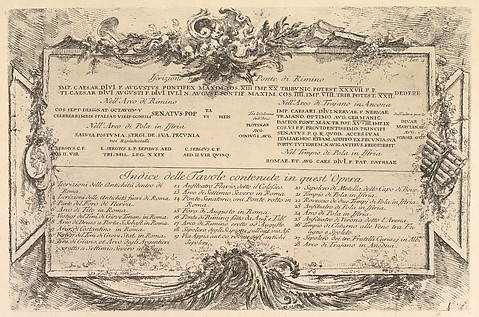
Iscrizione nei lati del Ponte di Rimino (Inscription on the side of the Rimini Bridge) followed by an index of plates in the volume, from "Antichità Romane de' Tempi della Repubblica, e de' primi Imperatori", Giovanni Battista Piranesi, ca. 1748Giovanni Battista PiranesiIscrizione nei lati del Ponte di Rimino (Inscription on the side of the Rimini Bridge) followed by an index of plates in the volume, from "Antichità Romane de' Tempi della Repubblica, e de' primi Imperatori"ca. 1748Metropolitan Museum of Art
View of St. Peter's Basilica and Piazza in the Vatican, from "Vedute di Roma" (Roman Views), Giovanni Battista Piranesi, ca. 1748Giovanni Battista PiranesiView of St. Peter's Basilica and Piazza in the Vatican, from "Vedute di Roma" (Roman Views)ca. 1748Metropolitan Museum of Art
View of the arches of the consuls Dolabella and Silanus enclosed within the Neronian arches of the Acqua Claudia, from "Roman Antiquities" (Le Antichità Romane), Giovanni Battista Piranesi, 1756Giovanni Battista PiranesiView of the arches of the consuls Dolabella and Silanus enclosed within the Neronian arches of the Acqua Claudia, from "Roman Antiquities" (Le Antichità Romane)1756Metropolitan Museum of Art
The Pantheon exterior (Veduta del Pantheon d'Agrippa oggi Chiesa di S. Maria ad Martyres), Giovanni Battista Piranesi, 1720–78Giovanni Battista PiranesiThe Pantheon exterior (Veduta del Pantheon d'Agrippa oggi Chiesa di S. Maria ad Martyres)1720–78Metropolitan Museum of Art
The Piazza di Spagna (Veduta di Piazza di Spagna), Giovanni Battista Piranesi, ca. 1750Giovanni Battista PiranesiThe Piazza di Spagna (Veduta di Piazza di Spagna)ca. 1750Metropolitan Museum of Art
The Piazza del Popolo (Veduta della Piazza del Popolo), from "Vedute di Roma", Giovanni Battista Piranesi, ca. 1750Giovanni Battista PiranesiThe Piazza del Popolo (Veduta della Piazza del Popolo), from "Vedute di Roma"ca. 1750Metropolitan Museum of Art
Colonnaded hall according to the custom of the ancient Romans, and niches adorned with statues (Sala all'uso degli antichi Romani con Colonne, e nicchie ornate di Statue), from "Prima Parte di Architettura, e Prospettive", Giovanni Battista Piranesi, ca. 1750Giovanni Battista PiranesiColonnaded hall according to the custom of the ancient Romans, and niches adorned with statues (Sala all'uso degli antichi Romani con Colonne, e nicchie ornate di Statue), from "Prima Parte di Architettura, e Prospettive"ca. 1750Metropolitan Museum of Art
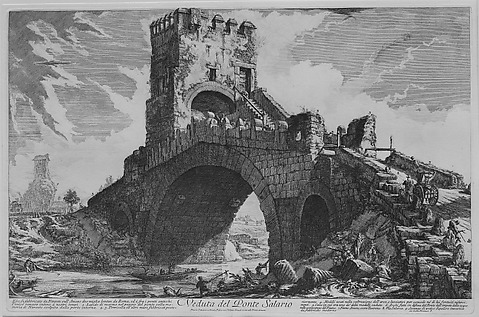
View of the Ponte Salario, from "Vedute di Roma" (Views of Rome), part I, Giovanni Battista Piranesi, ca. 1750–78Giovanni Battista PiranesiView of the Ponte Salario, from "Vedute di Roma" (Views of Rome), part Ica. 1750–78Metropolitan Museum of Art
Demonstration panel showing technique for raising travertine and marble blocks for the construction of the tomb of Cecilia Metella, Rome, from "Le Antichità Romane", Giovanni Battista Piranesi, 1756Giovanni Battista PiranesiDemonstration panel showing technique for raising travertine and marble blocks for the construction of the tomb of Cecilia Metella, Rome, from "Le Antichità Romane"1756Metropolitan Museum of Art
Chimneypiece: Architrave decorated with a Greek key motif and a circular fireback with figures of the zodiac (Ch. décorée d'une grecque), from Diverse Maniere d'adornare i cammini ed ogni altra parte degli edifizi...(Different Ways of ornamenting chimneypieces and all other parts of houses), Giovanni Battista Piranesi, ca. 1769Giovanni Battista PiranesiChimneypiece: Architrave decorated with a Greek key motif and a circular fireback with figures of the zodiac (Ch. décorée d'une grecque), from Diverse Maniere d'adornare i cammini ed ogni altra parte degli edifizi...(Different Ways of ornamenting chimneypieces and all other parts of houses)ca. 1769Metropolitan Museum of Art
137