Carlo CrivelliItalien
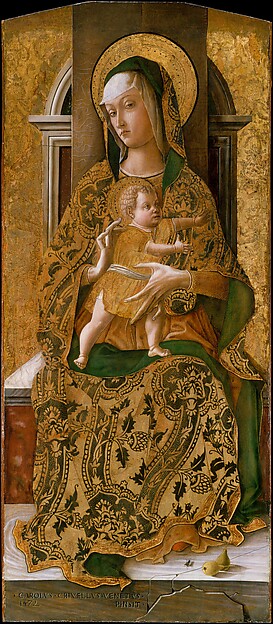
Virgin and Child
Darf man es sehen?
Ja, es empfängt Besucher

Victoria and Albert Museum
London, Vereinigtes Königreich
SaalMedieval & Renaissance, Room 64a, The Robert H. Smith Gallery
Öffentlich ausgestellt. Wer dafür bürgt, steht unten.
- Geprüft
- Unverändert seit
- Quelle
- Sammlungsdaten des Museums selbst
About the painting
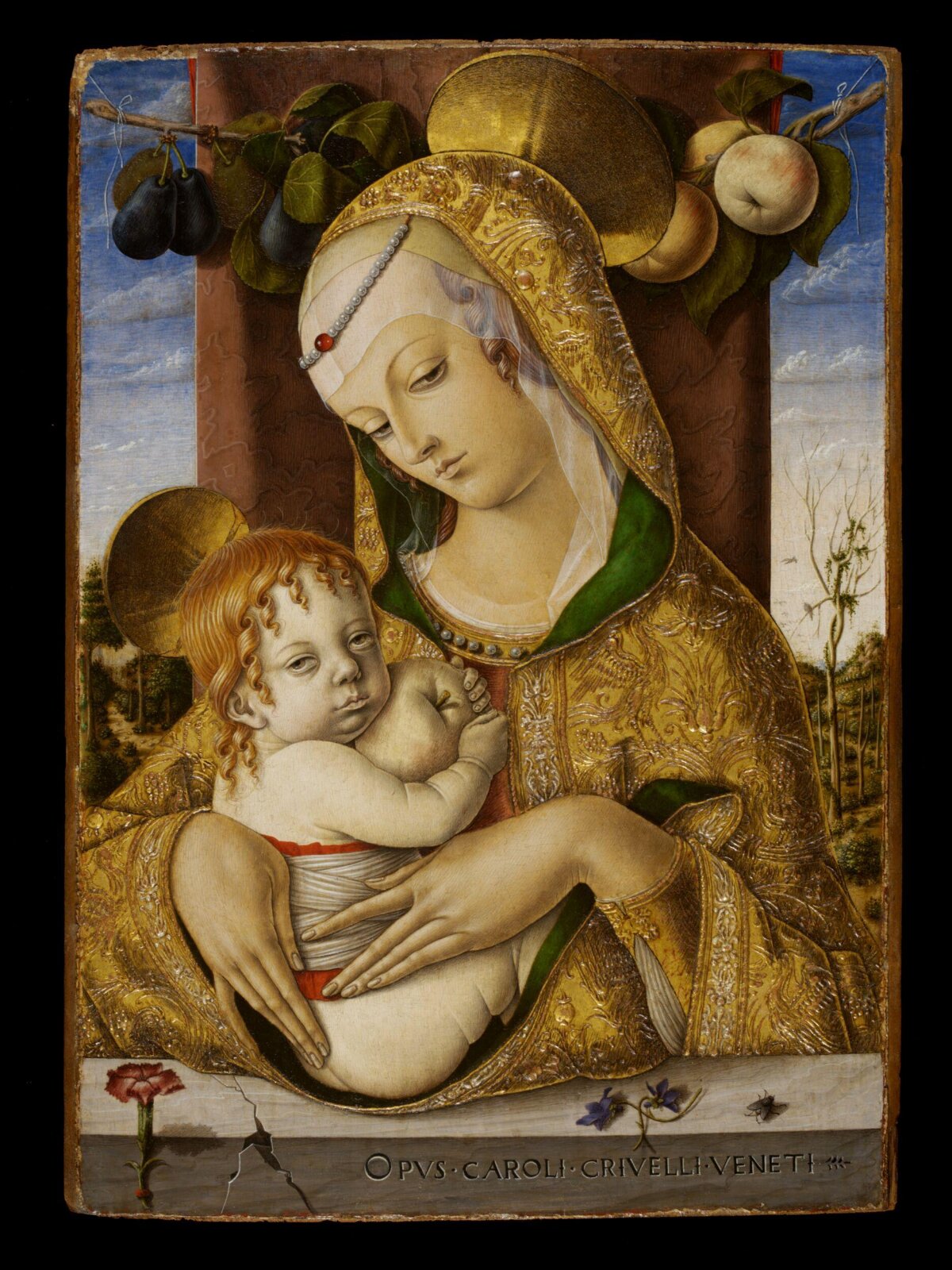
Madonna and Child with an Apple or Madonna and Child Holding an Apple is a tempera and gold on panel painting by Carlo Crivelli, executed c. 1480, now in the Victoria and Albert Museum in London, having entered it as part of the Jones Bequest of 1882 - its previous provenance is unknown. It is signed OPVS CAROLI CRIVELLI VENETI.
Usually placed between the artist's Lenti Madonna and Ancona Madonna and Child in terms of dating, it was produced for private devotion. Several replicas are known - one each in a private collection in Venice (possibly seen by Testi in 1915), the one in the Eugen Bracht Collection in Berlin and later in the Hermann Eissler Collection in Vienna is now in New York (with variations; attributed to the Master of the Brera Predella by Drey in 1927), Museo della Ca' d'Oro in Venice (school of Crivelli with variations).
In the museum's words
Carlo Crivelli (ca. 1430-1495) was probably born in Venice where he may have been the pupil of Jacopo del Fiore or Giambono but his style shows also the influence of the school of Squarcione in Padua, especially his pupils: Mantegna, Marco Zoppo and Giorgio Schiavone. He had to flee Venice quite soon in his career and was living by 1465 in Zara in Dalmatia (now Zadar, Croatia), then a province of the Venetian Republic. By 1483 he had settled in Ascoli Piceno, the largest city in the southern Marches, where he died in 1495.
Read on
This painting is a small devotional picture showing a Madonna and Child embraced, standing before a parapet. The Madonna wears a lavish gilded stucco mantle in the Gothic fashion and stands before a dark red embroidered cloth of honour with on top a swag of fruits. In the background is a distant hilly landscape with green trees on the left and a leafless tree on the right, enlivened by the deep blue hues of the sky. Fruits and flowers in this composition enclose Christian symbolic meanings alluding to the life of Christ and are not therefore mere decorative devices. Pictures of this kind were very popular in the 15th century and appear to constitute an important part of Crivelli’s oeuvre.
Victoria and Albert Museum
Angaben
- Inventarnummer
- 492-1882
What it shows
Im Katalog
Quellen
- Victoria and Albert Museum: the museum's own open data · abgerufen vor 10 Tagen
- Bild: Victoria and Albert Museum — © Victoria and Albert Museum, London