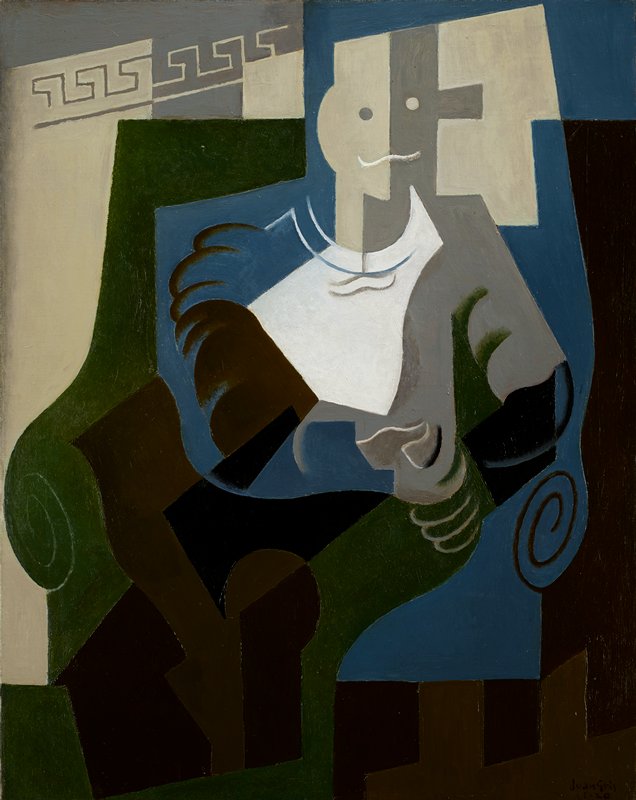
Juan GrisSpanien, 1887–1927
Violin and Fruit-Dish
Darf man es sehen?
Unbekannt

London, Vereinigtes Königreich
Der Besitzer ist bekannt; ob das Werk derzeit ausgestellt ist, nicht.
- Unverändert seit
- Quelle
- Das Museum
Angaben
- Inventarnummer
- NG5935
Im Katalog
Quellen
- Wikidata
- Bild: National Gallery — Juan Gris · Public domain · Wikimedia Commons
Derweil im Leben von Juan Gris
Das ganze Leben1910s–1920s
The pupil Picasso “wished away”
Gris regarded Picasso as a teacher, but according to Gertrude Stein in The Autobiography of Alice B. Toklas, Picasso treated him with undisguised irritation: Gris was the only person Picasso wished away. At first Gris was spoken of only as Picasso’s follower, but when he became an independent artist and one of the leaders of Cubism, Picasso grew jealous.
1922–1924
Working with Diaghilev and the Ballets Russes
From 1922 to 1924 he worked with Sergei Diaghilev and his ballet company; in 1924 he designed sets and costumes for the Ballets Russes.
1923
Major exhibitions in Paris and Berlin
In 1923 major exhibitions of Gris’s work took place at the Galerie Simon in Paris and the Galerie Flechtheim in Berlin.
1924
The Sorbonne lecture “The Possibilities of Painting”
In 1924 he gave his definitive lecture, Des possibilités de la peinture (“The Possibilities of Painting”), to students of the philosophy faculty at the Sorbonne, arguing that no work destined to become classic can look like a work of an earlier period. He articulated most of his aesthetic theories in 1924–25.
1925
An exhibition at Flechtheim’s in Düsseldorf
In 1925 a major exhibition of his work was held at the Galerie Flechtheim in Düsseldorf.
October 1925
Uremia and heart trouble
From October 1925 Gris was frequently ill with bouts of uremia and cardiac problems.