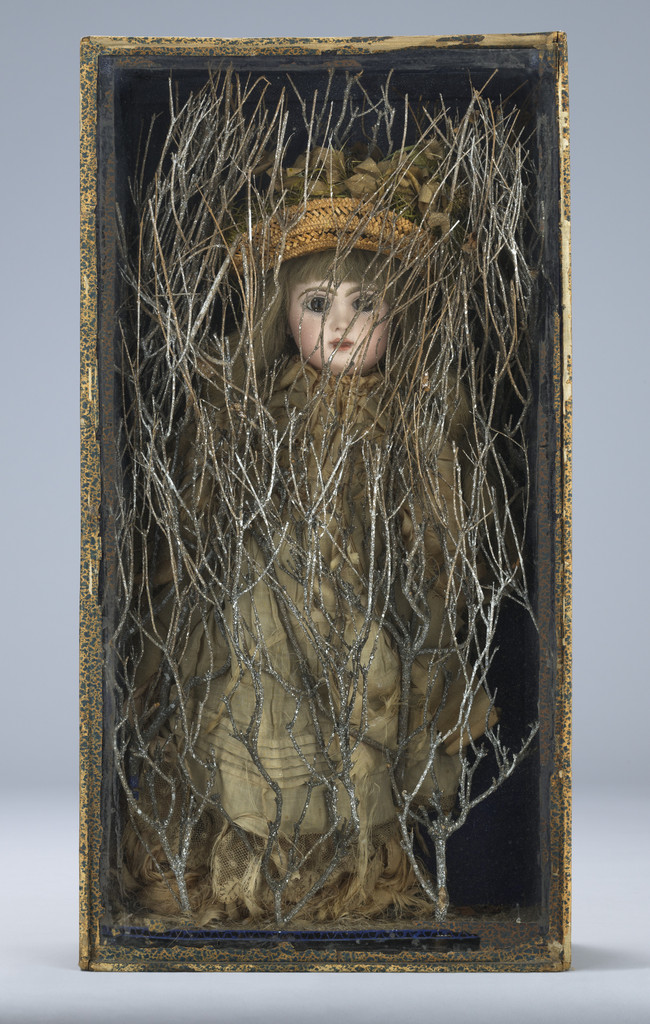
Untitled (Lighted Dancer)
Kann ich es sehen?
Ja, derzeit ausgestellt
Wo ist „Untitled (Lighted Dancer)“ heute? Art Institute of Chicago, Saal 397, Chicago. Ja, derzeit ausgestellt. Geprüft 16. November 2026.

Chicago, Vereinigte Staaten
Geschlossen· öffnet um 11:00
Öffentlich ausgestellt.
- Geprüft
- Unverändert seit
- Quelle
- Das Museum
Über die Skulptur
The subject of this box is the dancer Renee “Zizi” Jeanmaire (b. 1924), whom Cornell met in New York in 1949, when she performed in a ballet adaptation of Bizet’s Carmen, partnered by her husband Roland Petit. (That same year, the Hugo Gallery in New York put on a joint exhibition of Cornell’s work on the Romantic Ballet and of Petit’s ballet productions under the title La Lanterne magique du ballet romantique of Joseph Cornell/Decors for Ballets Choreographed by Roland Petit.) Jeanmaire’s flamboyant performances in Carmen “set a high-water mark in the projection of unabashed sexuality in ballet” (New York, Castelli, Feigen, Corcoran, Joseph Cornell and the Ballet, 1983, exh. cat. by Sandra Leonard Starr, p. 74). Cornell’s diary entries record his passionate involvement in a friendship that was, in fact, one-sided, for Jeanmaire barely recalled him (ibid.).
Mehr lesen
In November of 1949, he noted in his diary “grat [itude]. for Zizi different mood from orig. intensity. Less obsession” (ibid., p. 75), and in the same month had a fantasy about her one night while passing the Winter Garden Theater where she was dancing (ibid., p. 7.5 n. 9). It was, however, as the Princess Aurora in La Belle au bois dormant (Sleeping Beauty), the epitome of the Romantic Ballet, that he chose to depict her, rather than as the fiery Carmen.
Cornell’s use of artificial light, with which he also experimented in some of his bird boxes (see, for example, Untitled (Lighted Bird)), is particularly effective here; the dancer is caught in the spotlight, as if on stage, and the specks of glass and glitter flash in the dim blue light like a sequined costume. As so often in Cornell’s works, the division between the natural and the artificial is erased here, conferring an uncanny character to the scene. The dancer is surrounded not by obvious stage scenery or curtains, but by a large chunk of real tree bark. The viewer has the momentary feeling of looking out from a hole in a tree trunk, like one of Cornell’s owls, onto this moonlit star.
— Entry, Dawn Ades, Surrealist Art: The Lindy and Edwin Bergman Collection at the Art Institute of Chicago, 1997, p. 60.
Art Institute of ChicagoCC BY 4.0
Angaben
- Inventarnummer
- 1982.1841
Im Katalog
Quellen
- Art Institute of Chicago
- Bild: Art Institute of Chicago — © the artist or rights holder