ART WIKI32.979 ausgestellt
KarteSammlungKünstlerMuseenAusstellungenJournal
Anmelden

ART WIKI

Wo das Meisterwerk hängt und wann man vorgelassen wird.

Sammlungen: Art Institute of Chicago, Cleveland Museum of Art, Eremitage, Getty Villa, Harvard Art Museums, Hirshhorn Museum and Sculpture Garden, J. Paul Getty Museum, Louvre, Metropolitan Museum of Art, Minneapolis Institute of Art, Museum of Modern Art, National Gallery of Art, National Museum of Asian Art, National Portrait Gallery, Puschkin-Museum, Rijksmuseum Amsterdam, Russisches Museum, Smithsonian American Art Museum, Statens Museum for Kunst, Tretjakow-Galerie, Victoria and Albert Museum, Whitney Museum of American Art, Staatskatalog des Museumsfonds Russlands (274 Museen), Europeana (19 Museen), Wikidata (6 Museen), Paris Musées (12 Museen) und Joconde, die Museumsdatenbank des französischen Kulturministeriums (495 Museen). Die Bilder gehören ihren Rechteinhabern.

Rubriken

  • Karte
  • Suche
  • Sammlung
  • Meisterwerke
  • Jetzt ausgestellt
  • Künstler

Mehr

  • Museen & Galerien
  • Ausstellungen
  • Journal
  • Woher die Daten stammen
  • Datenschutz & Cookies
StartseiteKarteKatalog
  1. Sammlung/
  2. Art Institute of Chicago/
  3. Untitled (Blue Sand Box)
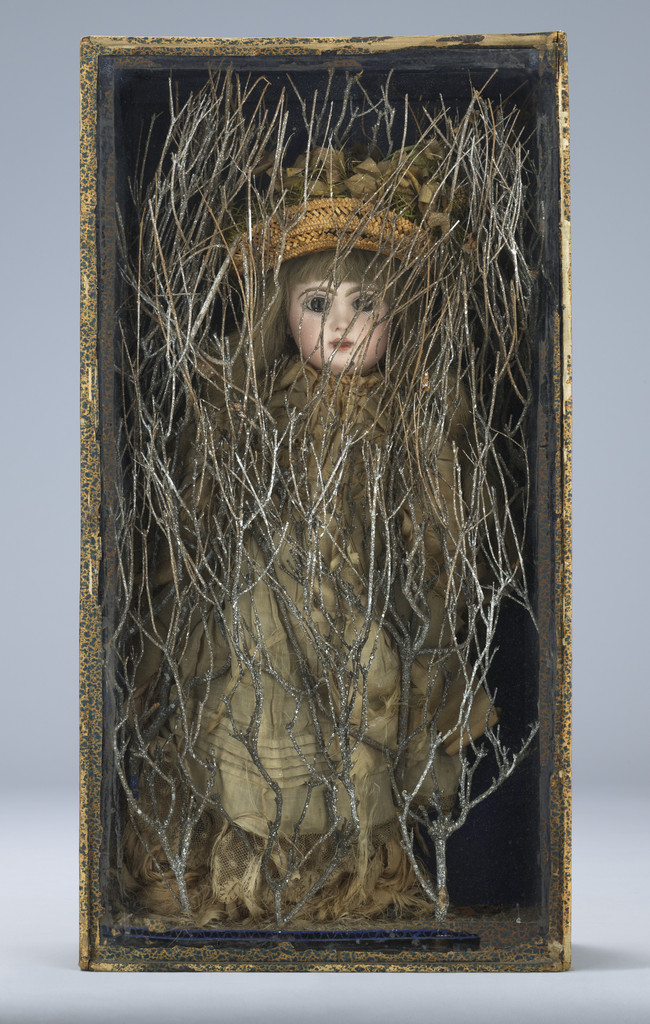
Untitled (Blue Sand Box), Joseph Cornell, early 1950s
JJoseph CornellVereinigte Staaten, 1903–1972

Untitled (Blue Sand Box)

early 1950s · Mixed Media

Darf man es sehen?

Ja, es empfängt Besucher

Art Institute of Chicago

Chicago, Vereinigte Staaten

Saal397

Öffentlich ausgestellt. Wer dafür bürgt, steht unten.

Geprüft
vor 3 Tagen
Unverändert seit
19. Aug. 2026
Quelle
Das Museum
Auf der KarteMuseumsseite

Über das Werk

This box is, like others of its type, designed to be handled; the sand, the metal ring, and the ball scattering into different formations like iron filings or a kaleidoscope. The inside of the box is painted white on all sides; a fine network of cracks suggests that it was artificially aged. As noted in the above media description, sixteen faint lines are etched into the bottom (or rear wall) of the box, radiating from a common center, and resulting in raised lines of white paint on either side of the incisions. An oval form was etched, using the same technique, in the upper right corner. The blue sand forms patterns when shaken that are determined by the raised lines. The three different mobile elements—ring, ball, and sand—make very different sounds as the box is shaken.

Weiterlesen

Cornell mentioned “sand boxes” as early as 1945 in his diary jottings. Significantly, in an entry of October 8, 1945, he referred to two different kinds of objects that are possible sources for these boxes: the “sailor’s box” and the “sand box as discovered in shop—birdhouse that might have [been] tended by her hands” (Cornell 1993, pp. 125–26). It is not entirely evident what he meant by the latter, but the link with the “birdhouse” suggests the sand tray that is customarily placed on the bottom of a bird‘s cage. The sailor’s box was an object of deep resonance for Cornell, with its references to voyages, exotic birds and butterflies, navigation, and treasured keepsakes in general. In a diary note of April 4, 1943, Cornell described an “Exhibition of miscellaneous objects found in trunks of sailors... shells, toy snake, wales [sic] tooth, beads (exotic), a butterfly box” (Cornell Papers, AAA, reel 1058; originally cited in New York 1980–82, pp. 33–34). The Sand Boxes are perhaps like some such treasure salvaged from the bottom of the sea.

— Entry, Dawn Ades, Surrealist Art: The Lindy and Edwin Bergman Collection at the Art Institute of Chicago, 1997, p. 78-79.

Art Institute of Chicago · CC BY 4.0

Angaben

early 1950s
19031972
Inventarnummer
1982.1860

Im Katalog

Nachkriegskunst20. JahrhundertVereinigte Staaten

Quellen

  • Art Institute of Chicago
  • Bild: Art Institute of Chicago — © the artist or rights holder

Mehr von Joseph Cornell

Alle Werke
Untitled (Bébé Marie), Joseph Cornell, early 1940s

Untitled (Bébé Marie)

early 1940s · Museum of Modern Art

Paolo and Francesca, Joseph Cornell, 1943-1948

Paolo and Francesca

1943-1948 · National Gallery of Art

Untitled (Swan Box), Joseph Cornell, c. 1945

Untitled (Swan Box)

c. 1945 · National Gallery of Art

Sand Fountain, Joseph Cornell, 1948

Sand Fountain

1948 · National Gallery of Art

Untitled (Medici Prince), Joseph Cornell, c. 1952

Untitled (Medici Prince)

c. 1952 · National Gallery of Art

Untitled (Medici Prince), Joseph Cornell, c. 1953

Untitled (Medici Prince)

c. 1953 · National Gallery of Art

Untitled (Grand Hotel Bon Port, Ostend Hotel), Joseph Cornell, 1954

Untitled (Grand Hotel Bon Port, Ostend Hotel)

1954 · National Gallery of Art

Les constellations voisines du pôle, Joseph Cornell, 1961

Les constellations voisines du pôle

1961 · National Gallery of Art

Im selben Saal · Gallery 397, Art Institute of Chicago

Museumsseite
Juan Soriano De Lacandón, Leonora Carrington, 1964

Leonora Carrington

Juan Soriano De Lacandón, 1964

Untitled (Butterfly Habitat), Joseph Cornell, c. 1940

Joseph Cornell

Untitled (Butterfly Habitat), c. 1940

Untitled, Balthus, c. 1972

Balthus

Untitled, c. 1972

Untitled (For Trista), Joseph Cornell, c. 1969

Joseph Cornell

Untitled (For Trista), c. 1969

Untitled (Satie and Ravel), Joseph Cornell, March 14, 1968–early September 1969

Joseph Cornell

Untitled (Satie and Ravel), March 14, 1968–early September 1969

The Tiara, Joseph Cornell, 1966/67

Joseph Cornell

The Tiara, 1966/67

Untitled (L'Abeille), Joseph Cornell, April 7, 1966

Joseph Cornell

Untitled (L'Abeille), April 7, 1966

Now, Voyager, Joseph Cornell, 1966

Joseph Cornell

Now, Voyager, 1966