 Egon SchieleÖsterreich, 1890–1918
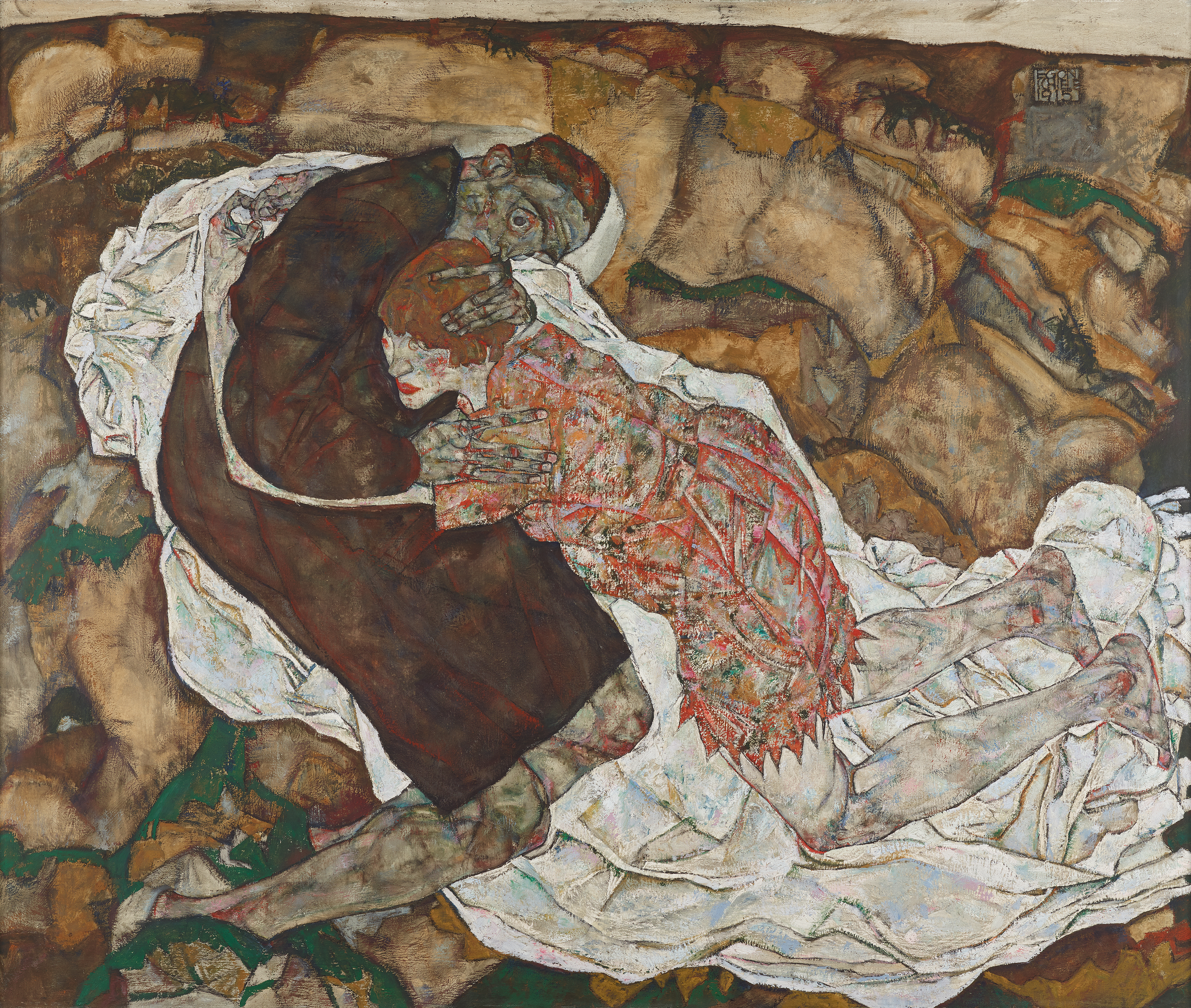
Tod und Mädchen
Darf man es sehen?
Unbekannt

Wien, Österreich
Der Besitzer ist bekannt; ob das Werk derzeit ausgestellt ist, nicht.
- Unverändert seit
- Quelle
- Das Museum
Über das Gemälde
Vergänglichkeit und Tod sind existenzielle Themen, an die sich Schiele immer wieder wagt – hier verbunden mit einer biografischen Episode. Er zeigt ein Paar, mit beiden Armen klammert sich die junge Frau an ihren Geliebten. Der Blick des Mannes, es ist ein Selbstbildnis Schieles, geht ins Leere. Das fragile Gleichgewicht – der Künstler deutet es in der instabilen Haltung der beiden an – scheint jeden Moment zu zerbrechen. Das Mädchen ist seine langjährige Partnerin und sein Modell Wally Neuzil, die er verlassen hat, um die bürgerliche Edith Harms zu heiraten. Neuzil ließ sich nach der Trennung zur Krankenschwester ausbilden und starb 1917 während ihres Kriegseinsatzes an Scharlach.
Österreichische Galerie Belvedere
Angaben
Im Katalog
Quellen
- Österreichische Galerie Belvedere
- Bild: Österreichische Galerie Belvedere — CC BY-SA 4.0
Derweil im Leben von Egon Schiele
Das ganze Leben1912–1916
Success at exhibitions across Europe
In 1912–1916 Schiele took part widely and successfully in exhibitions: his work was shown in Vienna, Budapest, Munich, Prague, Hamburg, Stuttgart, Zurich, Hagen, Dresden, Berlin, Rome, Cologne, Brussels and Paris.
1913
First solo show in Munich
In 1913 the Galerie Hans Goltz in Munich mounted Schiele’s first solo show.
1915
Choosing Edith, and Wally leaves
In 1915 Schiele chose the more socially acceptable Edith, apparently expecting to continue his relationship with Wally; when he explained the situation, Wally left him at once and he never saw her again. In February 1915 he wrote to his friend Arthur Roessler that he intended to get married, advantageously, but not to Wally.
17 June 1915
Marries Edith Harms
Despite some opposition from the Harms family, Schiele and Edith were married on 17 June 1915, the anniversary of the wedding of Schiele’s parents.
20 June 1915
Called up three days after the wedding
Although Schiele had avoided conscription for almost a year, three days after his wedding he was ordered to report for active service: he was first stationed in Prague, where Edith stayed in a hotel while Egon lived in an exhibition hall with his fellow conscripts; his commanding officer allowed them to see each other occasionally.
1917
Transferred to Vienna: art comes first again
In January 1917, having done everything he could to get out of military service, Schiele was transferred to a military supply depot in Vienna and given no particular responsibilities. He was again able to focus on his art, and his output was prolific, reflecting the maturity of an artist in full command of his talents.