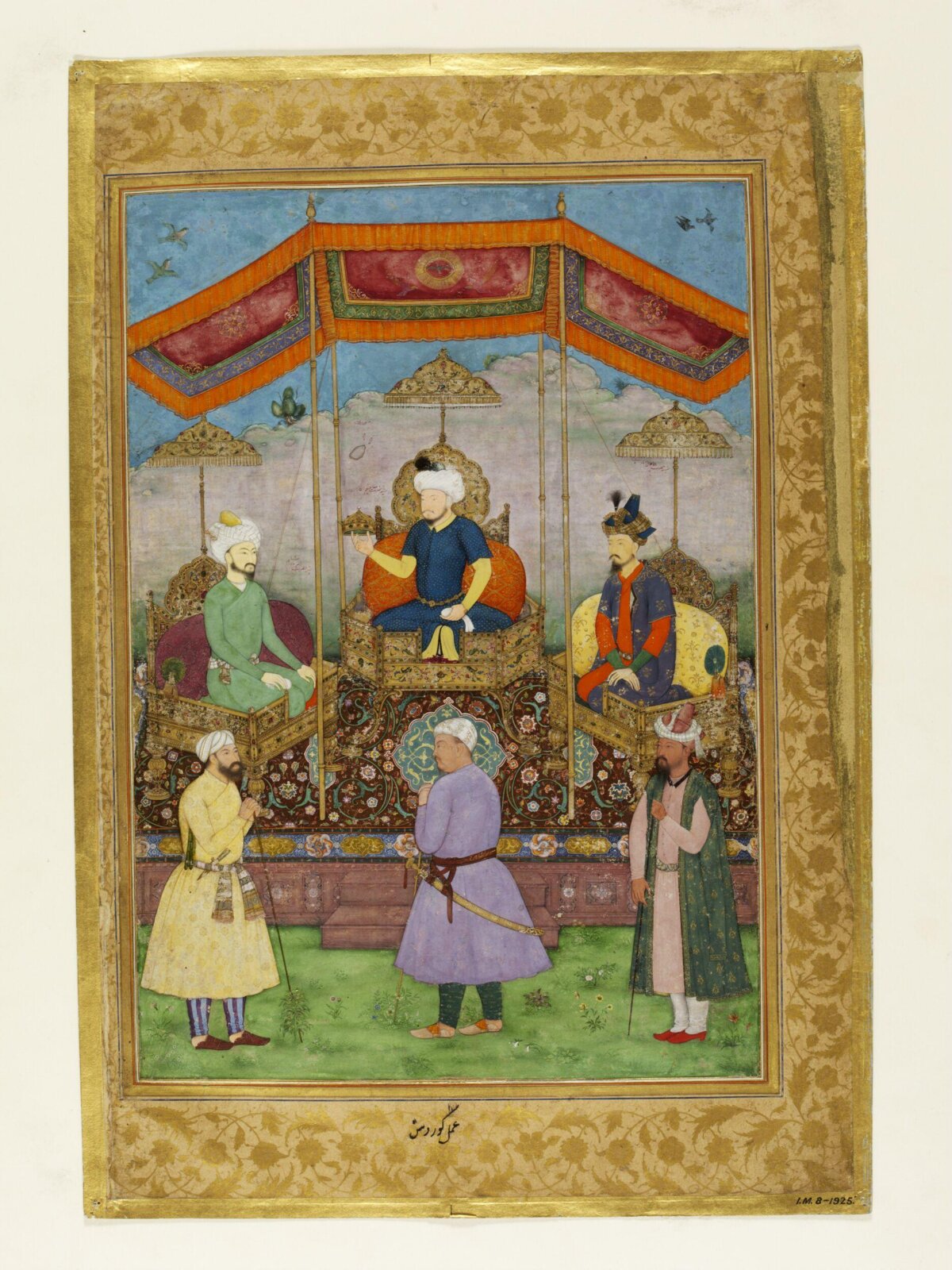
Timur, Babur and Humayun
Kann ich es sehen?
Derzeit nicht ausgestellt
Wo ist „Timur, Babur and Humayun“ heute? Sammlung: Victoria and Albert Museum, London. Derzeit nicht ausgestellt. Geprüft 25. September 2026.

London, Vereinigtes Königreich
Es gehört zur Sammlung, ist derzeit aber nicht ausgestellt.
- Geprüft
- Unverändert seit
- Quelle
- Das Museum
Über das Gemälde
Timur (1336–1405), the Central Asian ruler from whom the Mughals were descended, sits in the centre of this allegorical painting. He hands the imperial crown to the founder of the Mughal dynasty, Babur (r.1526–1530), who is seated to his right. On his left is Babur’s son Humayun, the second Mughal emperor (r.1530–1540 and 1544–1545), who briefly lost the throne and was forced into exile in Iran. All are seated on jewelled thrones beneath parasols, an emblem of royalty. Before them stand their chief ministers, all identified in minuscule Persian inscriptions: on the right is Bayram Khan, with Mirza Shah Rukh and Mirza Rustam in the middle and on the left respectively.
Mehr lesen
An attribution in black ink on the lower border notes that the painting was done by Govardhan, an artist of the imperial Mughal workshop during the reigns of Jahangir (r. 1605-1627) and Shah Jahan (r. 1628-1658). It was probably done to mark Shah Jahan's accession. It came from a group of paintings now divided between the V&A and the Chester Beatty Library in Dublin, popularly known as the ‘Minto Album’ from its association with a former owner, Lord Minto. A companion painting from the same album now in the Chester Beatty Library depicts Akbar, Jahangir and Shah Jahan, the immediate successors of Babur and Humayun, similarly enthroned.
Victoria and Albert Museum
Angaben
- Inventarnummer
- IM.8-1925
Was es zeigt
Im Katalog
Quellen
- Victoria and Albert Museum
- Bild: Victoria and Albert Museum — © Victoria and Albert Museum, London