Auguste RodinFrankreich, 1840–1917
The Walking Man
Darf man es sehen?
Ja, es empfängt Besucher

Harvard Art Museums
Cambridge, Vereinigte Staaten
Saal3200, floor 3, Ancient Mediterranean and Middle Eastern Art
Öffentlich ausgestellt. Wer dafür bürgt, steht unten.
- Geprüft
- Unverändert seit
- Quelle
- Sammlungsdaten des Museums selbst
About the sculpture
Rodin deemed a head and arms to be superfluous to this sculpture; stripped of these, the torso and legs alone express the essential concept of movement. Rodin created many such fragments (that is, sculptures purposefully lacking limbs) as he experimented with simplification and pure forms of expression. He found that by removing “extraneous” elements, he could focus attention on motion as the main feature of a work. Walking Man was assembled from elements of two sculptures Rodin had made earlier in his career. He took studies of legs he had created for a sculpture of St. John the Baptist and united them with an unfinished, rough-surfaced torso crafted for the same project. Rodin wrote how deeply he was inspired by fragmentary Classical sculpture, declaring that “these divine fragments . . . move me more profoundly than living persons.” An avid collector of Classical art, Rodin displayed selections from his antiquities collection alongside his own creations in his home and studio.
Harvard Art Museums
Angaben
- Inventarnummer
- 1943.1148
Im Katalog
Quellen
- Harvard Art Museums: the museum's own open data · abgerufen vor 7 Tagen
- Bild: Harvard Art Museums — © President and Fellows of Harvard College
Derweil im Leben von Auguste Rodin
Das ganze Leben1890s–1900s
Young sculptors in Rodin's studio
His income let him hire gifted young sculptors, among them Antoine Bourdelle, Charles Despiau, Jules Desbois, François Pompon and Aristide Maillol. Constantin Brancusi left after two months, convinced that nothing grows under a big tree.
1897
An album of Rodin's drawings
The industrialist and collector Maurice Fenaille published an album of 147 reproductions of Rodin's drawings in an edition of 125 copies. It sold out at once.
1898
Parts from Camille Claudel
Rodin never gave up Rose Beuret, his companion of the lean years and the mother of his son; in 1898 he and Claudel parted. A few years later Claudel suffered what is called a nervous breakdown, and her family confined her to an institution for thirty years.
1898
The scandal over “Balzac”
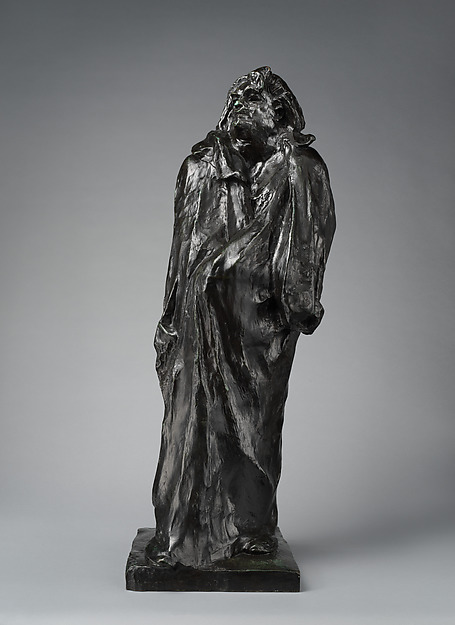
The monument's showing in 1898 caused a storm: the Société des Gens de Lettres rejected it, the press ran parodies, and Monet, Debussy and the future premier Clemenceau signed a manifesto in Rodin's defence. Rodin repaid the commission and moved the statue to his garden; he never completed another public commission.
1900
Rodin's pavilion at the World's Fair
The French government gave him an entire pavilion: a retrospective of 136 sculptures and 14 unfinished works showed “The Gates of Hell” for the first time. The exhibition brought sales of sculptures to museums around the world worth about 200,000 francs.
1900s
Portraits of the famous and the rich
Rodin began to receive regular commissions for portraits; his clients included Bernard Shaw, Gustav Mahler, Georges Clemenceau, the Argentine president Sarmiento, the chemist Berthelot and the philanthropist Bertha Palmer. Clemenceau was displeased: he thought the portrait looked like a “Mongol general”.