Christian Gotfried Jüchtzer
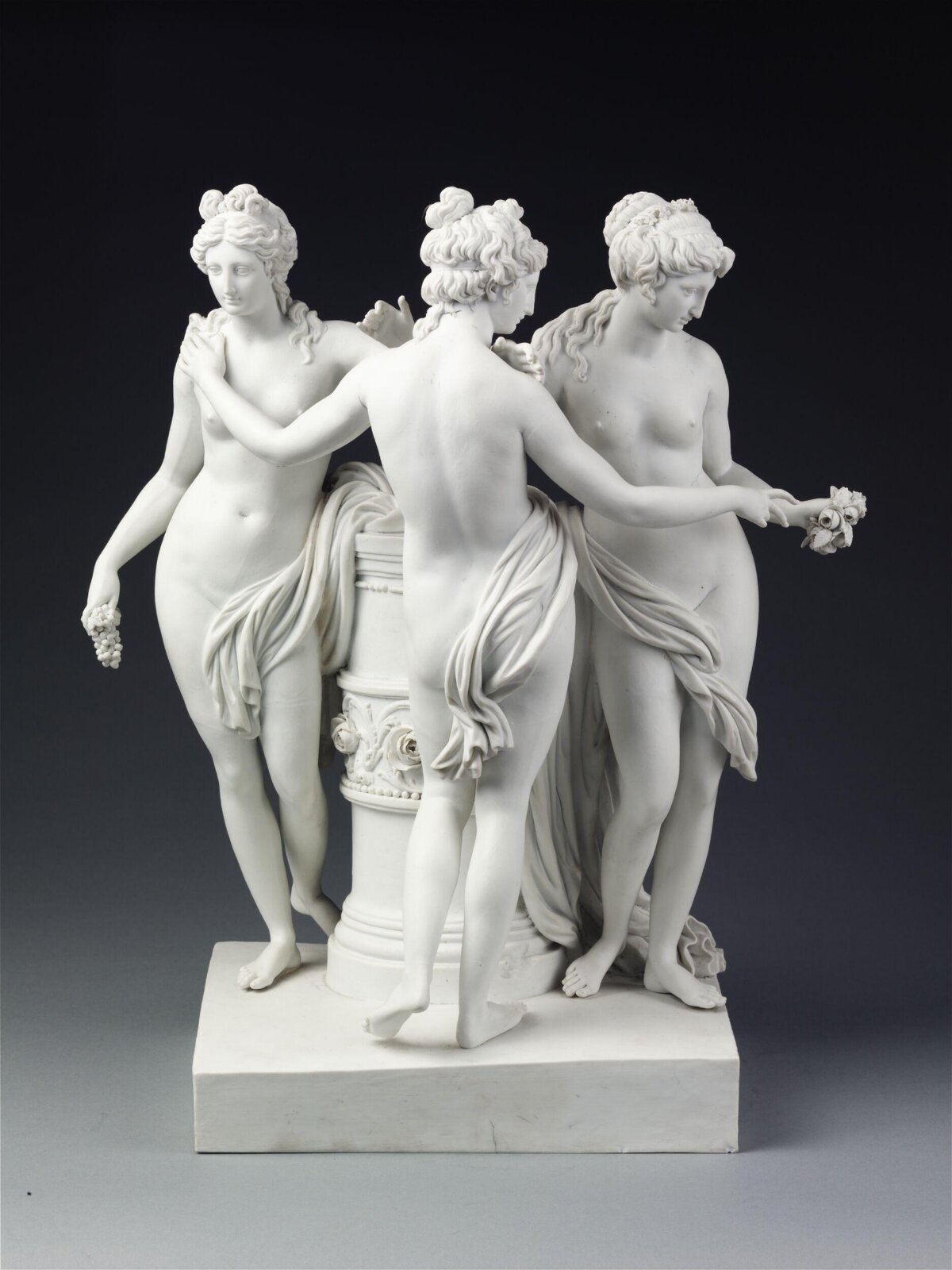
The Three Graces
Darf man es sehen?
Ja, es empfängt Besucher

Öffentlich ausgestellt. Wer dafür bürgt, steht unten.
- Geprüft
- Unverändert seit
- Quelle
- Das Museum
Über die Skulptur
The group depicts the Three Graces from classical Greek mythology, Aglaea, Euphrosne and Thalia, who represent charm, beauty and joy and who were the companions of Aphrodite, Apollo and Athena. The composition is based on classical sculptures and wall painting of this subject. The specific source was probably a sculpture in the collection of Cardinal Borghese in Rome, which was restored in the early seventeenth century with the addition of flowers in the hands of the outer figures (as here), and which was reproduced in a print of 1680 by N. Sandrart. A drawing showing a similar composition, possibly a preliminary design for the group, survives at the Meissen factory. This is dated 1784 and has been attributed to J.E. Schenau, who ran the Meissen drawing school, and more recently to the modeller of this piece, C.N. Jüchtzer.
Weiterlesen
The figure group was entered into the factory’s model book in December 1784, and in the following year Jüchtzer exhibited a biscuit porcelain example at a Dresden art exhibition. By1789 the factory moulds required repair by Jüchtzer, which probably indicates that the model was a popular one and that the moulds had worn out.
Victoria and Albert Museum
Angaben
- Inventarnummer
- C.576-1920
Was es zeigt
Im Katalog
Quellen
- Victoria and Albert Museum
- Bild: Victoria and Albert Museum — © Victoria and Albert Museum, London