 Édouard ManetFrankreich, 1832–1883
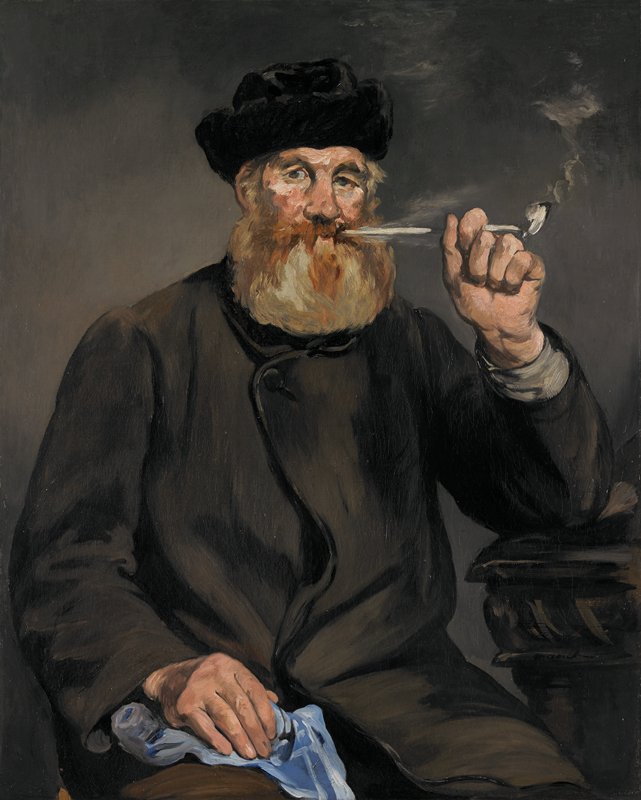
The Smoker
Darf man es sehen?
Ja, derzeit ausgestellt
Wo ist „The Smoker“ heute? Minneapolis Institute of Art, G355, Minneapolis. Ja, derzeit ausgestellt. Geprüft 29. September 2026.

Minneapolis, Vereinigte Staaten
Öffentlich ausgestellt.
- Geprüft
- Unverändert seit
- Quelle
- Das Museum
Über das Gemälde
This working-class character was one of many ordinary Parisians painted by Manet in the 1860s. A year before making this portrait, Manet had traveled to Madrid, Spain, where he was reportedly enchanted by the naturalistic depictions of common people painted by Diego Velásquez in the 1600s. Manet emulated the Spanish master in his own series of everyday scenes while adding a modern twist: elevating the images to the impressive scale of a formal portrait.
This is a Louis XIV revival frame from the nineteenth century, a Gift of the Douglas and Mary Olson Frame Acquisition Fund. Frames of this style are characterized by their leaf and floral motif. Here these sculptural elements appear to be growing and reaching beyond the frame.
Minneapolis Institute of Art
Angaben
- Inventarnummer
- 68.79
Im Katalog
Quellen
- Minneapolis Institute of Art
- Bild: Minneapolis Institute of Art — public domain
Derweil im Leben von Édouard Manet
Das ganze Leben1865
“Olympia” at the Salon: a scandal
In 1865 the Salon accepted “Olympia”, and the frank depiction of a self-assured prostitute created a scandal; according to Antonin Proust, only the precautions taken by the administration prevented the painting from being punctured and torn. The popular press caricatured it, while the avant-garde, including Courbet, Cézanne and Monet, championed it.
after 1865
Café Guerbois and the Batignolles group
After returning from Spain Manet became a regular at the Café Guerbois in the Batignolles quarter, where Fantin-Latour, Whistler, Duranty, Degas, Renoir, Monet and Pissarro gathered, with Émile Zola as Manet's ardent defender. After harsh reproaches from Duranty, Manet challenged him to a duel and wounded him, but they made up and remained good friends until Manet's death.
1865
Flight to Spain: El Greco, Velázquez, Goya
The persecution after “Olympia” forced Manet to flee, almost literally, to Spain, where he spent his time to good purpose, getting to know the works of El Greco, Velázquez and Goya and finding in them a justification of his own aesthetic taste.
1867
His own pavilion near the Pont de l'Alma
In 1867, during the World's Fair in Paris, Manet set up his own pavilion near the Pont de l'Alma and showed fifty of his best works of the past ten years. Possibly this step led to his works being accepted at the next two Salons.
1867
Zola defends Manet in print
In 1867 Émile Zola, who supported Manet publicly in the press, wrote that the public was not accustomed to such simple and direct translations of reality and that this luminous and serious painting interprets nature with a gentle brutality.
1868
Friendship with Berthe Morisot
In 1868 Manet became a friend and colleague of Berthe Morisot; she is credited with convincing him to attempt plein air painting, to which Camille Corot had introduced her. Through Morisot, Manet became friends with Degas, Monet, Renoir, Sisley, Cézanne and Pissarro.