 Thomas Hart BentonVereinigte Staaten, 1889–1975
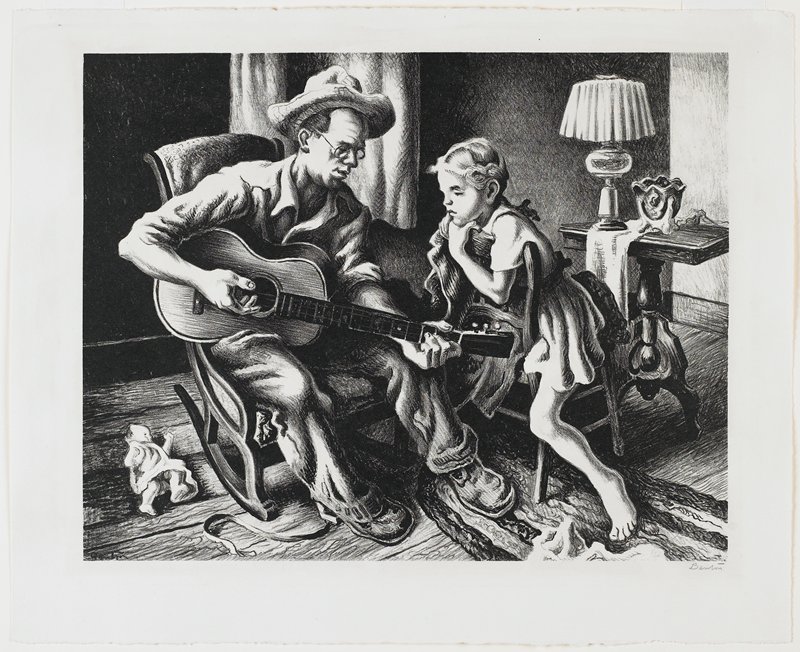
The Music Lesson
Kann ich es sehen?
Derzeit nicht ausgestellt
Wo ist „The Music Lesson“ heute? Sammlung: Minneapolis Institute of Art, Minneapolis. Derzeit nicht ausgestellt. Geprüft 29. September 2026.

Minneapolis, Vereinigte Staaten
Es gehört zur Sammlung, ist derzeit aber nicht ausgestellt.
- Geprüft
- Unverändert seit
- Quelle
- Das Museum
Über das Werk
A gifted draftsman, Thomas Hart Benton adopted lithography as his principal printmaking medium, its autographic qualities offering the same expressive possibilities as drawing. In the Music Lesson, Benton portrays celebrated folksinger E. Gale Huntington (1902-1993) teaching his young daughter a song on the guitar. Huntington was a local fixture on Martha’s Vineyard, a Massachusetts island near Cape Cod where Benton summered for some 50 years.
Minneapolis Institute of Art
Angaben
- Inventarnummer
- P.98.28.1
Im Katalog
Quellen
- Minneapolis Institute of Art
- Bild: Minneapolis Institute of Art — © T.H. and R.P. Benton Testamentary Trusts / Licensed by VAGA at Artists Rights Society (ARS), NY
Im Leben von Thomas Hart Benton
Das ganze Leben1929–1974
92 lithographs, 1929–1974
From 1929 to 1974 Benton produces 92 lithographs in editions ranging from 2 to 500; the signed, limited-edition lithographs are sold at five dollars each through the Associated American Artists Galleries in New York.
1935–1941
Employed by: Kansas City Art Institute
1939–1944
Illustrates Twain and Steinbeck
Creates illustrations for Mark Twain's “Tom Sawyer” (1939), John Steinbeck's “The Grapes of Wrath” (1940), Twain's “Huckleberry Finn” (1941) and “Life on the Mississippi” (1944).
1942
A harmonica album for Decca Records
An accomplished harmonica player, he records the album “Saturday Night at Tom Benton's” for Decca Records.
1944
In the film series “Passing Parade”
Appears in an episode of John Nesbit's Passing Parade titled “Grandpa Called It Art”, which shows several contemporary artists at work; Benton demonstrates his process for the camera, from obtaining a farmer's permission to sketch his farm through making a three-dimensional model of the scene to the final painting.
after 1945
Regionalism falls from favor
After the war Regionalism falls from favor, eclipsed by the rise of Abstract Expressionism; Benton remains active for another 30 years, but his work contains less contemporary social commentary and portrays pre-industrial farmlands.