Pierre-Auguste RenoirFrankreich, 1841–1919
The Laundress
Kann ich es sehen?
Ja, derzeit ausgestellt
Wo ist „The Laundress“ heute? Art Institute of Chicago, Saal 201, Chicago. Ja, derzeit ausgestellt. Geprüft 29. September 2026.

Chicago, Vereinigte Staaten
Geschlossen· öffnet morgen um 11:00
Öffentlich ausgestellt.
- Geprüft
- Unverändert seit
- Quelle
- Das Museum
Über das Gemälde
Pierre-Auguste Renoir’s model for The Laundress was Nini Lopez, whom he painted regularly between 1874 and 1880 in his scenes of modern life. He made this canvas shortly after completing the illustrations for Émile Zola’s L’Assommoir (The Drunkard), a gritty novel about the downfall of a laundress in the brutal and degrading world of working-class Paris. Unlike those illustrations , this painting lacks any portrayal of backbreaking labor or social oppression. Renoir chose instead to visually reference the 19th-century stereotype of laundresses being promiscuous, signaled in this and other contemporary depictions of such figures by the sleeve slipping off the shoulder. This young woman appears artfully disheveled and rosy-cheeked as she tends to the laundry in her affluent employer’s home, standing next to a basket of linens and a stove used to heat irons.
Art Institute of ChicagoCC BY 4.0
Angaben
Was es zeigt
Im Katalog
Quellen
- Art Institute of Chicago
- Bild: Wikimedia Commons — Public domain (PD-Art)
Im Leben von Pierre-Auguste Renoir
Das ganze Leben1876
Second Impressionist exhibition
Hoping to secure an income from portrait commissions, Renoir showed mainly portraits at the second Impressionist exhibition.
1879
Triumph at the Salon of 1879
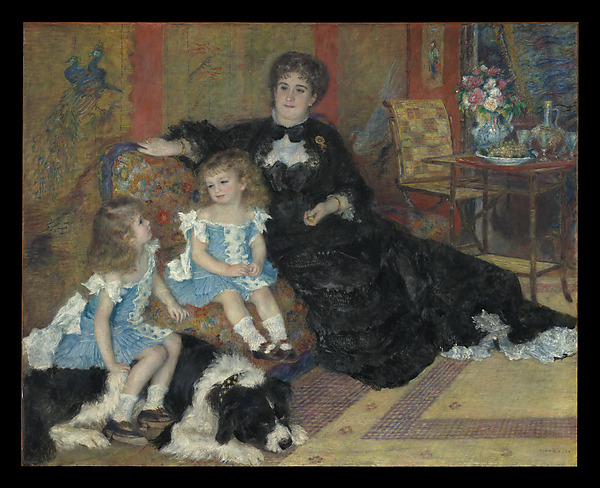
Presenting "Portrait of Madame Charpentier and Her Children" and the full-length "Portrait of the Actress Jeanne Samary," Renoir won universal recognition, and with it financial independence.
1880
Meeting Aline Charigot
Renoir met the young seamstress Aline Charigot — his future wife. His happiness with her colored the works of his so-called "Ingres" period.
1881
Algeria, Madrid, Italy
Renoir traveled to Algeria, the land of Delacroix, then to Madrid to see the works of Velázquez, and to Italy, where he saw Titian in Florence and Raphael in Rome. The journey convinced him that with Impressionism he had "reached the limit," and turned him toward classicism.
6. Juli 1881
Daughter born: Lucienne Bisson