Thomas Armstrong
The Hay Field
Darf man es sehen?
Ja, es empfängt Besucher

Victoria and Albert Museum
SaalStair LLondon, Vereinigtes Königreich
Öffentlich ausgestellt. Wer dafür bürgt, steht unten.
- Geprüft
- Unverändert seit
- Quelle
- Sammlungsdaten des Museums selbst
About the painting
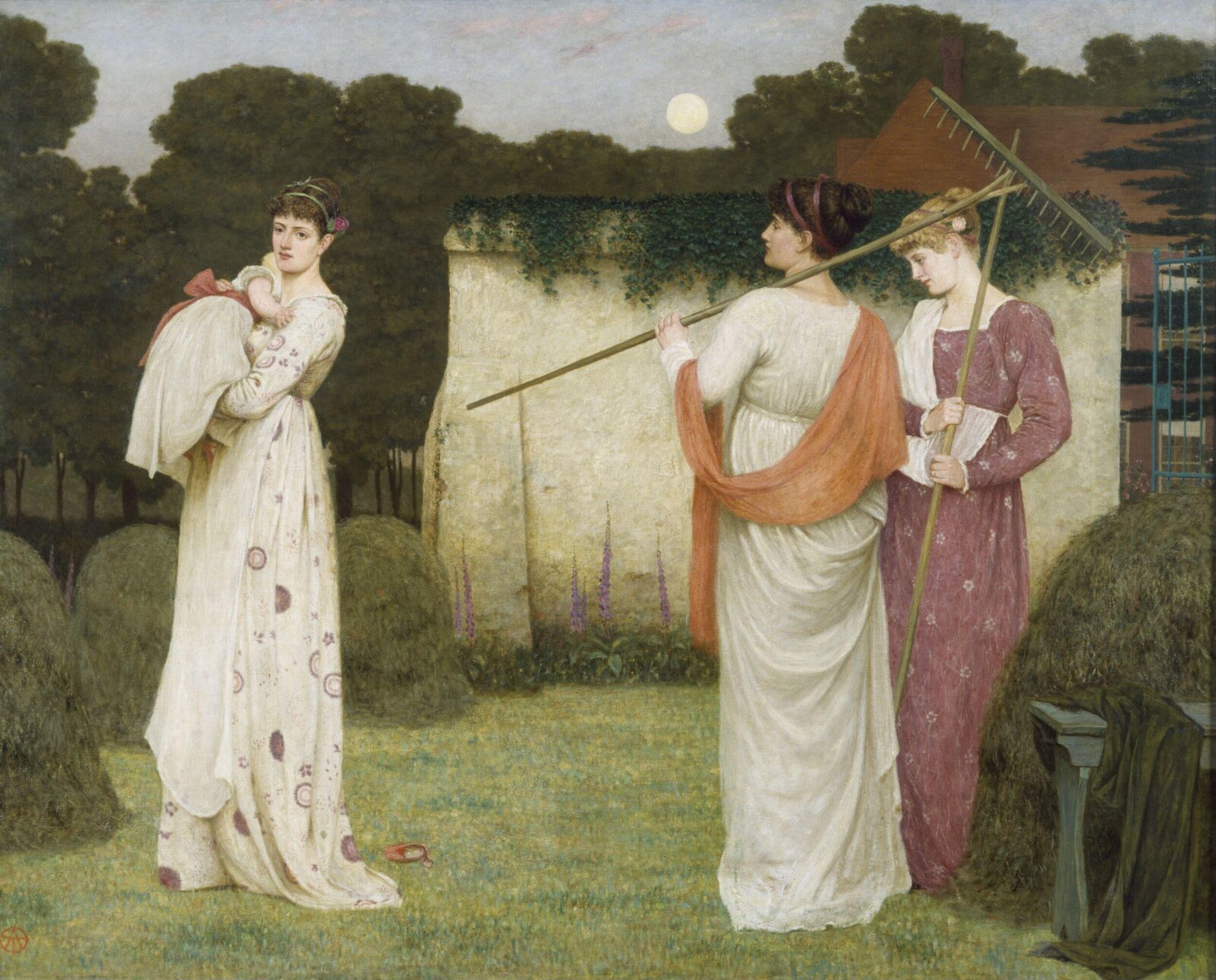
The Hay Field is an 1869 genre painting by the British artist Thomas Armstrong. Armstrong had studied in Paris under Ary Scheffer. Initially associated with the realist movement, this work reflects the influence of the Aesthetic Movement on his style. The three poised haymakers reflect a romanticised view of the rural ideal and may make referee to the Three Graces.
The painting was displayed at the Royal Academy Exhibition of 1869 at Burlington House in Piccadilly. Today it is in the collection of the Victoria and Albert Museum in South Kensington, having come into its possession in a 1917 bequest.
In the museum's words
Thomas Armstrong (1832-1911) undertook his early training as a painter in Paris. While studying at the studio of Ary Scheffer, he spent the evenings at the famous Académie Suisse. In 1854 he also spent time in the artists' colony at Barbizon, where he made the acquaintance of Millet. After a brief period of study in Antwerp, Armstrong returned to Paris where he began life-long friendships with George Du Maurier, Edward John Poynter and James Whistler. In 1860 he returned to London where he continued to work as a painter until 1881 when he was appointed Director of the Art Division of the Department of Science and Art, based at the South Kensington Museum. This role gave him responsibility for the organisation and supervision of art education throughout Britain.
Read on
This painting was exhibited at the Royal Academy in 1869 and is typical of the work produced by Armstrong in the 1860's. His early work focused on themes of social deprivation but in 1860 he joined the circle of painters associated with the emergent Aesthetic Movement. Like artists such as Myles Birkett Foster, Armstrong here romanticises rural life and the female agricultural labourer to create a harmonious figurative picture. His languid beauties invoke a Classical and 'Aesthetic' ideal - the three Graces perhaps - disposed in a frieze-like composition, and dressed in Greek-style costumes with ribbon-bound hair. The colours and the mood of the picture are close to Pre-Raphaelite painting, and the women themselves recall the figures in the pseudo-classical fantasies of Albert Moore or Alma-Tadema.
Victoria and Albert Museum
Angaben
- Inventarnummer
- P.9-1917
What it shows
Im Katalog
Quellen
- Victoria and Albert Museum: the museum's own open data · abgerufen vor 10 Tagen
- Bild: Victoria and Albert Museum — © Victoria and Albert Museum, London







