 Félix Edouard VallottonFrankreich, 1865–1925
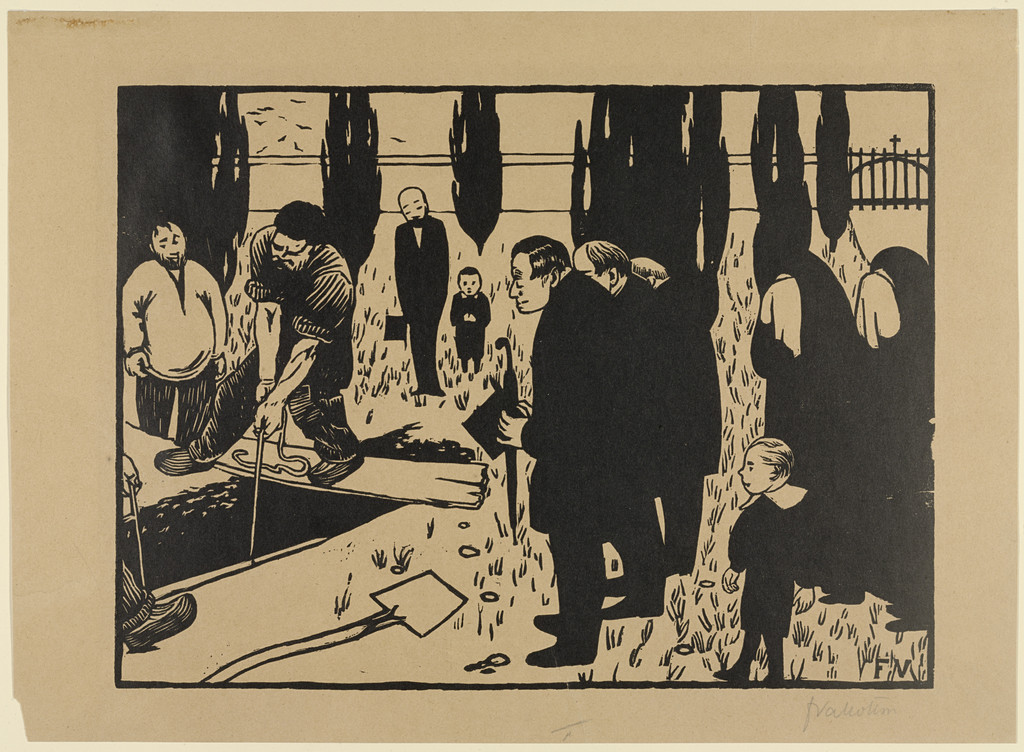
The Funeral
Kann ich es sehen?
Derzeit nicht ausgestellt
Wo ist „The Funeral“ heute? Sammlung: Museum of Modern Art, New York City. Derzeit nicht ausgestellt. Geprüft 22. September 2026.

New York City, Vereinigte Staaten
Es gehört zur Sammlung, ist derzeit aber nicht ausgestellt.
- Geprüft
- Quelle
- Das Museum
Angaben
- Inventarnummer
- 389.1962
Im Katalog
Quellen
- Museum of Modern Art
- Bild: Museum of Modern Art — © the artist or rights holder
Im Leben von Félix Edouard Vallotton
Das ganze Leben1889
The Exposition Universelle and the discovery of Hokusai
Vallotton showed several paintings at the Paris Exposition Universelle, and there he saw the gallery of Japanese prints, particularly Hokusai, which would strongly influence his work; he also collected such prints himself.
1889
Typhoid, depression and a rest in Zermatt
Poverty (his father's firm was struggling and could no longer support him), typhoid fever and then depression wore Vallotton down; in 1889 he went back to Zermatt in Switzerland for several weeks to recover, and painted several Alpine landscapes there.
1889
Meets Hélène Chatenay
Vallotton met Hélène Chatenay, who worked in a Swiss factory or shop; she became his companion for ten years.
1891
Leaves the Salon for the Indépendants
Showing at the official Salon des Artistes for the last time, Vallotton exhibited six paintings at the avant-garde Salon des Indépendants for the first time. Commissions from Swiss patrons began to arrive at the same time.
1892
“The Foreign Nabi” and friendship with Vuillard
Among the Nabis — Bonnard, Roussel, Maurice Denis — Vallotton found a lifelong friend in Édouard Vuillard; he kept a little apart from the others, earning the jocular title of “the Foreign Nabi”.
1893–1897
Woodcuts for La Revue Blanche; the Natansons' patronage
His woodcuts brought Vallotton clients and financial security: he illustrated leading French periodicals, including La Revue Blanche, and foreign ones such as The Chap-Book of Chicago, and cut covers for theatre programmes and book illustrations. Thadée Natanson, publisher of La Revue Blanche, and his wife Misia became his patrons and introduced him to the Paris avant-garde elite — Mallarmé, Proust, Satie and Debussy.