 Honoré DaumierFrankreich, 1808–1879
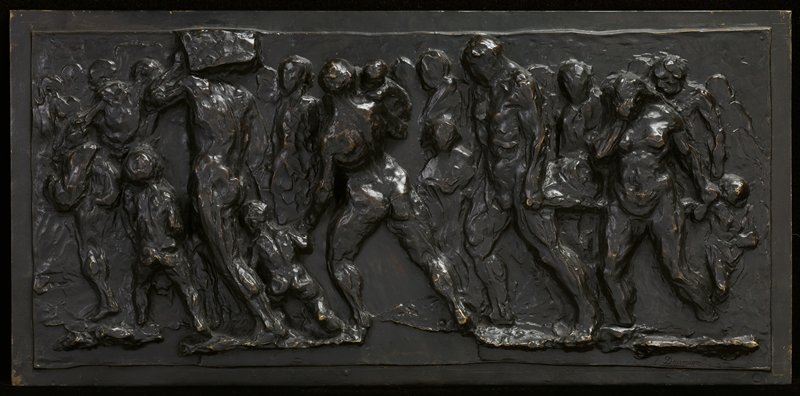
The Fugitives
Darf man es sehen?
Ja, es empfängt Besucher

Minneapolis Institute of Art
SaalG354Minneapolis, Vereinigte Staaten
Öffentlich ausgestellt. Wer dafür bürgt, steht unten.
- Geprüft
- Unverändert seit
- Quelle
- Sammlungsdaten des Museums selbst
About the sculpture
The bas-relief sculpture is one of Daumier's earliest expressions of the theme of exile, which he explored frequently between 1848 and 1870. Although possibly inspired by the Polish Revolution or the 1848 insurrection in France, the precise subject remains unknown. This bronze comes from an original edition of five produced in November 1893 by the Siot-Decauville firm. Daumier's painting, The Fugitives, was his last and most dramatic rendering of the refugee theme and might refer to events surrounding the onset of the Franco-Prussian war, or to the insurrection of the commune in France in 1870. Daumier was less interested in depicting specific events than in responding to the depth of human suffering caused by these events.
Minneapolis Institute of Art
Angaben
- Inventarnummer
- 56.31
Im Katalog
Quellen
- Minneapolis Institute of Art: the museum's own open data · abgerufen vor 6 Tagen
- Bild: Minneapolis Institute of Art — public domain
Derweil im Leben von Honoré Daumier
Das ganze Leben1848
Sketch "The Republic" Among Competition Finalists
On Courbet's advice, Daumier submitted an oil sketch, "The Republic" (now in the Musée d'Orsay), to the competition for an allegory of the new Republic; it was very well received and was among the twenty finalists, but Daumier never executed the finished painting.
1848
Albums on the Revolution of 1848
The Revolution of 1848 provided the material for two of Daumier's albums, "Parliamentary Idylls" and "The Representatives Represented"; he once again launched a political campaign in the pages of Le Charivari.
1849
First Participation in the Salon
In 1849 Daumier exhibited at the Salon for the first time, showing the painting "The Miller, His Son, and the Donkey"; from the late 1840s he devoted himself increasingly to painting.
1849
State Commission for a Painting
Through the Academy of Fine Arts, Daumier received a commission from the Ministry of the Interior for a painting worth 1,000 francs (later increased to 1,500). He never painted the picture, though he drew advances, and only in 1863 did he deliver to the state the gouache "The Drunkenness of Silenus" (1849).
1852
Baudelaire on Daumier in a Collection of Essays
Baudelaire contributed to a collection of essays published in 1852 celebrating Daumier's lithographs and prints, calling him "one of our leading men not only in caricature but in modern art."