 Balthasar PermoserDeutschland, 1651–1732
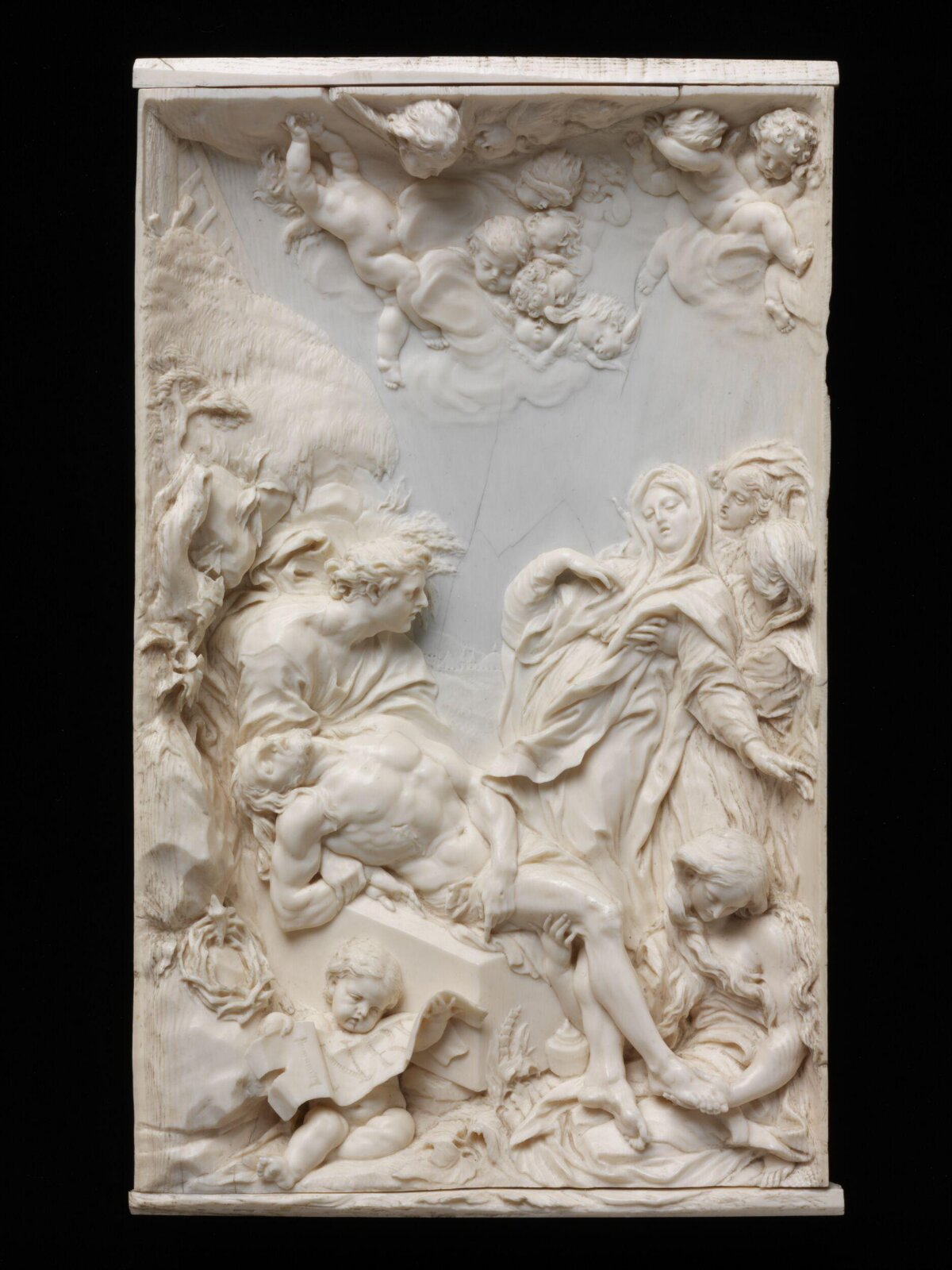
The Entombment
Darf man es sehen?
Ja, es empfängt Besucher

Victoria and Albert Museum
London, Vereinigtes Königreich
SaalSculpture, Room 111, The Gilbert Bayes Gallery
Öffentlich ausgestellt. Wer dafür bürgt, steht unten.
- Geprüft
- Unverändert seit
- Quelle
- Sammlungsdaten des Museums selbst
About the sculpture
Throughout the ages artists and craftsmen have made virtuoso carvings as a display of their skill and ingenuity. Although ivory, wood and stone are relatively easy to carve, other materials such as gemstones are much more demanding. Most of these carvings were made for wealthy patrons and collectors, who delighted in the rarity of the material and quality of the carving. Balthasar Permoser(1651-1732) was famous for his monumental sculpture, but he also worked on a more intimate scale. He was among the foremost sculptors of the late Baroque period in Germany. This ivory exemplifies his sensitive carving, in particular the swooning Virgin falling away from the figure of the dead Christ. The concave top of the relief reflects the shape of the ivory tusk. In terms of subject matter, he executed both profoundly religious works, and elegant pieces of a purely secular nature.
Read on
He trained initially in Salzburg and in 1671 went to Vienna, where he is likely to have studied ivory carving. He visited Rome in 1674-5, and in about 1677 entered the service of the Medici in Florence in the sculpture workshops run by Giovanni Battista Foggini (1652-1725). Some of his ivory figure groups were later reproduced in porcelain by the Doccia, Fürstenberg and Meissen manufactories. In 1690 he moved to Dresden to work at the court of the Elector of Saxony, and remained there for the rest of his life, apart from a spell in Berlin, where he collaborated with Andreas Schlüter (c. 1659-1714) on the Berliner Schloss.
Victoria and Albert Museum
Angaben
- Inventarnummer
- A.30-1949
What it shows
Im Katalog
Quellen
- Victoria and Albert Museum: the museum's own open data · abgerufen vor 11 Tagen
- Bild: Victoria and Albert Museum — © Victoria and Albert Museum, London