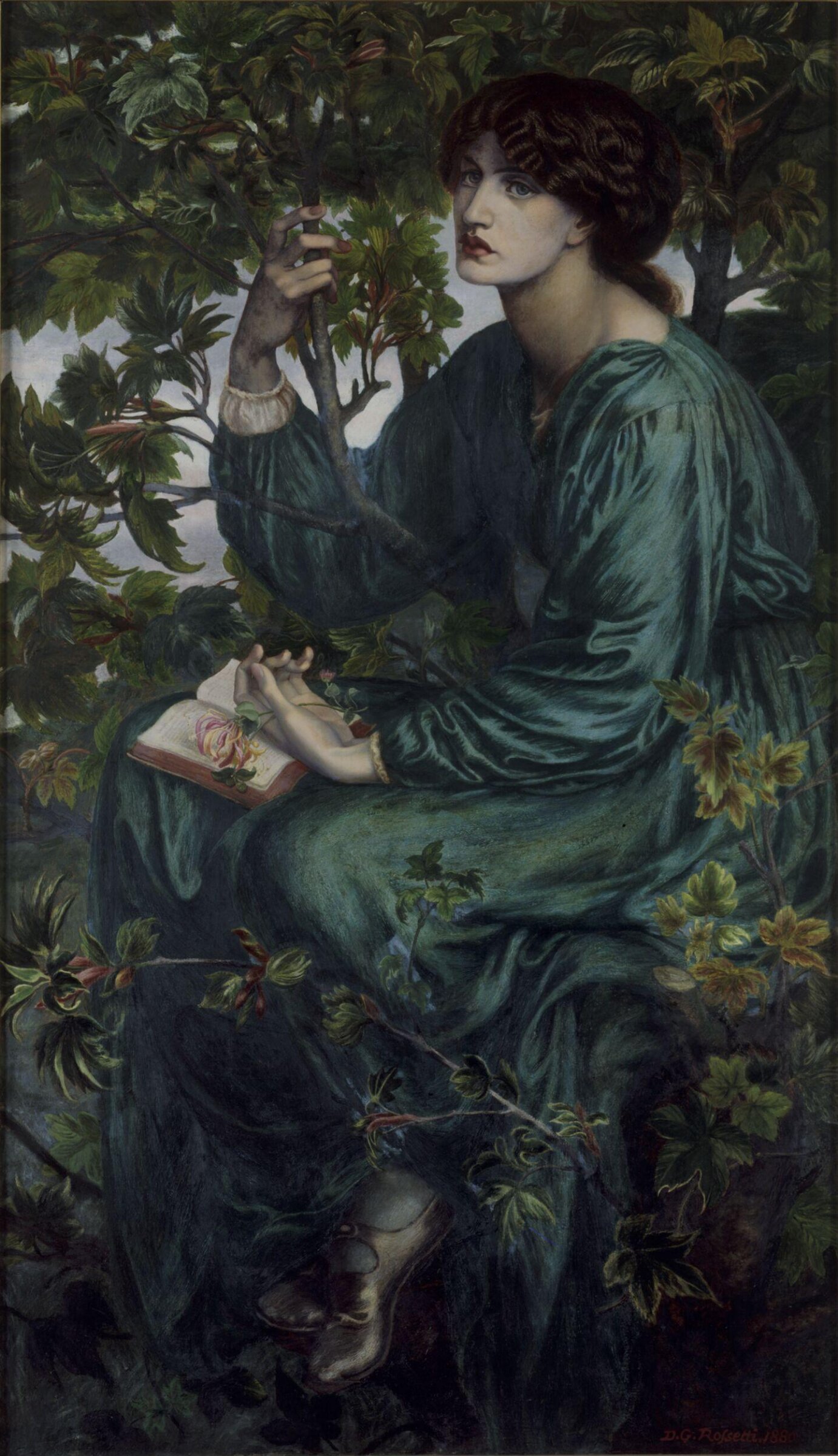
Dante Gabriel RossettiEngland, 1828–1882
The Blessed Damozel
Kann ich es sehen?
Ja, derzeit ausgestellt
Wo ist „The Blessed Damozel“ heute? Harvard Art Museums, Gallery 2130, floor 2, European and American Art, 17th–19th century, Cambridge. Ja, derzeit ausgestellt. Geprüft 29. September 2026.

Cambridge, Vereinigte Staaten
Saal2130, floor 2, European and American Art, 17th–19th century
Öffentlich ausgestellt.
- Geprüft
- Unverändert seit
- Quelle
- Das Museum
Über das Gemälde
Rossetti was a poet as well as an artist. His poem “The Blessed Damozel” was first composed in 1847, when he was nineteen, and he continued to revise it until just before his death. William Graham, one of the artist’s most faithful patrons, commissioned a painting of its subject in 1871. The poem uses archaic language to describe the damozel, or damsel, leaning out of heaven — “the rampart of God’s house”— to behold her earthbound lover. The painting takes the form of a Renaissance altarpiece, with the damozel as a surrogate for the Virgin Mary. Graham, an avid collector of early Renaissance paintings, suggested that he add the predella (the panel or step traditionally found below the main part of an altarpiece) with the reclining lover in a terrestrial landscape. The two-part frame, designed by the artist, emphasizes the separation between heaven and earth — the “gold bar” described in the poem.
Harvard Art Museums
Angaben
- Inventarnummer
- 1943.202
Im Katalog
Quellen
- Harvard Art Museums
- Bild: Harvard Art Museums — © President and Fellows of Harvard College
Im Leben von Dante Gabriel Rossetti
Das ganze Leben1869
Poems from the grave: the exhumation
Prevailed upon by friends, in particular Charles Augustus Howell, Rossetti in 1869 had his poems exhumed from his wife’s grave in order to collate and publish them.
1869–1874
Kelmscott Manor: a summer house and a retreat
In 1869 Morris and Rossetti rented Kelmscott Manor at Kelmscott, Oxfordshire, as a summer home, but it became a retreat for Rossetti and Jane Morris: they spent summers there with the Morrises’ children while William Morris travelled to Iceland in 1871 and 1873.
1870
The 1870 “Poems”
In 1870 Rossetti published the volume “Poems by D. G. Rossetti,” collating the recovered texts and some translations, such as his 1869 “Ballad of Dead Ladies” after Villon; the word “yesteryear” is credited to Rossetti as a neologism used for the first time in this translation.
1871
Love for Jane Morris
In 1871 Rossetti fell in love again — with Jane, the wife of his friend William Morris; they became lovers, and Jane sat for him often.
October 1871 – May 1872
Buchanan’s attack: the “fleshly school of poetry”
In October 1871 Robert Buchanan attacked both Rossetti’s poems and his morality in The Contemporary Review; against the advice of his brother William Michael, Rossetti issued a written reply in December, and in May 1872 Buchanan published a 100-page pamphlet, “The Fleshly School of Poetry and Other Phenomena of the Day.”
June – September 1872
The breakdown of 1872: laudanum and Scotland
In June 1872, after the savage criticism of his poems, Rossetti suffered a mental breakdown in which he attempted unsuccessfully to kill himself with an overdose of laudanum. He spent nine weeks recuperating in Scotland and in September joined Jane Morris at Kelmscott, but spent his days in a haze of chloral and whisky.