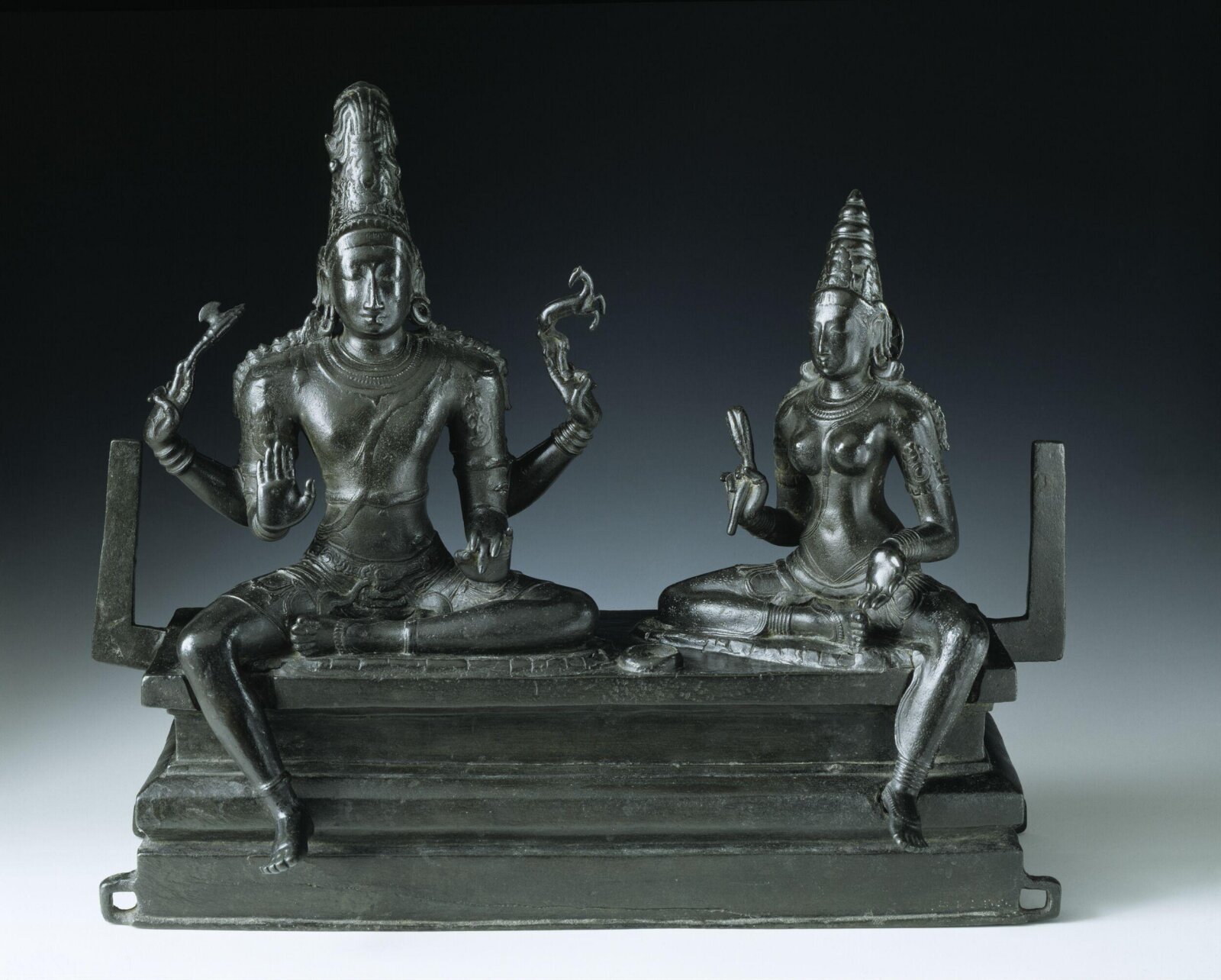
Somaskanda
Darf man es sehen?
Empfängt derzeit nicht

Victoria and Albert Museum
London, Vereinigtes Königreich
Es gehört zur Sammlung, ist derzeit aber nicht ausgestellt.
- Geprüft
- vor 7 Tagen
- Unverändert seit
- 25. Sept. 2026
- Quelle
- Sammlungsdaten des Museums selbst
About the sculpture
This sculpture represents Shiva seated with his consort Uma (Parvati) and their child Skanda (now missing) in the centre. This subject was especially popular in shrines of the Pallava period (300-888 AD), and continued to be so in the Chola period (850-1267 AD). They were often produced for processional use. In this example, the figures rest on a rectangular base with upright projections that could support an arch shaped surround (torana), and or have rings attached through which a cord could be secured that would enable this image to be carried during processions.
Read on
Shiva sits upright with his four arms clearly displayed. In his upper right hand, Shiva holds an axe (parasu), whilst his lower right hand is poised in the gesture of abhaya-mudra (bestowing protection). Similarly, his lower left hand is held in the vitarka-mudra,which implies that Shiva is the expounder of subtle knowledge. Separately, from Shiva's upper left hand, an antelope is seen leaping with its head turned towards him. This possibly alludes to Shiva's avatar as Pasupati, the Lord of the Animals.
Shiva's ear-ornaments are distinctive. He wears a circular ear-lobe plug (patra kundala) on the left and a pendant makara kundala on the right, together these emphasise his dual nature.
Parvati sits turned towards Shiva. In her right hand she holds a lotus-bud, while her left hand bestows grace using the varada-mudra.Both figures have a projecting disc (siras cakra) at the back of their heads. This was used for hanging garlands during pujas (worship) and processions.
Victoria and Albert Museum
Angaben
- Inventarnummer
- IM.158-1929
What it shows
Im Katalog
Quellen
- Victoria and Albert Museum: the museum's own open data · abgerufen vor 7 Tagen
- Bild: Victoria and Albert Museum — © Victoria and Albert Museum, London