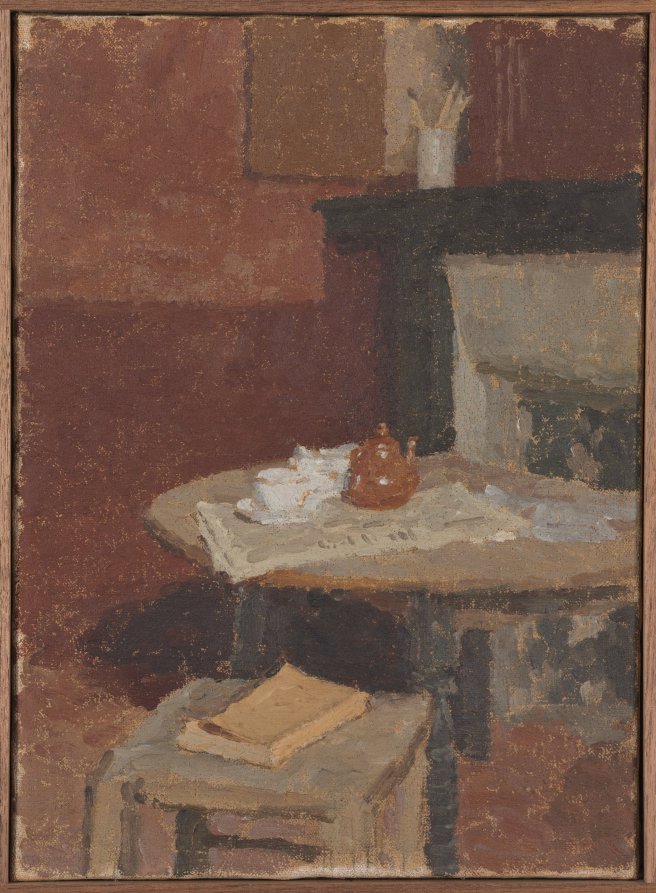
Gwen JohnVereinigtes Königreich, 1876–1939
Self-portrait
Darf man es sehen?
Unbekannt: Das Museum schweigt sich aus

National Gallery
London, Vereinigtes Königreich
Der Eigentümer ist bekannt. Ob es heute ausgestellt ist, sagt das Museum nicht, und Raten haben wir nicht gelernt.
- Unverändert seit
- 29. Sept. 2026
- Quelle
- Sammlungsdaten des Museums selbst
Angaben
- Inventarnummer
- NG5366
Quellen
- Wikidata · abgerufen vor 5 Tagen
- Bild: National Gallery — Gwen John · Public domain · Wikimedia Commons
Derweil im Leben von Gwen John
Das ganze Leben1900
Debut at the New English Art Club
In 1900 she exhibited her work for the first time, at the New English Art Club (NEAC) in London.
late 1900 – c. 1903
McEvoy’s engagement and an awkward time in Bayswater
At the end of 1900 Ambrose McEvoy became engaged to Mary Edwards, and an awkward period ensued: Gwen went on living at the McEvoy family home in Bayswater until Ambrose and Mary moved to Shrivenham in Oxfordshire in around 1903.
late 1903
Leaves for France with Dorelia McNeill
In late 1903 she travelled to France with her friend Dorelia McNeill, Augustus John’s lover, whose daughter Vivien would also become an artist. Landing in Bordeaux, they set off on foot, intending to reach Rome, sleeping in fields and living on money earned by selling portrait sketches, but made it only as far as Toulouse; when she first arrived in France Gwen lived in poverty, on a diet of mostly figs and bread.
1904
Begins modelling for Rodin and becomes his lover
In that same year she began modelling for the sculptor Auguste Rodin and became his lover after being introduced by Hilda Flodin. Rodin used her as the model for a muse in his unfinished monument to Whistler.
1904
Moves to Paris and works as an artist’s model
In 1904 the two went to Paris, where Gwen found work as an artist’s model, mostly for women artists. During her years in Paris she met Matisse, Picasso, Brâncuși and Rilke, but the new developments in the art of her time had little effect on her, and she worked in solitude.
1904–1914
Ten years of devotion to Rodin: thousands of letters
Her devotion to Rodin, the most famous artist of his time and 35 years older than her, continued unabated for the next ten years, as documented in her thousands of fervent letters to him. Given to fierce attachments to both men and women that were sometimes disturbing to them, she was eventually kept at a distance by Rodin, despite his genuine feeling for her, through the use of concierges and secretaries.