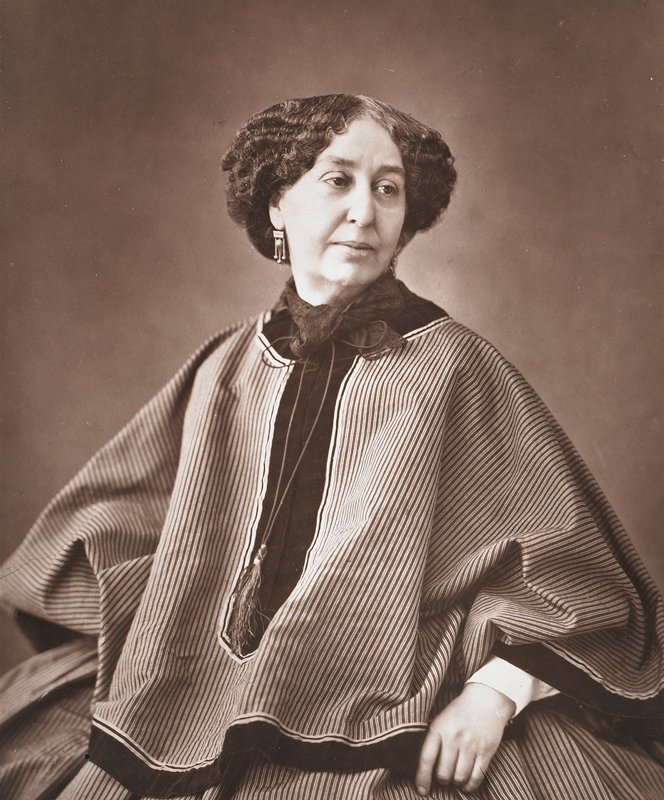
Félix NadarFrankreich, 1820–1910
Portret van Mathilde Stev*** (pseudoniem van Mathilde Kindt)
Kann ich es sehen?
Unbekannt
Wo ist „Portret van Mathilde Stev*** (pseudoniem van Mathilde Kindt)“ heute? Sammlung: Rijksmuseum Amsterdam, Amsterdam. Unbekannt.

Amsterdam, Niederlande
Der Besitzer ist bekannt; ob das Werk derzeit ausgestellt ist, nicht.
- Quelle
- Das Museum
Angaben
- Inventarnummer
- RP-F-F25430
Was es zeigt
Im Katalog
Quellen
- Rijksmuseum Amsterdam
- Bild: Rijksmuseum Amsterdam — public domain
Im Leben von Félix Nadar
Das ganze Leben1858
The world’s first aerial photographs
He became the first person to take aerial photographs, using the wet-plate collodion process: the plates had to be prepared and developed in the basket while aloft, and escaping gas ruined the images until Nadar invented a gas-proof cotton cover for his baskets. He also pioneered the use of artificial light in photography, working underground in the catacombs of Paris.
1860
A studio at 35 Boulevard des Capucines
In 1860 Nadar moved to 35 Boulevard des Capucines, where he photographed politicians (Guizot, Proudhon), stage actors (Sarah Bernhardt, Paulus), writers (Hugo, Baudelaire, Sand, Nerval, Gautier, Dumas), painters (Corot, Delacroix, Millet) and musicians (Liszt, Rossini, Offenbach, Verdi, Berlioz). In the studio he eschewed traditional sumptuous decors and unnecessary accessories and preferred natural daylight.
1862
An aeronautical society with Jules Verne
In 1862 he and Jules Verne established a Société pour la recherche de la navigation aérienne, which later became the Society for the Encouragement of Aerial Locomotion by Means of Heavier than Air Machines; Nadar served as president and Verne as secretary.
1863
Commissions the enormous balloon “Le Géant”
He commissioned the prominent balloonist Eugène Godard to build an enormous balloon, 60 metres high with a capacity of 6,000 cubic metres, named “Le Géant” (The Giant); it inspired Jules Verne’s “Five Weeks in a Balloon”.
1863
The first ascent of “Le Géant” from the Champ de Mars
About eighty thousand people watched the first ascent of the balloon from the Champ de Mars; its two-storey basket was the size of a small house and held everything needed, including a kitchen.
1863
The crash of “Le Géant” near Hanover
During a flight in October 1863 a strong wind carried the balloon off towards Germany, and near Hanover “Le Géant” crashed, injuring Nadar and his wife Ernestine.