 Edgar DegasFrankreich, 1834–1917
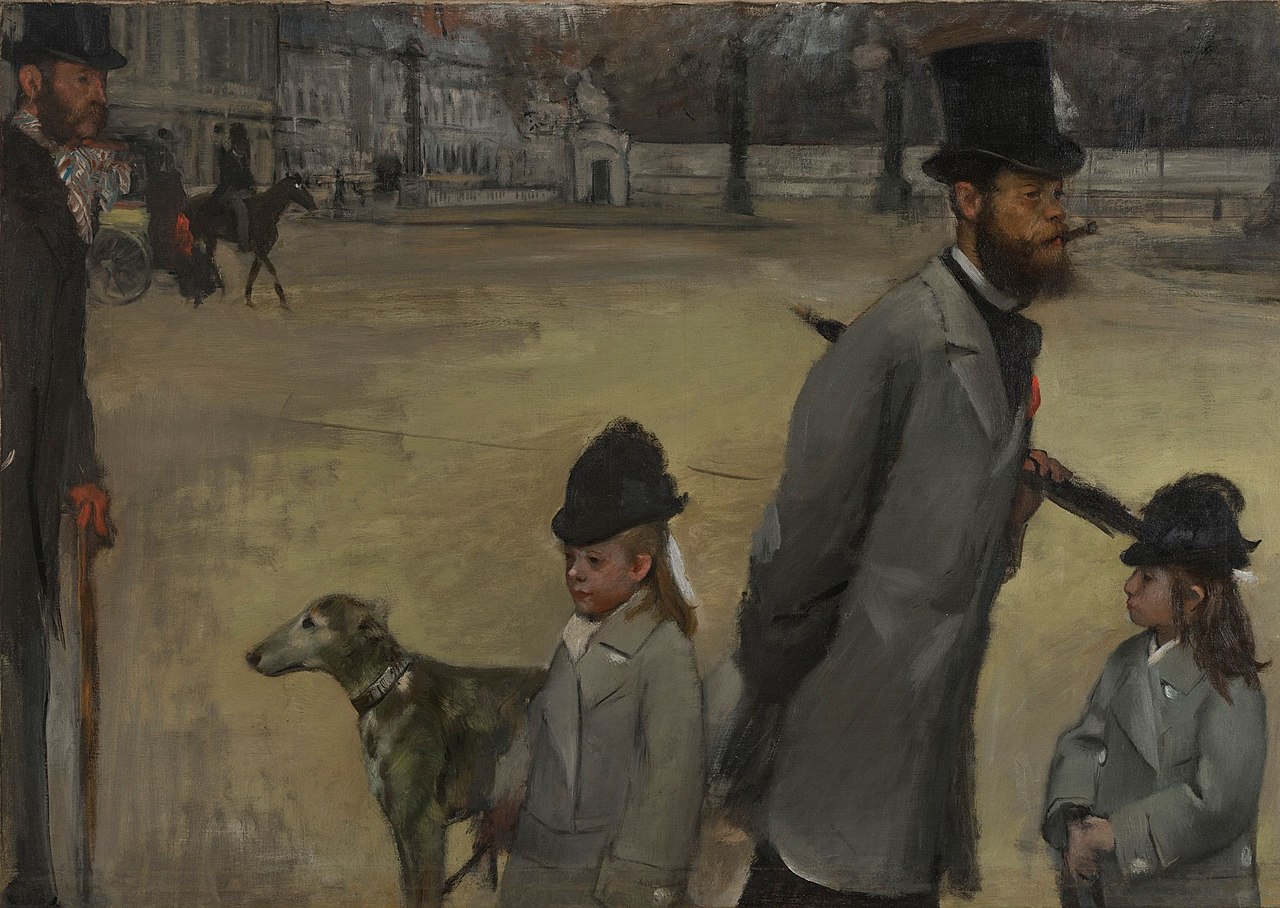
Place de la Concorde
Darf man es sehen?
Ja, es empfängt Besucher

Sankt Petersburg, Russland
Öffentlich ausgestellt. Wer dafür bürgt, steht unten.
- Geprüft
- Unverändert seit
- Quelle
- Das Museum
Über das Gemälde
Place de la Concorde or Viscount Lepic and his Daughters Crossing the Place de la Concorde is an 1875 oil painting by Edgar Degas. It depicts the cigar-smoking Ludovic-Napoléon Lepic, his daughters Eylau and Jeanine, his dog, and a solitary man on the left at Place de la Concorde in Paris. The man on the left may be the playwright Ludovic Halévy. The Tuileries Gardens can be seen in the background, behind a stone wall.
Notable for its innovative composition, use of negative space, and cropping, the painting reflects influences from photography and contemporary urban transformations during Haussmann's Paris. Widely thought to be lost after World War II, the painting was revealed in 1994 to be part of a collection looted by Soviet forces, later displayed at the Hermitage Museum in the controversial "Hidden Treasures Revealed" exhibition. It remains in the Hermitage's collection today.
Angaben
- Inventarnummer
- ГЭ-10622
Im Katalog
Quellen
- Eremitage
- Bild: Eremitage — Museum open access
Derweil im Leben von Edgar Degas
Das ganze Lebenearly 1870s
Meets Durand-Ruel
Degas met the dealer Durand-Ruel, later the most prominent of the trusted dealers with whom he planned his strategy at auctions.
1870s
From “de Gas” back to plain “Degas”
The archives disproved the legend of an ancient noble line: the artist's paternal ancestors were bakers, and the name “de Gas” was invented by his father, who commissioned a false genealogy. In the 1870s Edgar returned to the plain spelling, Degas.
Oktober 1872 – März 1873 · Wohnort
New Orleans
1873–1874
His brother's debts: he sells his house and collection
After his father's death Degas learned that his brother René had run up enormous business debts. To save the family's reputation he sold his house and an inherited art collection and for the first time in his life depended on sales of his own work.
1874
The first Impressionist exhibition
Disenchanted with the Salon, Degas joined a group of young artists organizing an independent exhibiting society. He took a leading role in organizing the eight shows of 1874–1886 and exhibited in all but one, despite constant conflicts with the group.
1877
Friendship with Mary Cassatt
Degas invited Mary Cassatt to show in the third Impressionist exhibition, having admired her portrait “Ida” at the Salon of 1874. He introduced her to pastel and engraving, while she helped him sell paintings and promoted his reputation in the United States.