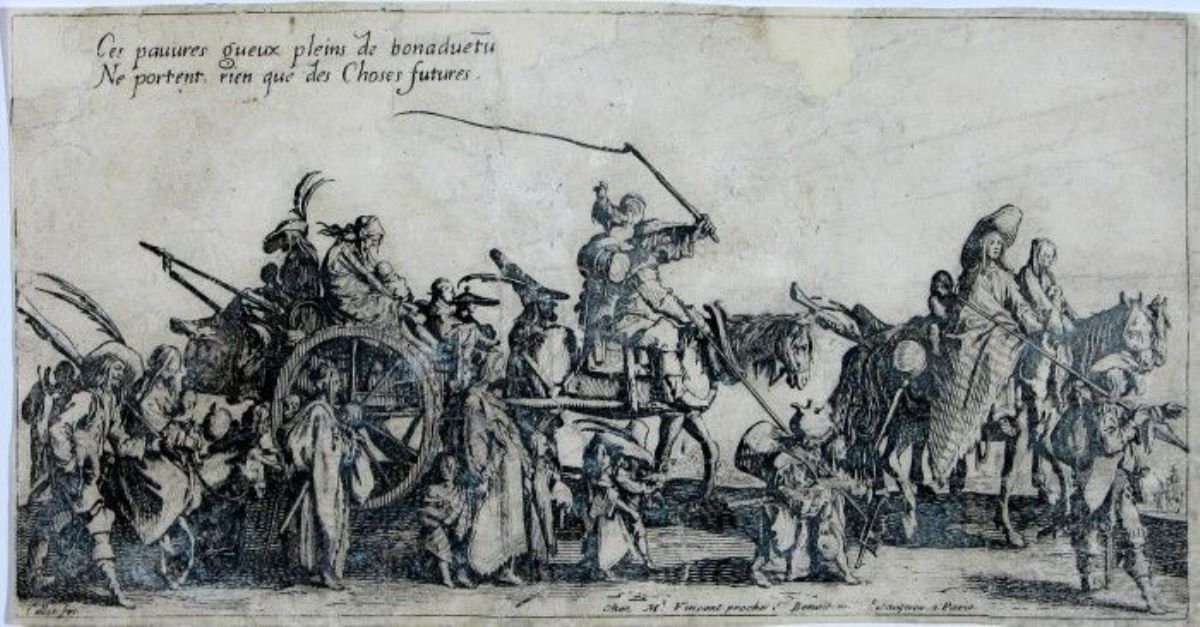
 Jacques CallotFrankreich, 1592–1635
Plecarea
Darf man es sehen?
Unbekannt: Das Museum schweigt sich aus

Brukenthal-Museum
Hermannstadt, Rumänien
Der Eigentümer ist bekannt. Ob es heute ausgestellt ist, sagt das Museum nicht, und Raten haben wir nicht gelernt.
- Unverändert seit
- 27. Sept. 2026
- Quelle
- Sammlungsdaten des Museums selbst
Über das Werk
Prima stampă din seria „Țiganii” reprezintă plecarea șatrei de țigani. Două femei călare sunt urmate de o căruță trasă de un cal, pe care stă un țigan cu biciul ridicat, cu un sac în spate și un cocoș. În căruță și pe jos se află bărbați înarmați, femei și copii purtând bagaje. Șatra se îndreaptă spre dreapta. Seria se bazează pe amintirile gravorului care a călătorit în tinerețe spre Italia, împreună cu o șatră de nomazi.
Brukenthal-Museum
Angaben
What it shows
Quellen
- Brukenthal-Museum: the museum's own open data · abgerufen vor 5 Tagen
- Bild: Brukenthal-Museum — CC BY-SA 4.0
Derweil im Leben von Jacques Callot
Das ganze Leben1611–1621 · Wirkungsort
Florence
1614–1621
At the court of Cosimo II de’ Medici
Under Parigi’s direction Callot works at the court of the Grand Duke of Tuscany Cosimo II de’ Medici in the Uffizi, designing festivals and theatrical performances — later these give him themes for his series of grotesque prints; during his Florentine years he becomes an independent master and often works for the Medici.
1621
Returns to Nancy after the death of Cosimo II
After the death of Grand Duke Cosimo II de’ Medici, Callot responds to Duke Charles IV of Lorraine’s wish to see him at his court and returns to Lorraine, where he is received with flattering honours; staying in Nancy, he sends his prints all over Europe, and Rembrandt becomes a keen collector of them.
1621–1635 · Wirkungsort
Nancy


