 Kazimir MalevichRussland, 1879–1935
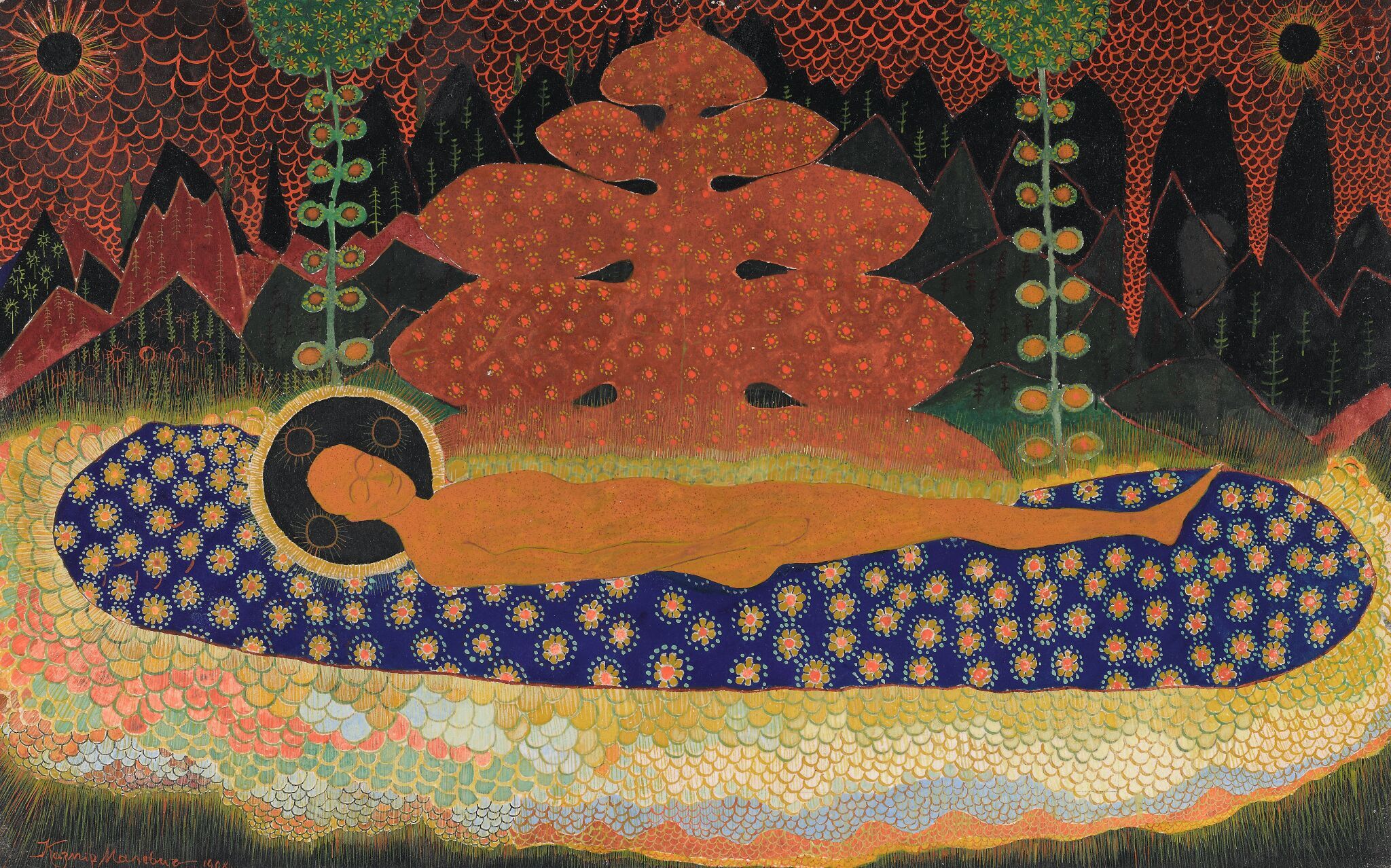
Плащаница
Kann ich es sehen?
Unbekannt
Wo ist „Плащаница“ heute? Sammlung: Tretjakow-Galerie, Moskau. Unbekannt.

Moskau, Russland
Der Besitzer ist bekannt; ob das Werk derzeit ausgestellt ist, nicht.
- Unverändert seit
- Quelle
- Das Museum
Über das Werk
In den Worten des Museums — auf Russisch
«Плащаница» ‒ самое раннее из графических произведений Малевича в Третьяковской галерее. Источником сюжета, композиции и художественной формы Малевичу послужила плащаница ‒ тканый вышитый покров, изображающий тело Христа в погребальных пеленах и используемый в православном богослужении. Обычно плащаницы исполнялись в технике золотного шитья в сочетании с рельефными аппликациями из ткани. Центральная часть по периметру обрамлялась орнаментом, мотивы которого часто вплетались и в саму композицию.
Mehr lesen
Рисунок Малевича ‒ фантазия на тему плащаницы; в своей интерпретации он не следует традиционной иконографии ни в композиции (как правило, включавшей Голгофский крест на заднем плане или Бога-отца, осеняющего с облака благословением тело Христа), ни в изображении Иисуса. Это, скорее, имитация художественной формы плащаницы ‒ декоративности расшитой узорами ткани, аппликативной условности фигуры и деталей.
И в выборе Малевичем церковной плащаницы как объекта имитации, и в пластическом решении работы отразились многие тенденции, связанные с эстетикой символизма и модерна: тяготение к мистическим и религиозным мотивам, к стилизации, всеобщее увлечение декоративно-прикладным искусством. Стилизация под гобелен была одним из излюбленных художественных методов эпохи модерна.
Пристрастие Малевича к сюжетам, связанным с мистическими, таинственными явлениями, интерес к монументально-декоративным формам искусства свидетельствуют о сильном влиянии на его творчество художественных установок объединения «Голубая роза». Пластические приемы, примененные Малевичем в «Плащанице», ‒ силуэтная выразительность, волнообразные линии и мягкие, словно оплывающие, контуры, декоративный ритм чередования дробного узорочья и локальных цветовых пятен ‒ в целом почерпнуты из стилистики модерна.
Tretjakow-Galerie
Angaben
- Inventarnummer
- Р-4351
Im Katalog
Quellen
- Tretjakow-Galerie
- Bild: Tretjakow-Galerie — © State Tretyakov Gallery
Im Leben von Kazimir Malevich
Das ganze Leben5 August 1905 – 1906
Turned down by the school, and a commune in Lefortovo
On 5 August 1905 Malevich applied for the first time to the Moscow School of Painting, Sculpture and Architecture, but was not accepted; he did not want to go back to his wife and children and settled in an artists’ commune in Lefortovo — in the house of the artist Kurdyumov, where about thirty people lived and paid seven roubles a month. In the spring of 1906, when the money ran out, he had to return to his old job in Kursk, and in the summer he applied to the school again — and again without success.
1907
The 14th exhibition of the Moscow Association of Artists, and meeting Larionov
In 1907 Malevich took part in the 14th exhibition of the Moscow Association of Artists and met Mikhail Larionov, a leading figure of the Moscow avant-garde who strongly influenced him in those years.
1907–1909
The “Blue Rose”, icons and the “Golden Fleece”
The Symbolists’ “Blue Rose” exhibition (1907) left a deep impression on Malevich — its echoes can be seen in the paintings “The Triumph of Heaven” (1907) and “The Shroud of Christ” (1908). By 1908 he had developed a strong interest in Russian icons and folk art, while the “Golden Fleece” group’s exhibition revealed Van Gogh, Matisse, Braque, Gauguin and Cézanne to Moscow.
1907–1910
Rerberg’s studio and the family in Moscow
From 1907 to 1910 Malevich worked in F. I. Rerberg’s studio, which prepared pupils for entry to the Moscow School — yet he was never admitted to the school itself. In 1907 his mother, Ludwika, came to Moscow, found work there as a canteen manager and soon summoned her son’s family.
December 1908 – 1909
The end of his first marriage and his marriage to Sofia Rafalovich
At Christmas 1908 his mother’s canteen was robbed and the family’s property inventoried and sold; relations between Malevich and his wife worsened, and Kazimira Zgleits moved with the children to the village of Meshcherskoye and then, leaving with a doctor, left the children with a stranger. Malevich found them at the home of the steward Mikhail Rafalovich, whose daughter Sofia soon became his common-law wife; in 1909 he divorced and married her, and from then on he constantly lived and worked in her father’s house at Nemchinovka.
1910
The first “Knave of Diamonds” exhibition
In December 1910 Malevich took part in the first exhibition of the “Knave of Diamonds” group, founded by Natalia Goncharova and Mikhail Larionov, who sought to combine the Western modernism of Cézanne with the traditions of Russian folk art; the “Knave”, he said, stood for youth, and “diamonds” for beautiful youth. In 1924 he claimed that this exhibition had severely shaken the aesthetic foundations of art in society and criticism.