 John RuskinEngland, 1819–1900
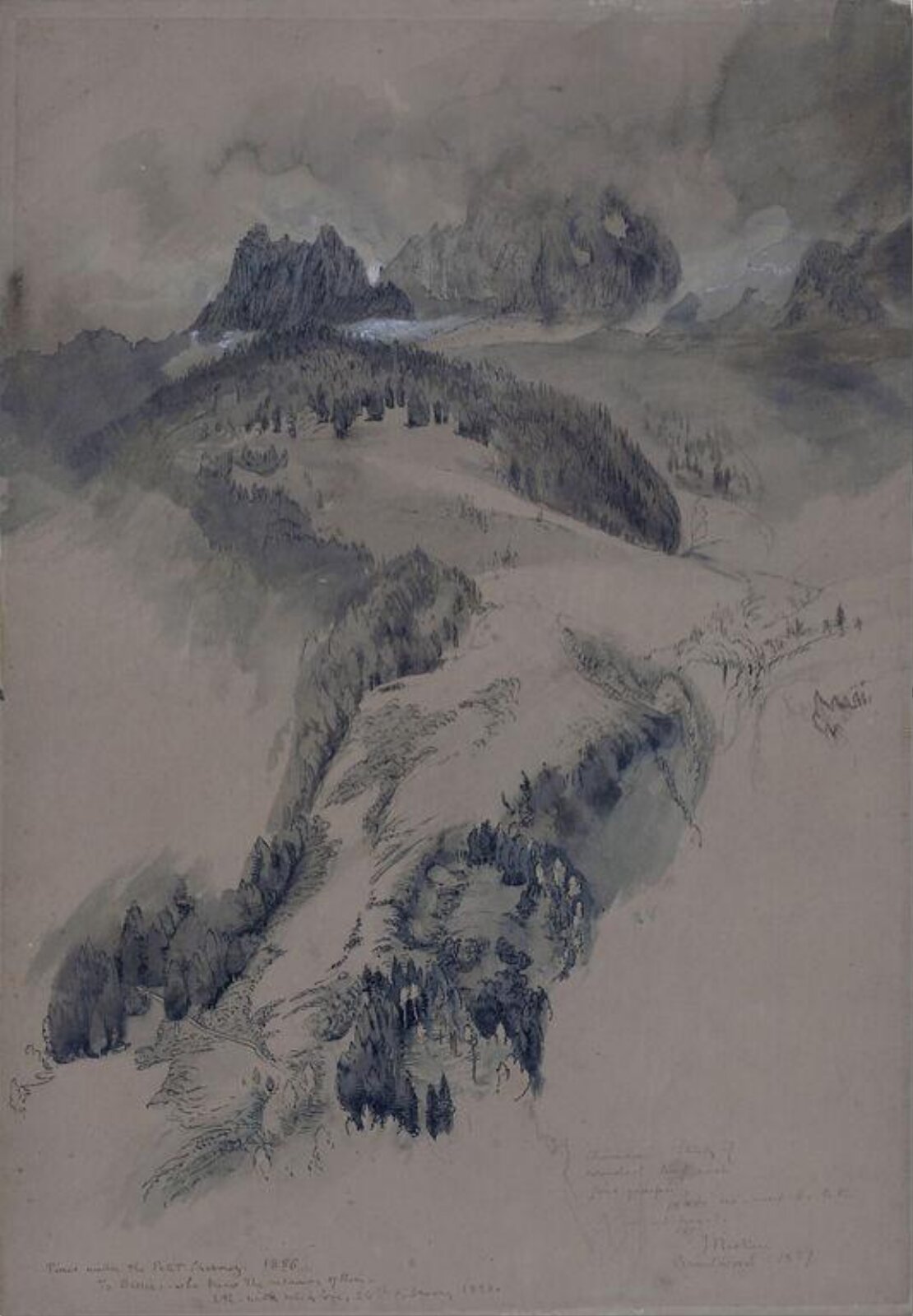
Pines under the Petit Charmoz
Darf man es sehen?
Empfängt derzeit nicht

Victoria and Albert Museum
London, Vereinigtes Königreich
Es gehört zur Sammlung, ist derzeit aber nicht ausgestellt.
- Geprüft
- Unverändert seit
- Quelle
- Das Museum
Angaben
- Inventarnummer
- E.405-1986
Im Katalog
Quellen
- Victoria and Albert Museum
- Bild: Victoria and Albert Museum — © Victoria and Albert Museum, London
Derweil im Leben von John Ruskin
Das ganze Leben1834–1900 · Wirkungsort
Great Britain
1850s
Patron of Hunt, Rossetti and Burne-Jones
Ruskin continues to support Holman Hunt and Rossetti, provides an annuity of £150 in 1855–57 to Rossetti's wife Elizabeth Siddal (and pays for Henry Acland's medical care of her), and gives critical and financial help to John Brett, John William Inchbold and Edward Burne-Jones, whom he calls “Brother Ned”. His father disapproves of such friends — a further cause of tension between them.
April – July 1854
Effie leaves Ruskin and the marriage is annulled
Suffering from illness and from fierce quarrels with her husband and his overly protective parents, Effie goes to her own parents in Scotland; she and Millais have fallen in love, and her leaving causes a public scandal. In April 1854 she files a suit of nullity on grounds of non-consummation, which is granted in July; Ruskin does not even mention it in his diary.
1858
Turin: Veronese against a dull sermon
In Turin Ruskin sits through a particularly dull sermon at a Waldensian church and sees Paolo Veronese's “Presentation of the Queen of Sheba” at the Galleria Sabauda; later, in April 1877, he will name this as the start of his “unconversion” from Evangelical Christianity. His faith, long shaken by Biblical and geological scholarship, collapses, and, believing that much of his writing had rested on lies and half-truths, Ruskin goes through a deep personal crisis before returning to Christianity after a long struggle.
1858
Meeting Rose La Touche
In 1858 Ruskin meets Rose La Touche (1848–1875), from an extremely devout Protestant family; during a period of acute religious crisis he falls passionately in love, first with the girl and then with the young woman.
May 1858
Completes his work on the Turner Bequest
Having persuaded the National Gallery to let him work on the Turner Bequest — nearly 20,000 works left to the nation by the painter — Ruskin completes the enormous task of cataloguing, framing and conserving them by May 1858. Four hundred watercolours are displayed in cabinets of his own design.